
In the early evening on a balmy Sunday in early October, my husband and I drove seven miles to visit the roosting place of coastal New Hampshire’s Great Egrets. At dusk, in twos and threes the Great Egrets began arriving from their marshes; yellow bills pointing the way, heads tucked against shoulders, giant wings outstretched, and legs straight back in parallel black lines. They came mostly from the north and sailed above us, soundless in their long glide toward the ghostly woods. Nearing the stand of trees, some circled a bit, then floated down and landed amid the dead trees that fill the marsh, giant wings never colliding with the thick limb spears.
As the minutes passed and the evening grew darker, more and more egrets filled the marsh, white punctuation marks against gray trees in the darkening evening. Once down, they froze in place, tucked their heads, and got on with the business of sleeping. I scanned the birds, at least 180 of them, looking for other species, but there were none. Then one arrived, a Great Blue Heron, the center of a threesome with a Great Egret on either side. At the marsh, the trio separated, and the Great Blue settled lightly in a giant heron nest at a high point in the marsh. In black profile against the waning light, the highest bird visible. It seemed to be the finishing touch, a star atop the tree. My thoughts turned to the egrets, and I imagined their long solitary days of patient yet hyper-focused watching, standing, wading, and spearing. What instinct or algorithms tell them “now”? Leave this place and gather at another.
I have observed thousands of crows gather at dusk in Lawrence, Massachusetts, their convening a black flash mob of chaos and cacophony, a “murder”—yes. This congregation of Great Egrets in a rural Seabrook marsh was something else. It was a silent white ballet, exquisite and elegant, to be improvised every evening until another miracle tells them “now.” Then, until next spring, our marshes will be empty of these great white birds.
One night later, we were at Burley Farms in Epping near a marsh at dusk. There, a single Great Egret was roosting in a dead tree. As we watched, I thought, “Well, it looks like that one won’t be heading to Seabrook.” Then, at 6:45 pm, it lifted off! Its direction was southeast. At Great Egret speed of 25 mph, it would easily cover the 16 miles and arrive in time to roost with the others.
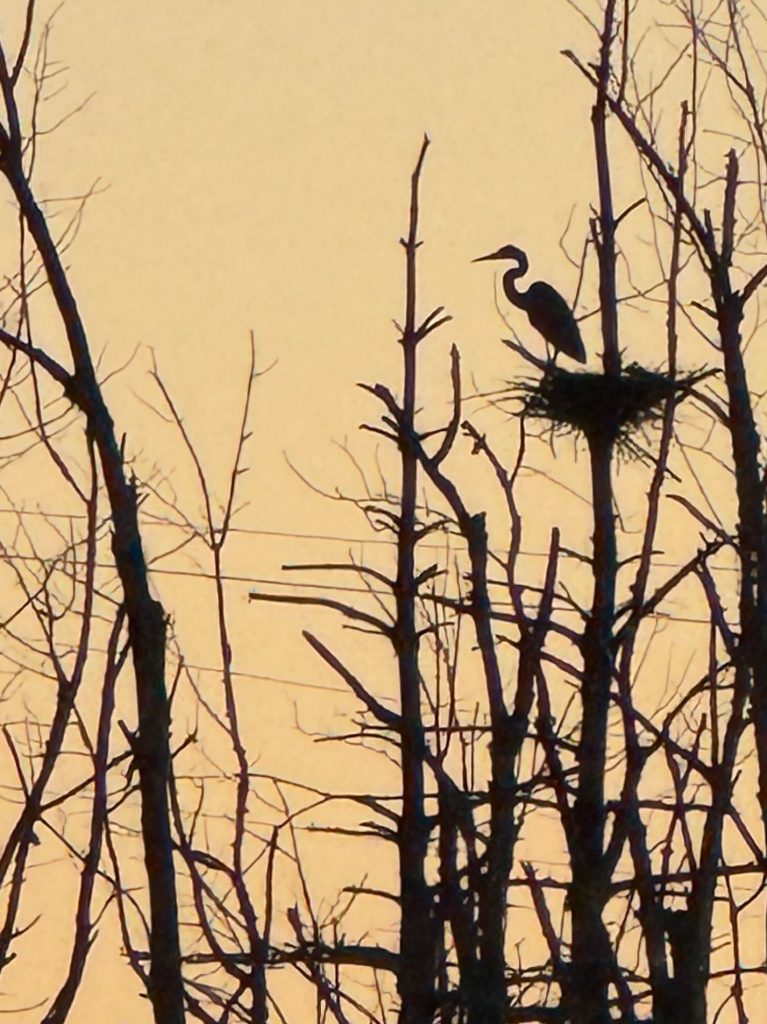
Great Blue Heron at dusk by Karen Dudra, 10-5-2025 Seabrook, NH.
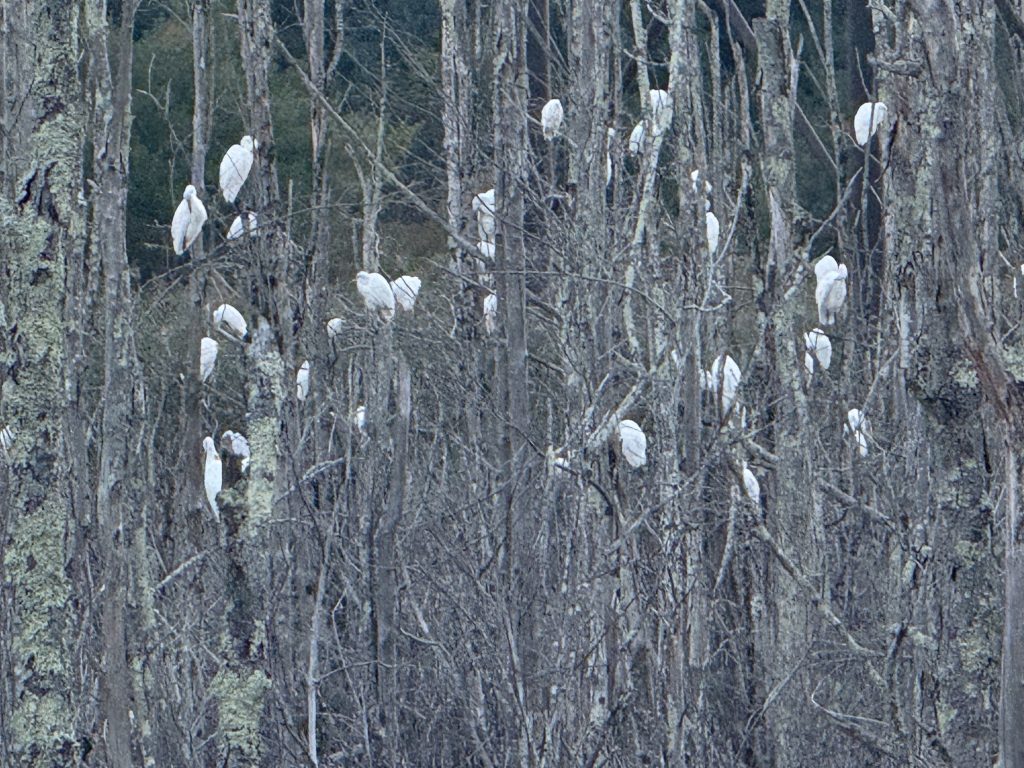
Great Egrets Roosting by Karen Dudra, 10-5-2025 Seabrook, NH.
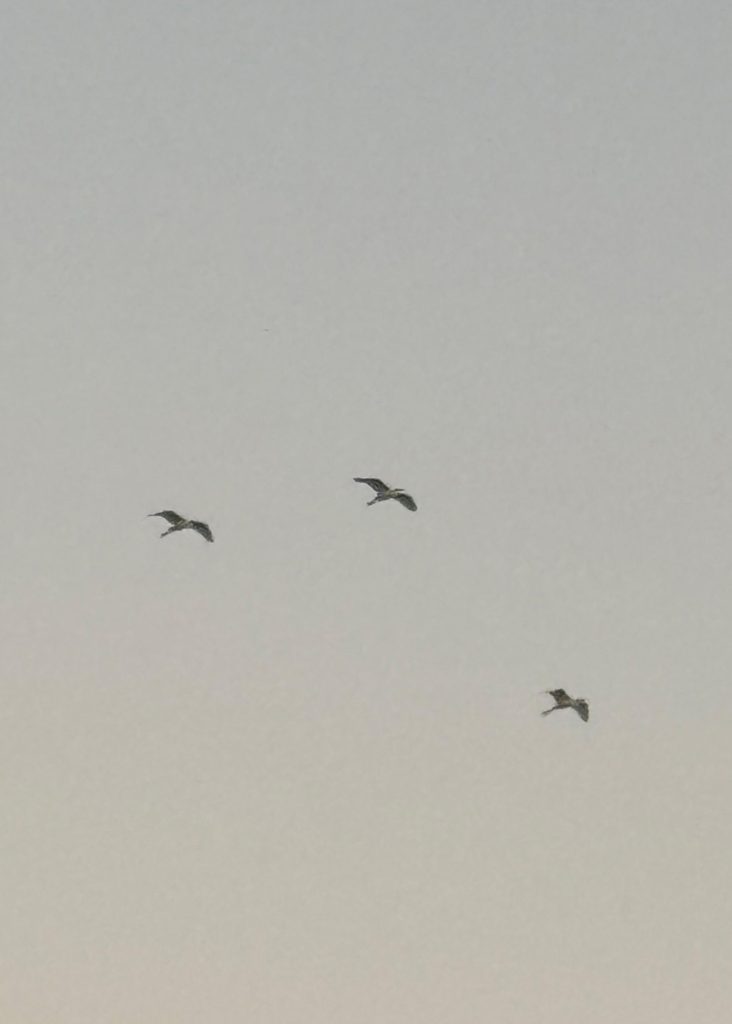
Great Egrets in flight by Karen Dudra, Seabrook, NH.
Enjoy this field note? Check out other field notes from Fall 2025!
- A Peregrine Falcon on the Rocks: Questions Anyone? by Bruce Conti
- A Curious Eastern Bluebird Nest by Alison Rhodes
- Grouse Identification Puzzle by Kathryn Frieden
- A Hummingbird Named Hoglet by Evy Nathan
Want even more? Visit our “From the Field” page.