
Many birders participate in a “Big Day,” either on their own, in a group, or as part of an organized birding activity. A few examples of organized ones are the Christmas Bird Count which started in 1900, the Cornell Lab of Ornithology Global Big Day, which debuted in May 2015, and the Superbowl of Birding, run by the Massachusetts Audubon’s Joppa Flats Education Center every January since 2004. The concept of a big day started back in the early 1900s and is credited to Ludlow Griscom, who has been called the “Patron Saint of modern American birdwatching.” He was an ornithologist at the American Museum of Natural History and championed the activity of bird watching, as opposed to bird shooting, which had been the main bird-related activity before then. His first big days took place in Dutchess County, New York, where he organized a group of birders to record as many species as possible in a 24-hour period within a proscribed area.
Birders have many reasons for challenging themselves to do a Big Day and there are many variations in the parameters of that day. In general, besides adequate birding knowledge, a successful big day requires stamina, good weather, and a little good luck thrown in besides.
Motivation to do a Big Day
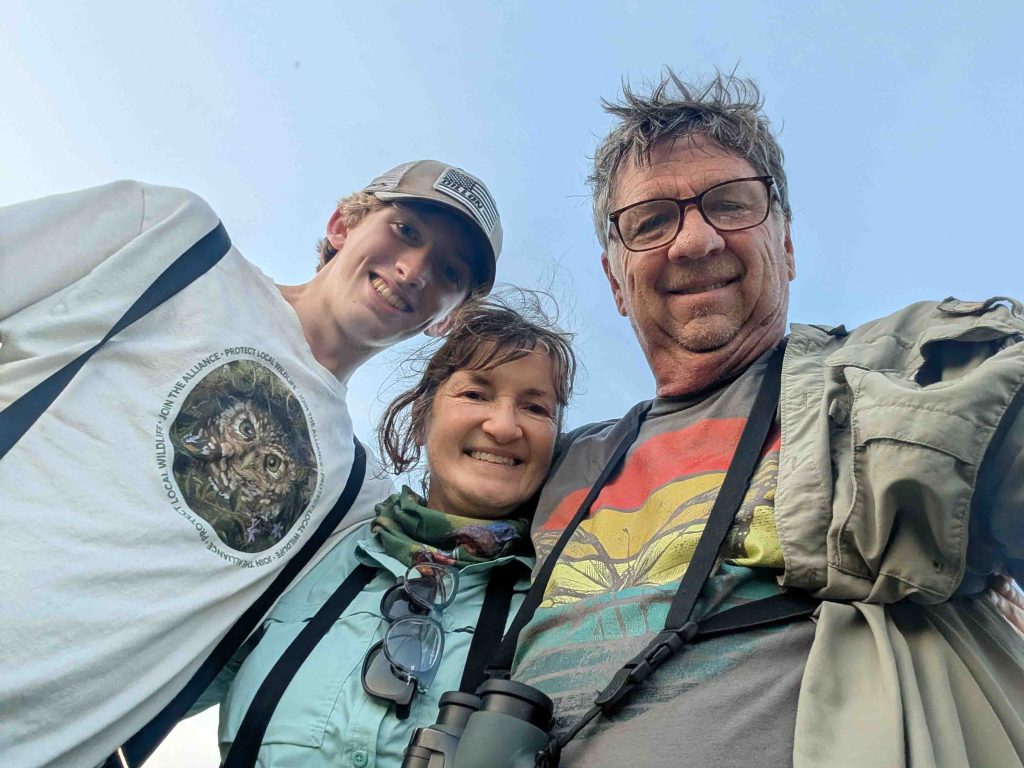
Steve and Jane Mirick
We used to do Big Days as a fund raiser for NH Audubon in mid-May. Every year, I’d get pledges per species. We kind of continued this tradition of putting 100% into a “game” of strategy and endurance. Then we went to New Jersey and competed in the World Series of Birding, which was a fundraiser and competitive event.
Kurk Dorsey
I enjoy the local Big Days because when I get a day for birding, I don’t want to spend that much of it driving, plus it tests my knowledge of my neighborhood and migration patterns.
Dylan Jackson
I’m partial to birding specifically in Sullivan County. It’s my home county (even though I live in Merrimack now) and it’s historically been pretty under-birded compared to other counties in the state. It also lies in the Connecticut River Valley which is a big migratory flyway so there can be a big payoff with rarities on occasion. So, I always focus my big days in strictly Sullivan for those reasons. I also have been trying to beat my Sullivan County Big Day record that I set back in 2015 with Pam Hunt and a few others. We had 116 species that day and despite coming tantalizingly close, it’s still a number that continues to stay out of reach.
Here are a few excerpts from their accounts of Big Days posted to the NH Birds Google Group in Spring 2025:
Highlights from Steve Mirick (5-16-2025)
Jane and I teamed up with Ethan Ring on Friday, 5-16-25 for a Big Day effort. We met Ethan at 2 am in Salem where we easily got Virginia Rail and Sora. We headed north to Concord where we easily got Eastern Whip-poor-will, barely got American Woodcock, but dipped on Common Nighthawk. Farther north at Pondicherry National Wildlife Refuge and Trudeau Road, we got all the basic north country birds, including Red Crossbills at two locations. Heading back south, we quickly got both Grasshopper Sparrow and Vesper Sparrow sitting on the fence at Concord Airport. At Pawtuckaway State Park, we got a singing Louisiana Waterthrush and in Exeter, a Ruddy Duck but missed the Lesser Scaup. A strategic move which got us two great birds was the Newfields portion of the Rockingham Rail Trail, a calling Least Bittern in mid-afternoon and a nice Pied-billed Grebe. Heading to the coast, the wind was now brisk out of the SSE, but we still managed to get a lot including bonus Sanderling and lots of Northern Gannets at Hampton Beach State Park (SP). As we went north, we ticked off all the ducks and loons and got a bonus Horned Grebe and American Oystercatcher at Rye Ledge. Finishing the day at Odiorne Point SP, Ethan picked out a Tennessee Warbler way up in the treetops. Our last bird was at Portsmouth International Airport at Pease, an Eastern Meadowlark. We finished the day at 8:00 pm. After 18 hours of birding, we had an impressive 154 species!
Highlights from Kurk Dorsey (5-24-2025)
I spent a lot of time scouring Durham to see if I could find 100 species while still doing three loads of laundry and eating all three meals with the family. I hit 113 species, including 19 warblers, plus several mammals (beaver, muskrat, coyote, and porcupine). I got a late start for May, I was not out of the house until 6:35 and it was raining too. The Fogg Dr. stretch was quite productive, with Wilson’s Warbler and Northern Waterthrush, as well as Bobolink and Swainson’s Thrush. Plus, the rain sort of slowed down. At the town landing, I had my only real shorebird, a Spotted Sandpiper, but the rising tide made it pretty quiet. I walked part of College Woods off Mill Road and found Louisiana Waterthrush, a couple of Canada Warblers, and the first of a handful of Lincoln’s Sparrows. At Thompson Forest on Wednesday Hill Road, I had my only Red-breasted Nuthatches. The first really good bird of the day was a Sora calling at Surrey Lane Marsh, and joining it on the billing was a Marsh Wren.
After lunch, I hit Oyster River Forest. A sapsucker was the best bird in the forest, but the field down to the river produced an Olive-sided Flycatcher (eight total flycatchers for the day!) and to my amazement, two Black Vultures soaring serenely overhead. At Spinney Lane, I had two Canada Warblers, plus I saw a Barred Owl catch a small rodent and fly off with it (should have put that on the mammal list). The highlight, however, was a gorgeous male Mourning Warbler that was going back and forth across the trail, about 20 feet up, eating well but not singing (don’t sing with your mouth full!). At the Adams Point Causeway, I picked up #100, a Snowy Egret! A Common Loon was still hanging out; maybe it heard about the snow up north this week.
After dinner, I went down to the eastern tip of Durham at the Route 4 bridge, which pulled in a nice flock of Common Terns, and another big surprise, three male Common Eiders hanging out with a female perched on a buoy. On a total whim, I then stopped at Wagon Hill farm, which I haven’t birded in years. I was greeted by an Orchard Oriole, which would have been a good outcome until I looked up and saw about 35 scoters flying overhead (unclear exactly which species)! With a little light left, I headed for Surrey Lane, where I picked up Virginia Rail grunting and at least three Common Nighthawks flying low over the water, doing some crazy acrobatics. I ended up with 113 species total, if you count the scoter sp.
Highlights from Dylan Jackson (5-24-2025)
I did a big day in Sullivan County today as I typically do every May. This year’s eBird Global Big Day was a total washout which ended up being a blessing because I usually find the eBird date is too early to get the maximum number of species. The weather wasn’t ideal for the first part of the day and as with every big day, luck just isn’t always on your side. My all-time single day total for the county is 116 and today I just fell short with 110. The following are the biggest takeaways:
Bird of the Day: This is definitely the Dickcissel that Jen and Brendan Armstrong found in Claremont. Luckily, I was only about ten minutes away when she got the word out, so I was able to swing right over and see it. It was happily hopping along and foraging in a manure pile while I was there. This is my first spring Dickcissel and the first one I’ve seen in breeding plumage.
Biggest Misses: Every Big Day has one or more “gimme” species that just seem to be unattainable when you want them most. For me, that was Eastern Bluebird. I checked several haunts that I know they frequent and had no luck. I had the same thing with Hooded Merganser. I also neglected to check Lake Sunapee for Ring-billed Gull which didn’t occur to me until long after I had called it a day.
Biggest Letdown: I woke up early to get to west Unity to try for my first Sullivan County Eastern Whip-poor-will in a location that should be pretty reliable for them. When I left my house in Wilmot, the moon was out and I thought conditions would be ideal, but it had clouded over by the time I got there, and they had probably stopped calling for the rest of the night. This species continues to elude me after almost 15 years of birding Sullivan County.