
Just after waking up from a strong night of migration, I opened the BirdWeather app on my phone to check what had been detected. Scrolling through the list, one detection stopped me. A Yellow-billed Cuckoo was detected. I pulled up the audio recording the device had captured just minutes before I woke up. The unmistakable knocking call of a Yellow-billed Cuckoo was right outside my window. I rushed outside and it called again. I never got my eyes on it, but I didn’t need to. A life bird, detected and confirmed from my own backyard, all because a small device had been listening while I slept.
That moment is exactly what BirdWeather’s PUC is all about.
What is BirdWeather and the PUC?
BirdWeather is a bioacoustics platform designed to make passive bird monitoring accessible to everyone. Their device, the PUC (Portable Universal Codec), is a compact, weatherproof recording unit that listens continuously for bird vocalizations and identifies them in real time using BirdNET, Cornell Lab of Ornithology’s AI-powered bioacoustics model. If BirdNET sounds familiar, it’s because Merlin’s Sound ID feature is actually based on the same model. BirdNET is trained to recognize over 6,000 species, making it one of the most powerful bird identification tools available to the public today. Beyond bird vocalizations, the PUC also records environmental data including temperature, humidity, pressure, air quality, eVOC, and eCO2.
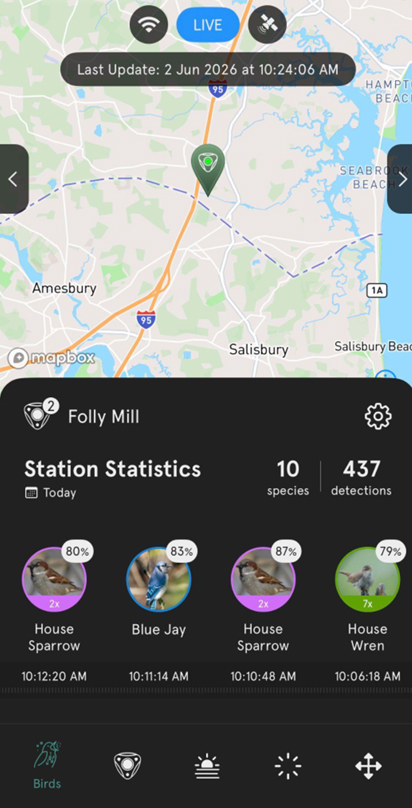
Setup
Setting up the PUC couldn’t be simpler. Mount the PUC outside at your preferred location, power it via batteries or USB-C, connect it to the BirdWeather app on your phone, and you’re ready to go. The device connects to your home WiFi and immediately begins detecting and logging bird vocalizations around the clock. Every detection is saved with an audio recording and spectrogram, so you can verify any detection yourself at any time.
My PUC is mounted just above my window, pointed directly toward my bird feeder, which sits along a brook and forested edge. It’s an ideal monitoring location. The combination of open feeder space, moving water, and dense woodland edge attracts a wide variety of species throughout the year. Having the device positioned here maximizes detections, capturing everything from common feeder birds to surprising migrants passing through the yard.
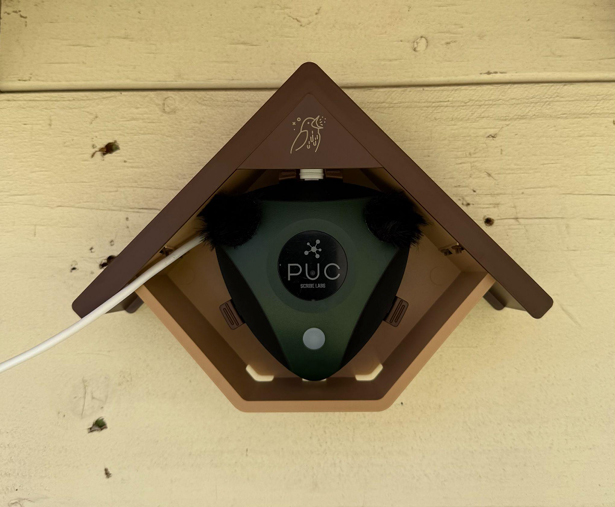
Ashton’s BirdWeather PCU setup.
Customization
What sets the BirdWeather PUC apart from similar devices is the level of customization available. Two key settings define the quality of your detections: Probability and Confidence.
Probability refers to how likely a species is to occur at your location based on range and season. Confidence refers to how certain the model is that the vocalization matches that species. Keeping both settings high ensures that most of your detections are accurate and reliable; however, lowering the probability setting opens the door to potential rarities, allowing the device to flag species outside of their expected range.
There is also an override feature for rare species. You can program the device to alert you to specific species regardless of confidence or probability, ensuring you never miss something unusual even if the device is uncertain. Combined with customizable push notifications for target species, this makes the PUC an incredibly powerful tool for the birder who wants to know the moment something special shows up.
Another useful feature is the included SD card. When using the PUC portably in the field, all audio detections are stored directly on the card, rather than being sent to the cloud. It’s a seamless transition between stationary and portable use, making the device just as capable on a trail as it is mounted outside in your yard.
What Has It Found?
I check the app a couple of times a day, usually first thing in the morning and whenever I think about it throughout the day. It has become a natural part of my birding routine, almost like checking eBird for rare bird alerts, but for my own backyard. Beyond the Yellow-billed Cuckoo, the PUC has detected both Louisiana and Northern Waterthrushes in my yard this year, new detections I likely would have missed entirely without it. During migration especially, the device picks up species I never would have expected to pass through. With over 150 species detected and counting, the device’s accuracy continues to impress.
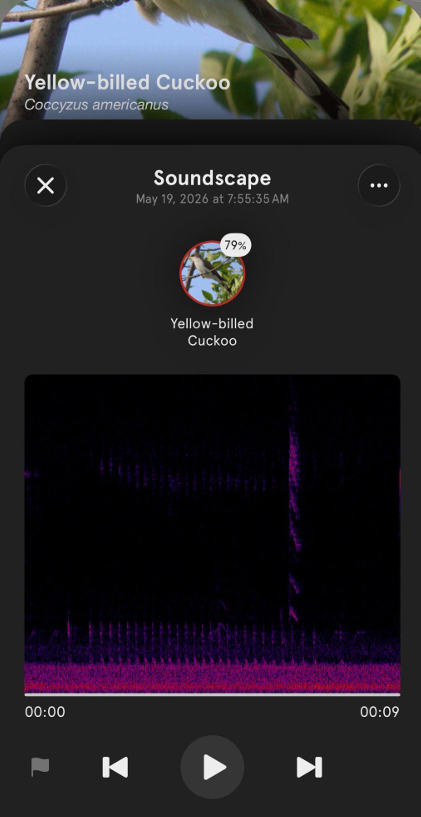
In the app, Ashton was able to review the recording of the Yellow-billed Cuckoo.
A Global Community of Listeners
One of the most exciting features of BirdWeather is its built-in community map. Through the app and website at www.birdweather.com, you can see every active PUC around the world and what species are being detected in real time. Here in New Hampshire alone, there are over 50 active PUCs, with a strong concentration along the seacoast. For those who prefer privacy, the map visibility can be turned off entirely.
This network of devices represents something that is truly exciting for citizen science. The more PUCs there are actively monitoring, the more data we collectively generate. As birders, we have always contributed to ornithological research through eBird checklists and breeding bird surveys. BirdWeather adds a powerful new dimension to that contribution, one that operates continuously, even when we’re busy. The conservation potential of widespread acoustic monitoring is enormous, from tracking population trends to documenting range expansions to identifying important stopover habitat.
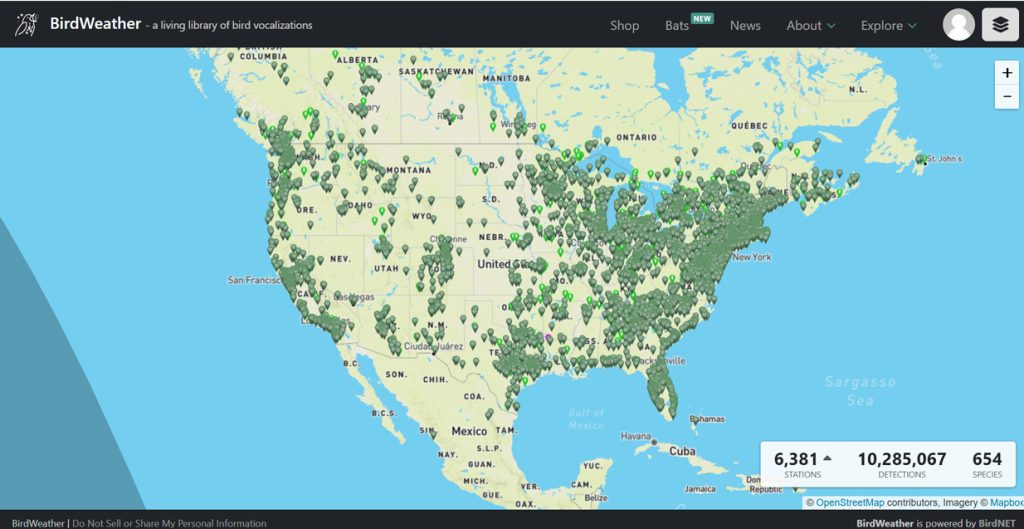
The global community of listeners.
Is It Worth It?
The BirdWeather PUC retails for $299 and importantly, there is no subscription fee. Many similar devices on the market require ongoing subscriptions, making the PUC’s one-time cost a significant advantage. For what you get with dual microphones, WiFi, GPS, environmental sensors, a weatherproof enclosure, and full portability, the value is exceptional. The portability feature also deserves a special mention. Unlike stationary monitoring systems, the PUC can be taken into the field.
Who Is It For?
Anyone who loves birds, especially backyard birders, will find immediate value in knowing exactly what is visiting their yard around the clock. Patch birders can deploy it at monitoring sites. Researchers and conservationists can use it for systematic acoustic surveys. Even casual nature enthusiasts who simply want to know what birds are singing outside their window will find it rewarding.
If you have any questions about the BirdWeather PUC or would like to learn more about my experience with it, feel free to reach out at ashtonipod@gmail.com
Editor’s Note: eBird and Bird Weather
Tools like BirdWeather are opening exciting new possibilities for birders, allowing us to detect species that might otherwise go unnoticed, including nocturnal migrants and birds vocalizing while we’re away or asleep. Because BirdWeather relies on automated acoustic detections and continuous monitoring, its records are different from eBird observations, which are based on birds detected and identified by an observer during a specific birding effort. For that reason, BirdWeather detections should only be entered into eBird if they are independently confirmed by the observer. Remember, even highly accurate AI models occasionally make mistakes, especially with distant, faint, overlapping, or unusual vocalizations. Rather than replacing eBird, BirdWeather offers a complementary way to learn about the birds using our yards, neighborhoods, and favorite birding locations. BirdWeather detections can alert birders to species they may then observe and document themselves in eBird. To learn more about eBird policies regarding passive acoustic monitoring, visit the help center under remote listening.