
Seeing a Black-backed Woodpecker in New Hampshire is a goal for many birders. This charismatic species is uncommon but can be found in suitable habitats, including the extensive spruce-fir forests of the 6,500-acre Pondicherry National Wildlife Refuge in Jefferson and Whitefield, NH. This article describes the bird’s natural history and offers guidance on how to spot one at the Pondicherry Refuge. Pondicherry is jointly managed by NH Audubon, NH Fish and Game, and the US Fish and Wildlife Service.
The Black-backed Woodpecker has a four-letter code, BBWO, used by biologists to record sightings. The BBWO is slightly larger than our more common Hairy Woodpecker, which inhabits the same habitats and tends to be more dominant.
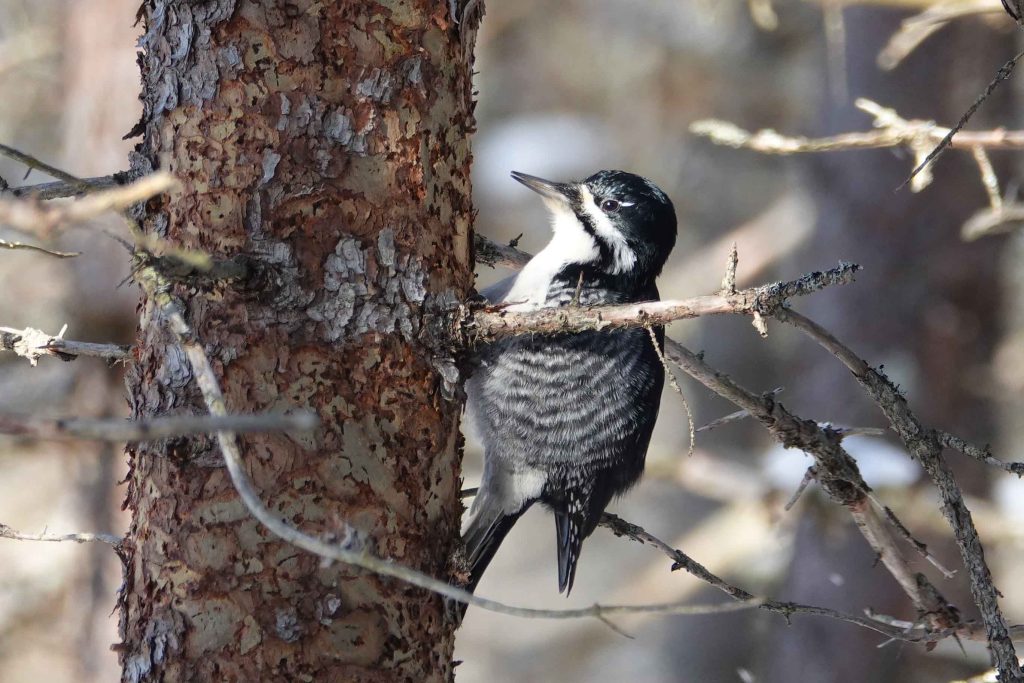
A female Black-backed Woodpecker has a charcoal-black back, fine side barring, and a stripe through its face. Most woodpeckers have four toes; the Black-backed Woodpecker and American Three-toed Woodpecker only have three toes. Photo by David Govatski.
What is the habitat of the Black-backed Woodpecker (BBWO) in New Hampshire?
BBWO rely on spruce-fir conifer forests. These are found at low elevations, such as in the Pondicherry and Lake Umbagog Wildlife Refuges, as well as in montane forests between 2,700 feet and the tree line. These forests include beaver-flooded conifer wetlands, large conifer blowdown areas, and stands affected by the balsam woolly adelgid and spruce budworm. The Caps Ridge Trail, beginning at 3,000 feet in Jefferson Notch, is another good location to potentially observe a BBWO along the first mile of the trail. The common factor in all BBWO habitat is the presence of Black Spruce and other conifers.
The BBWO is drawn to recently burned conifer forests that have been taken over by wood-boring beetles. Its charcoal-black back provides perfect camouflage against the fire-blackened trees. The number of BBWO nest cavities greatly increases during the first few years after a forest fire. The cavities made by the BBWO are later used by secondary cavity nesters, including bluebirds, nuthatches, and chickadees.
In Oregon, I have stopped at local ranger stations to explain what I was looking for and ask where a one- or two-year-old burn was located that I could visit. I have often been rewarded with sightings not only of the BBWO but also of the American Three-toed and White-headed Woodpeckers. Just be careful and avoid going out in windy conditions when these dead trees could fall unexpectedly.
What is the range of the Black-backed Woodpecker?
The BBWO can be found in Carroll, Coos, and Grafton Counties of New Hampshire. The North American range extends to Alaska and includes all the Canadian provinces, as well as California, Oregon, Washington, Idaho, Montana, Minnesota, Wisconsin, Michigan, and Maine. Populations are also located in the Black Hills of South Dakota, the Adirondacks of New York, and the Northeast Kingdom of Vermont. Surprisingly, the BBWO is not found in Colorado or Utah.
Where should we look for Black-backed Woodpeckers at Pondicherry?
Here in New Hampshire, we don’t have many forest fires burning in our conifer forests. Instead, we have areas where conifers have recently died. Beavers are known to flood areas containing many conifers, and this is one place to look for them. Wind, as mentioned earlier, creates blowdown areas where the BBWO can be found. Another disturbance regime is insect-killed areas, where the invasive sap-sucking Balsam-Woolly Adelgid (Adelges piceae) has caused tree mortality. All three of these disturbance regimes are present at Pondicherry.
Trails to look for Black-backed Woodpeckers at Pondicherry:
- Little Cherry Pond Trail: Excellent habitat for the entire mile-long trail from Cherry Pond to Little Cherry Pond. The closest access is a 1.6-mile hike along the Presidential Rail Trail from the trailhead at 289 Airport Road in Whitefield, NH.
- Mud Pond Trail: Good spruce-fir habitat exists from the junction of the Mooseway down to the 950-foot-long boardwalk to Mud Pond, where the habitat is excellent. The trail is 0.6 miles long and is wheelchair accessible. The trailhead parking is at 543 Bailey Road (NH 116) in Jefferson, NH.
- Mooseway: The first quarter mile from the junction with the Little Cherry Pond Trail has excellent habitat. Please note: This trail is only open in the winter and is best accessed via skiing or snowshoeing. In the summer you will find standing water on the trail.
- Presidential Rail Trail from Meadow Road to Cherry Pond: This 2.4-mile-long flat trail passes through excellent spruce fir habitat. The trailhead parking is at 794 Meadow Road (NH 115A) in Jefferson, NH.
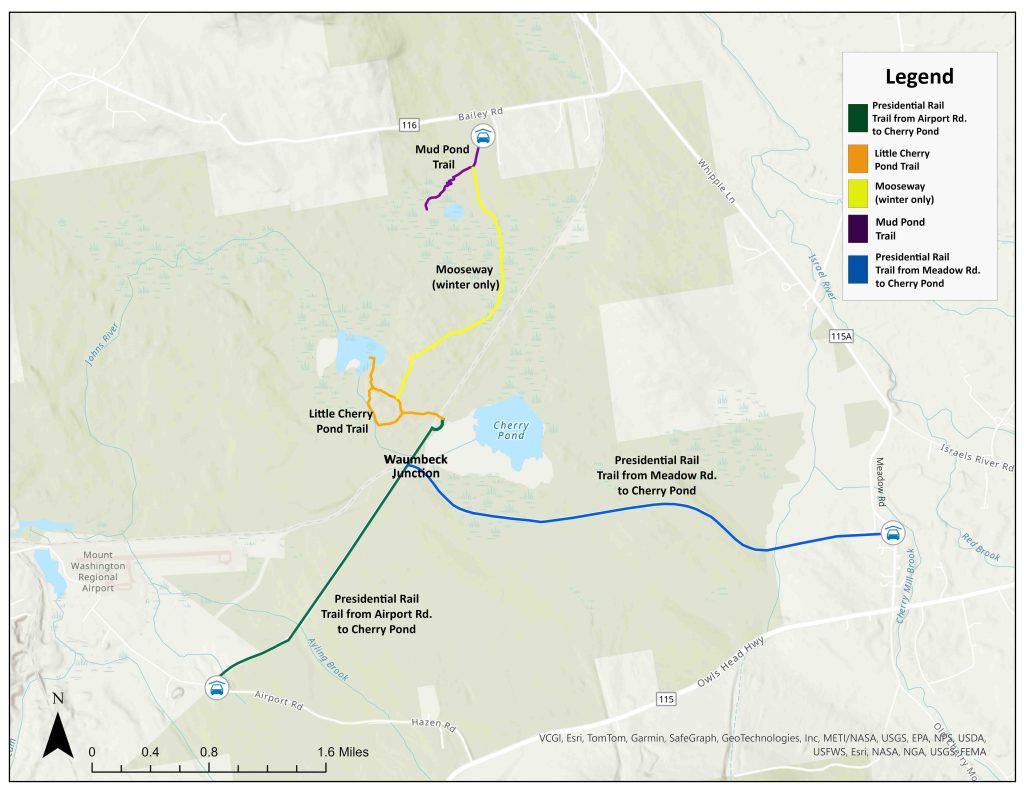
Key places to search for Black-backed Woodpeckers at Pondicherry National Wildlife Refuge in Whitefield/Jefferson, NH.
When should we look and listen for Black-backed Woodpeckers at Pondicherry?
The BBWO is present in Pondicherry year-round, but certain periods are better for spotting one. Drumming begins in late March and peaks in April, and is used to attract a mate and establish territory. Nest cavity construction starts in late April and early May when they become more secretive. Egg-laying usually begins by the end of May, with incubation lasting 12-14 days, making the birds harder to find during this time because one is incubating the eggs. The BBWO typically lays 3-4 eggs. Mid-June is when the Pondicherry birds hatch, and it’s often the best time to see adult birds constantly foraging to feed their young. The nestlings take three weeks to fledge. DO NOT report nest locations of the BBWO on NH Birds or other media.
Nest cavities are almost perfectly circular and feature a distinctive 45-degree bevel at the bottom, both inside and outside. The diameter of the cavity trees can be surprisingly small. One cavity in a seven-inch-diameter tree near Little Cherry Pond made me worry it could break off in a windstorm. The BBWO generally does not reuse its nest cavities. I have found these cavities in black spruce, balsam fir, and balsam poplar, typically between 6 and 20 feet up the trunk. I’ve also discovered nest cavities in telephone poles along a busy road.
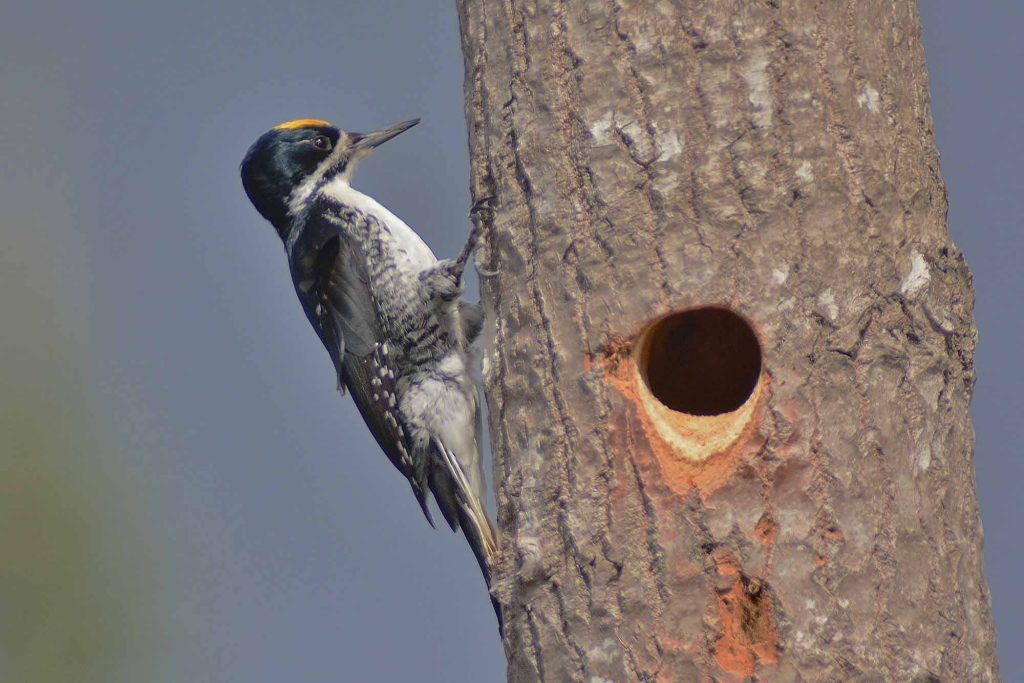
Black-backed Woodpecker nest cavity showing its distinctive bevel. The tree is a balsam poplar. Photo by Tom Berriman in Victory, Vermont.
Both male and female BBWOs drum to mark territory and communicate with mates. Drumming is most common in April, and each set can last up to 2 seconds. The call is a high-pitched “pik, pik.” A distinctive rattle snarl that begins with a whinny is sometimes heard. Learning these sounds in advance will help you locate a BBWO. Another sound, not used for communication, is the soft tapping of a BBWO probing for insects on a tree trunk or as it flecks bark. Stopping, looking, and listening every few hundred feet when you’re in the right habitat is a good practice. Remember, hearing a BBWO sound is usually how I find a BBWO.
What else should we look for in finding Black-backed Woodpeckers at Pondicherry?
The BBWO is a bark forager. Look for piles of bark at the base of conifers where the BBWO has been flecking off bark searching for beetles. This is especially helpful in winter when snow covers the ground, and you may know the date of the last snowfall. Hairy Woodpeckers will also fleck bark. Both species will often come back to the same tree.
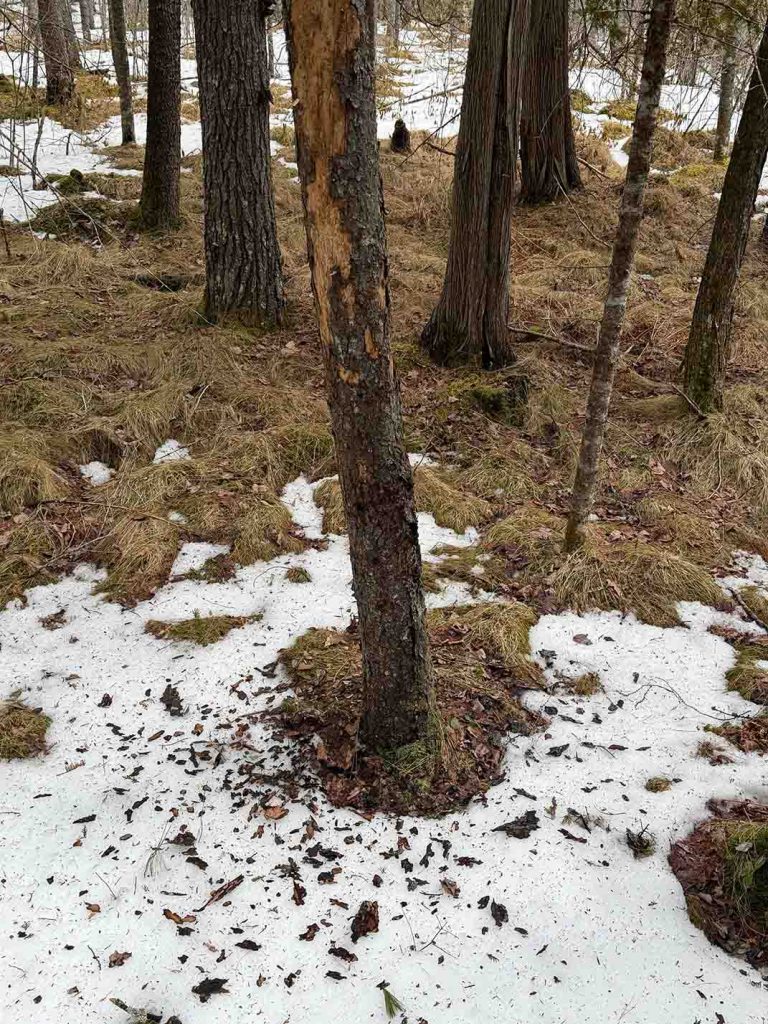
Flecked bark created by Black-backed Woodpeckers foraging in search of bark beetles. Photo by David Govatski.
eBird Hotspots for Pondicherry National Wildlife Pondicherry:
- Overall Pondicherry Hotspot: Pondicherry Wildlife Refuge, Jefferson/Whitefield
- Pondicherry Wildlife Refuge–Cherry Pond, Jefferson
- Pondicherry Wildlife Refuge–Little Cherry Pond, Jefferson/Whitefield
- Pondicherry Wildlife Refuge–Cherry Pond Access Trail, Whitefield/Jefferson
- Pondicherry Wildlife Refuge–Mud Pond, Jefferson.
Field Trip: Pondicherry Migratory Bird Day is the second or third Saturday in May. For 2026, the date is 16 May 2026, starting at 6 am. This is a good opportunity to spot a BBWO because we have many eyes and ears searching in the right habitat. You can learn more information here.