
Editor’s Note: This remarkable discovery was made during the City Nature Challenge, a global community bioblitz that encourages people to document biodiversity in their local area. Despite its name, the challenge is not limited to cities—entire regions, counties, and rural communities participate. Finds like this demonstrate how participatory science can contribute meaningful data and even uncover important milestones in our understanding of New Hampshire’s wildlife.
The day was April 27, 2026. It was the fourth and final day of the City Nature Challenge, a four-day global bioblitz and biodiversity celebration where each participating area has its own section, similar to a Christmas Bird Count. This year was the Monadnock Region’s first year participating in the challenge, and my friend Steven Lamonde and I served as organizers.
Curious to see how many species we could find in the Monadnock Region during our inaugural year, we set a loose goal of documenting 750 species of birds, plants, insects, fungi, slime molds– anything living was fair game. What that translated to for me was four days of scouring for spring ephemerals, moth lighting, hiking Mount Monadnock and other local mountains, and leading and participating in several events, in search of as many unusual species as I could find. It was exciting, exhausting, and most of all, fun.
On the evening of April 27, I found myself scrambling to squeeze in every new species that I could. With the sun setting and headlamp in hand, I set out to find three plant species that hadn’t yet been documented for the City Nature Challenge on a mountain along the Connecticut River Valley. The first two species I found quickly, while the final target, maidenhair spleenwort, was proving to be a bit more of a challenge.
Maidenhair spleenwort is a species of fern that tucks itself into little crevices on cliffs, boulders, and scree slopes, requiring hardly any substrate to grow. It’s an easy plant to find if you’re a bird or a mountain goat, but humans are a bit more limited in potential search areas for this species. Regardless, I scrambled along the base of a cliff in the hopes I could find a plant or two. It was getting darker, and I was running out of time and beginning to run out of hope.
It was beginning to get difficult to see, and I still hadn’t found the plant. As I carefully checked every crack and crevice, all of a sudden a bird– a vulture– flew out of a nearby cave created by fallen bedrock. As it landed in the tree, I noted that the silvery coloration in the underwing was limited to the primary feathers, and when it settled I noticed a short tail. My heart began racing as I realized the identity of the bird– a Black Vulture– and the circumstance I was now in.
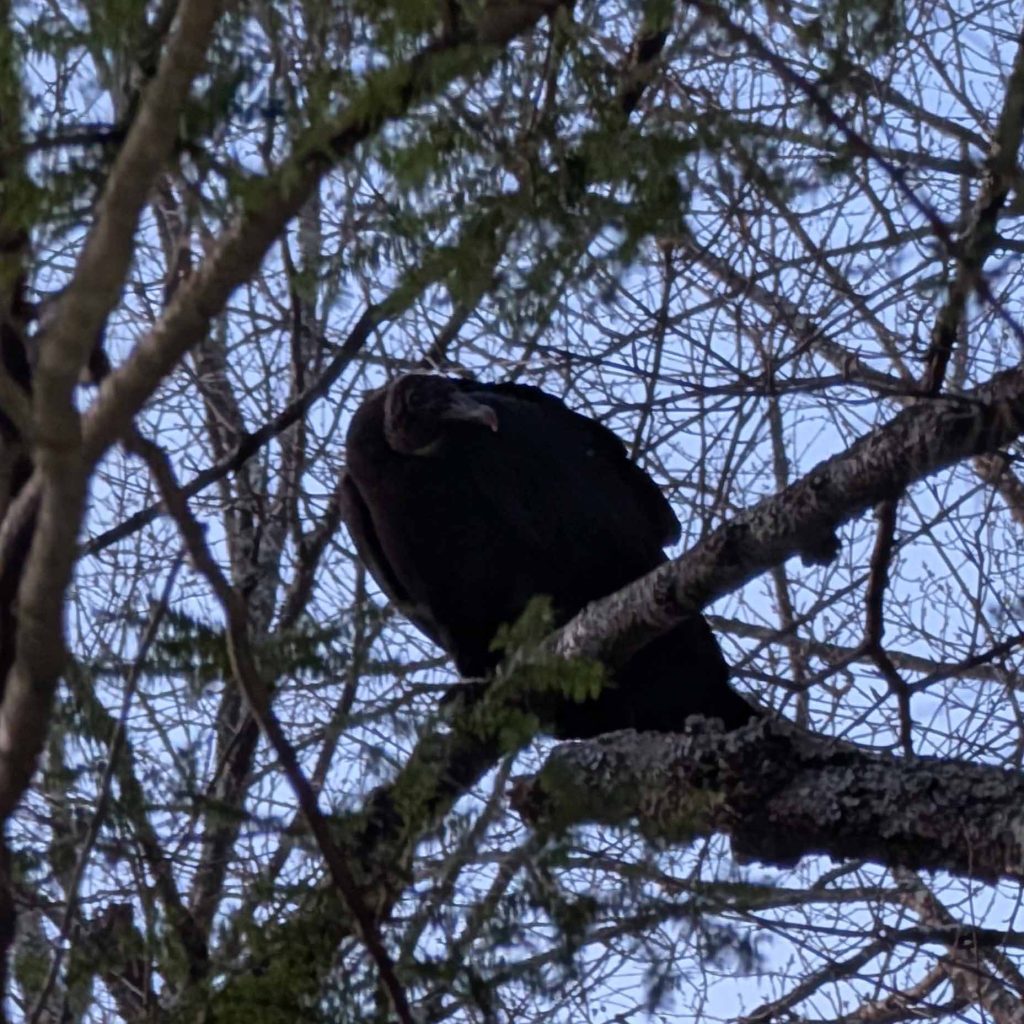
The Black Vulture watches from a nearby branch. Photo by Nate Marchessault.
From previous experience with Turkey Vultures, I knew that vultures in caves typically meant nests. I also was fairly certain that Black Vulture hadn’t been confirmed nesting in New Hampshire. I was also one hundred percent certain that vultures will projectile vomit up to 10 feet in order to drive anything they perceive to be a threat away from the nest.
Proceeding with caution, I carefully monitored the adult’s behavior as I inched closer to the cave. The bird watched me closely, clearly concerned, but did not hiss, growl, or show any other signs of distress. Eventually, I got close enough to the cave to peer inside. The stare down from the vulture was becoming anxiety-inducing. I shone my headlamp into the cave and found two white eggs mottled with brown on a barely-constructed nest of cleared away leaf litter. Nesting confirmed! I snapped a quick picture and quickly left the area to allow the adult to continue incubating in peace.
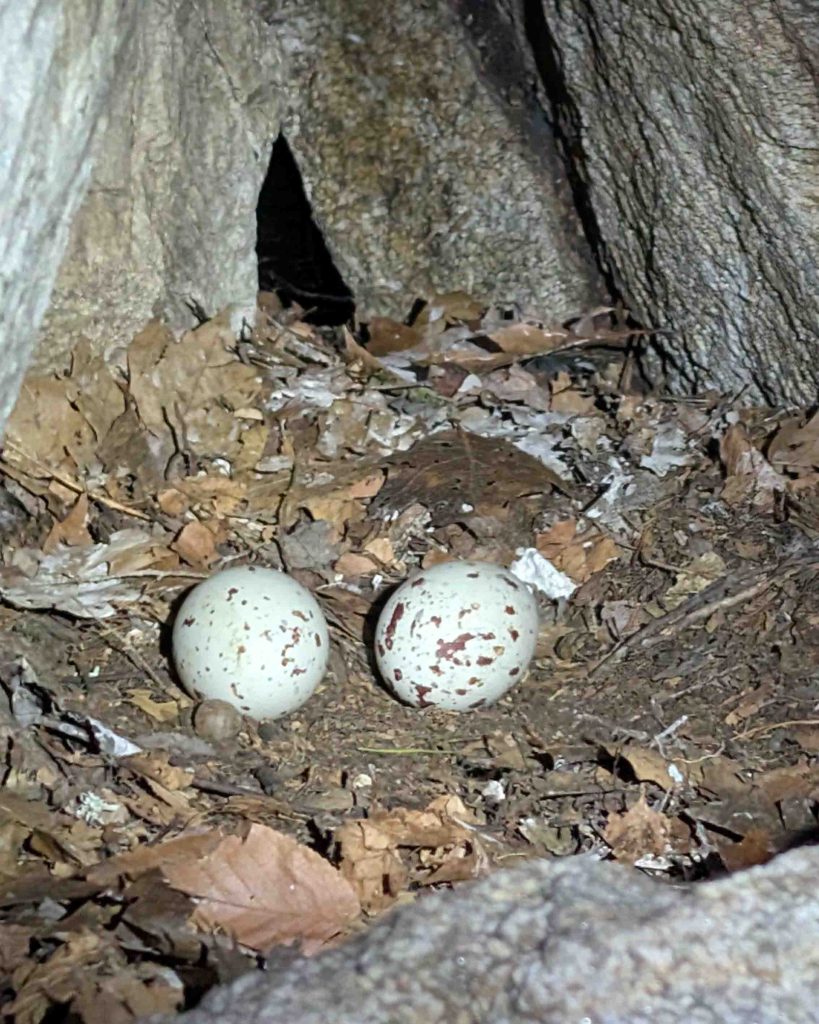
The first known Black Vulture nest in New Hampshire! Photo by Nate Marchessault.
Black Vultures are a species that has become increasingly common in the Northeast in the past several decades, historically being limited to the mid-Atlantic and further south on the East Coast. The first documented Black Vulture in New England was shot in Massachusetts in 1850; however for most other states, sightings of this species did not begin to occur until the 1980s and 90s (Buckley et al. 2022). Since then, sightings have skyrocketed in New England. Currently, Black Vultures have become relatively common as far north as southern Massachusetts and can be found reliably in several locations in southern New Hampshire.
This trend mirrors that of the Black Vulture’s close relative, the Turkey Vulture. Prior to the 20th century, Turkey Vultures were rare in New England and, in many states– including New Hampshire– didn’t become regular until about the 1960s (Kirk et al. 2024). Their first nesting in New England was recorded in the 1930s in Connecticut, while the first nesting in New Hampshire was recorded in 1981 (Foss 1994). By sheer coincidence, the first breeding records of both vulture species in New Hampshire were made by Harris Center employees, with John Kulish and Meade Cadot documenting the state’s first nesting Turkey Vultures.
Both species are thought to have expanded northward for similar reasons, including warming temperatures and increased food availability resulting from increased deer populations and greater amounts of roadkill. As to why Black Vultures have lagged behind Turkey Vultures in expanding their range, there are several potential reasons. One is that they are less efficient at maintaining lift and benefit from increased thermal activity from warmer temperatures. Another is that they do not possess a strong sense of smell as Turkey Vultures do and therefore must find food visually, either by finding carrion themselves or by following Turkey Vultures to a food source.
After regaining my composure from the experience with the vulture, I moved away from the cave and resumed searching crevices within the cliff and was able to find a diminutive maidenhair spleenwort plant before walking back to my car in the dark. In total, over 975 species were documented in the Monadnock Region– an impressive feat for our first year participating. The nest sighting was a wonderful bookend to a weekend full of chaos and adventure, and highlights how concentrated biodiversity documentation efforts can lead to scientifically important discoveries.
References
Buckley, N., B. Kluever, R. Driver, and S. Rush. 2022. Black Vulture (Coragyps atratus), version 2.0. In Birds of the World (P. Rodewald and B. Keeney, eds.). Cornell Lab of Ornithology, Ithaca, NY. https://doi.org/10.2173/bow.blkvul.02
Foss, C., ed. 1994. Atlas of Breeding Birds in New Hampshire. Audubon Society of New Hampshire, Concord, NH.
Kirk, D., M. Mossman, K. Bildstein, A. Naveda-Rodríguez, and J. Mallon. 2024. Turkey Vulture (Cathartes aura), version 2.0. In Birds of the World (N. Sly, P. Rodewald, and B. Keeney, eds.). Cornell Lab of Ornithology, Ithaca, NY. https://doi.org/10.2173/bow.turvul.02