
Odiorne Point State Park in Rye is more than just a beautiful, scenic destination on the seacoast of New Hampshire. In recent years, the 330-acre coastal park has consistently ranked as the state’s number one eBird Hotspot, drawing birders of every skill level to one of New Hampshire’s most important bird migration sites.
The park’s prominence as a birding destination is rooted primarily in its coastal location and the way migrating birds concentrate along the shoreline. At the same time, more than a decade of habitat restoration led by the Rockingham County Conservation District (RCCD) has helped improve habitat conditions in the park. Since 2010, the state organization has worked to reclaim the park from invasive plants that had overtaken nearly 90 percent of the property, replacing them with native vegetation in an effort to restore wildlife habitat.
The effort has transformed large portions of the park, but the work is far from finished. Funding, severe storms, invasive plant species, rising sea levels, an abundant deer population, and heavy public use continue to challenge restoration efforts. Meanwhile, some birders have questioned how best to balance habitat protection with the park’s growing popularity as a recreational destination.
On June 10, 2026, about 20 people joined the New Hampshire Audubon’s Seacoast Chapter for a behind-the-scenes tour exploring habitat management at Odiorne Point State Park. The walk was led by RCCD leaders Tracy Degnan, Senior Project manager and Arianna Spear, Conservation and Stewardship manager, and Matt Tarr, a State Wildlife Habitat Specialist for the University of New Hampshire Cooperative Extension.
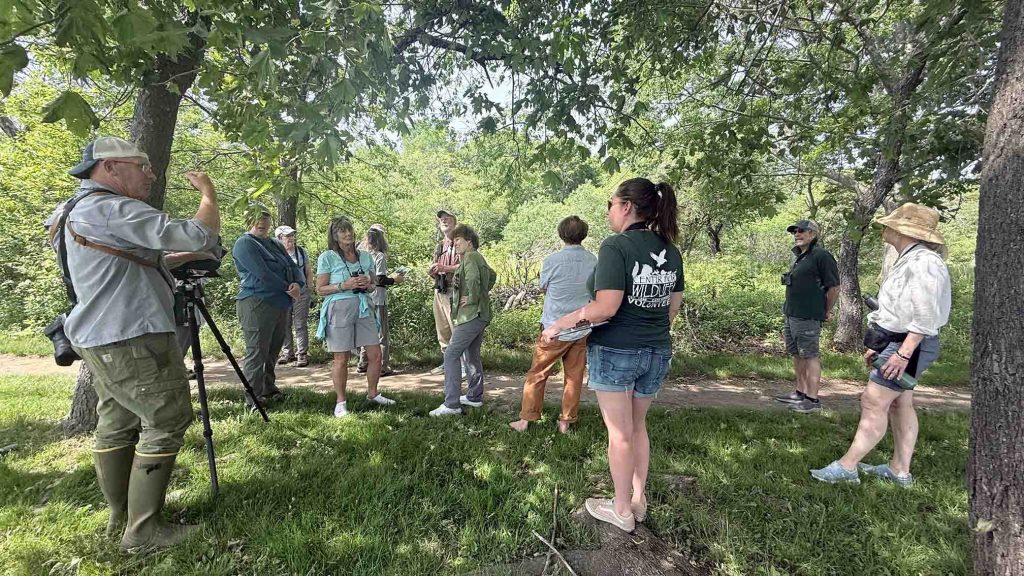
Birders gather to learn about habitat restoration at Odiorne State Park. Photo by Meera Mahadevan.
With habitats ranging from rocky shoreline and salt marshes to grasslands and tree groves, the state park has long been a go-to destination for birders. It serves as an important stopover during spring and fall migrations and encompasses the state’s longest stretch of undeveloped shoreline. According to eBird, a total of 315 bird species have been recorded at this hotspot over the years. Separately, some 2,494 species (which include all flora and fauna) have been identified at the state park during BioBlitz since 2003, according to the Seacoast Science Center.
The park itself also has a rich history. It was originally home to Pennacook and Abenaki communities before European settlers arrived in the 1600s. The Odiorne family owned the property from 1660 until 1942, when the U.S. military transformed it into Fort Dearborn during World War II. Former farmland became a military installation, complete with concrete bunkers and gun mounts, remnants of which still exist today.
New Hampshire acquired the property in 1961 and eventually opened it as a state park. The Seacoast Science Center opened there in 1992, initially operated by NH Audubon as a nature center before becoming an independent nonprofit in 2002. Today, the park welcomes thousands of visitors each year including school children. More than 98,000 people visited the Seacoast Science Center in 2025 alone, according to its annual report, and the park registers about 150,000 visitors annually, Deagan said.
Centuries of farming, military activity, and heavy recreational use have left lasting scars on the landscape. Disturbed soils created ideal conditions for invasive plants to flourish while making it difficult for native species to reestablish themselves.
“We had big military bulldozers all over this area moving that dirt around and moving the soil around, so the growing conditions have been significantly disturbed,” Tarr said. “Not to mention all the agriculture that happened before. That heavy soil disturbance lasts for generations—more than 100 years—and it makes it very difficult for native plants to grow.”
Despite those challenges, the park protects some of New Hampshire’s rarest coastal ecosystems, including pitch pine forests, sand dunes, and salt marshes.
The spread of invasive plants has been the greatest threat to those habitats, prompting local residents and conservationists to launch a coordinated restoration effort nearly two decades ago.
“We had an invasive species management plan created after recognizing that there’s invasive species everywhere,” RCCD’s Degnan said. “Park staff was small and had no capacity to handle management of anything other than the people that were trying to visit. We started over here by the playground because there were people hanging out in the brush and they were concerned about it. There were a multitude of kids there all the time, including mine.”
RCCD is a subdivision of the state and partners with the NH Department of Natural and Cultural Resources and other agencies. It was established by the state legislature in 1946 to oversee natural resources and address environmental challenges. It is directed by a board of supervisors and has a staff of about seven people. It is funded through various sources, including grants, municipal money, and occasional corporate donations.
State biologist Alan P. Ammann developed an ecological restoration plan in 2009 that divided the park into seven habitat types and 33 field areas that need restoration. The plan identified invasive plants as the greatest stressor affecting the park’s ecosystems. At the time, at least 18 of New Hampshire’s 26 prohibited invasive plant species had been documented at Odiorne, with roughly 230 of the park’s 330 acres heavily infested.
Among the most aggressive invaders is Asiatic Bittersweet (also known as Oriental Bittersweet), whose dense vines can overwhelm and kill trees and shrubs. Other invasive species found throughout the park include phragmites, Common Privet, Common and Glossy Buckthorn, Multiflora Rose, Japanese Honeysuckle, Japanese Knotweed, Purple Loosestrife, and Narrow-leaved Cattail (non-native and potentially invasive).
Holding a color-coded map of the park’s restoration work, Degnan explained how the project has advanced over the past 16 years.
“All the different color types indicate where we initiated restoration efforts,” she said. “The size of the color indicates the funding amount we got that year. Some years we only got about $5,000. Other years we received $50,000, so we were able to hire more people and accomplish much more work. That’s really how we’ve been doing it for 16 years—piece by piece. It’s a really hard way to do it, but you have to be persistent.”
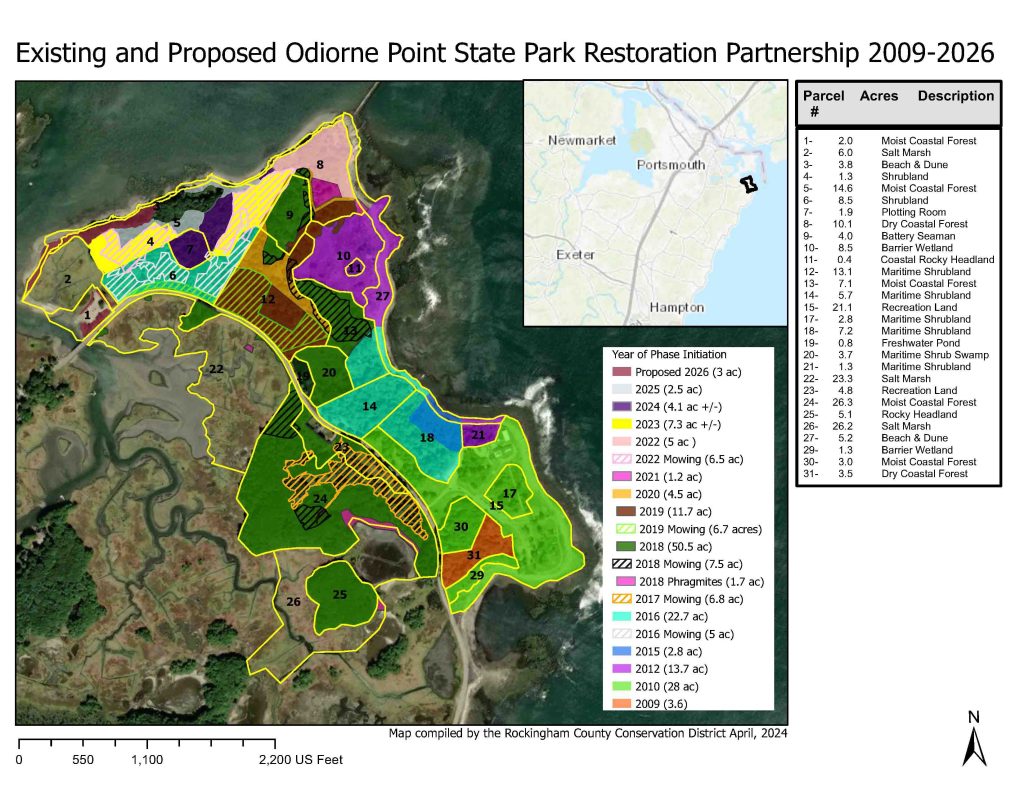
Existing and proposed restoration at Odiorne Point State Park in Rye, NH. Colors indicate either the year restoration was completed or restoration work proposed for 2026. Numbers indicate the parcel. View the key to find the main habitat type for a given parcel.
Over the years, RCCD has secured about $1 million through state funding, donations, and grants, along with an estimated $300,000 worth of volunteer labor, according to Degnan.
“Habitat restoration involves reducing invasive plants, evaluating the site, and then coming back with native species that are appropriate for that habitat type,” Degnan said. “Some years we plant more than others and other years we focus more on invasive plant control.”
RCCD has used a variety of techniques to reclaim the park’s habitats. Depending on the site, restoration crews have used Integrated Pest Management, which combines carefully targeted herbicide applications with mechanical and manual removal. Contractors have mowed dense stands of invasive plants using excavators fitted with drum mowers, particularly along the Little Harbor shoreline, while battery-powered augers have helped remove deep-rooted species. Crews have also relied on hand-pulling, tilling, and seedbed preparation before replanting native vegetation.
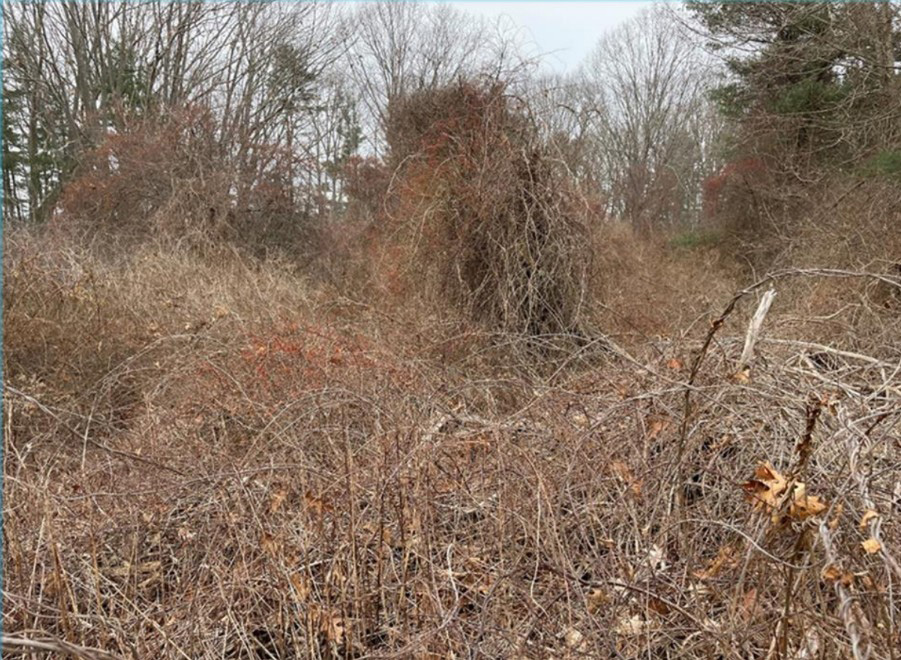
Pre restoration: A section of Odiorne State Park infested by bittersweet, an invasive vine which has smothered the surrounding trees. Photo courtesy of Rockingham County Conservation District.
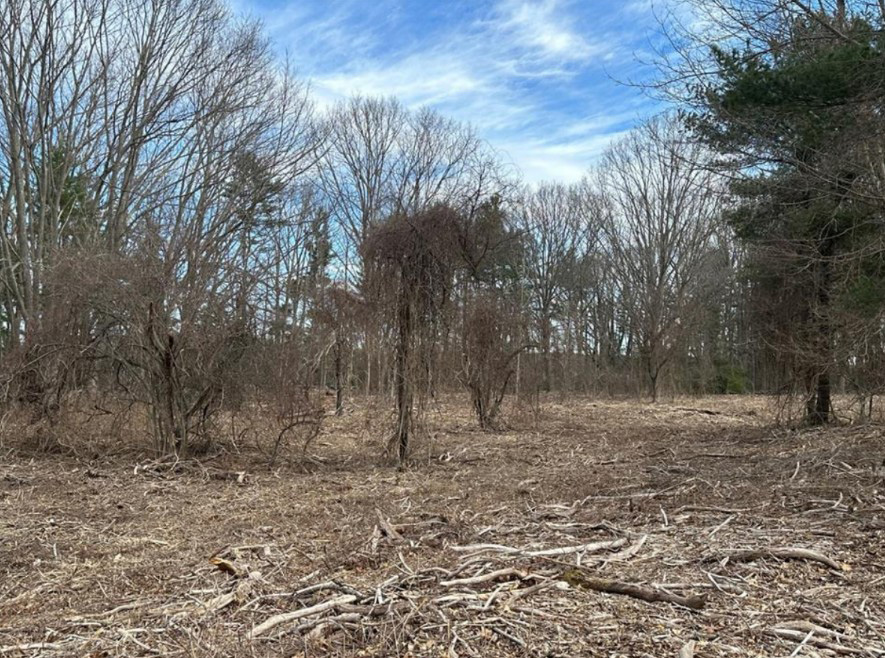
Post restoration: The bittersweet has been removed. Now the job is to make sure that the bittersweet does not return. Planting natives and careful monitoring can help prevent a resurgence. Photo courtesy of Rockingham County Conservation District.
Since 2010, the district has initiated restoration in about 165 acres of coastal habitat. Projects have included eliminating phragmites from a coastal salt pond, restoring a bayberry-beach plum maritime shrubland on a cobble dune, and removing buckthorn from a freshwater wetland that supports state-listed damselflies.
Even with those successes, restoration remains an ongoing challenge.
Human activity continues to undermine some of the work. Visitors sometimes ignore trail closures, moving signs and rock barriers intended to protect fragile habitats. Coastal storms have also accelerated erosion, particularly in the park’s dune system.
“We created our first new trail, and we also closed the dunes last year because they were being trampled and taken away by overwash during large storm events,” Degnan said.
“To be honest, it’s been hard for park staff,” she added. “It’s been hard for them to keep up with trying to blockade. People are pretty aggressive—they start taking away the little blocks that we have.”
Wildlife presents another obstacle. Odiorne’s abundant deer population feeds heavily on native vegetation while largely avoiding many invasive plants.
“A lot of these invasive plants have chemicals that discourage deer from eating them,” Tarr said. “In this landscape we have lots and lots of deer. That deer browsing gives many of these invasive plants a very significant competitive advantage. There are a lot of challenges here to getting native plants to grow.”
Yet Tarr cautions against viewing every invasive species as inherently harmful. From a bird’s perspective, some non-native plants still provide food or shelter. Similarly, native plants that thrive in disturbed areas can also provide habitat.
Staghorn Sumac, for example, is listed as a native plant and is a highly ranked shrub for wildlife habitats. However, because it spreads aggressively and readily colonizes disturbed sites, some people view it as “invasive.” At Odiorne, it grows on top of the bunkers! The sumac’s fuzzy red berries are a vital food source for over 300 bird species.
“As people, we want to put things in neat and tidy boxes,” Tarr said. “We want to say non-native plants are ‘bad’ and native plants are ‘good,’ but it’s not that easy, particularly from a habitat perspective.”
Every plant, he said, has some habitat value depending on the species that use it.
“What we really want to do is discourage one individual plant from becoming a monoculture over a large area,” he said.
Among the native species that have responded well to restoration are Northern Bayberry, Virginia rose, and Eastern Red Cedar. Degnan said restoration crews also collect seeds that are sent to the state nursery in Boscawen, where they are grown into saplings and later returned to Odiorne Point State Park for planting after RCCD purchases it.
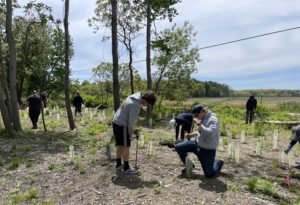
Volunteers plant native plants from the State Nursery in restored areas. Photos courtesy of Rockingham County Conservation District.
Looking ahead, conservation efforts are increasingly focused on climate resilience. Rather than simply replacing invasive plants, managers are planning for rising sea levels and stronger coastal storms.
“These days, we’ve moved over to the boat ramp and we’re looking at coastal resiliency now,” Degnan said. “We are looking at how to make the shoreline more resilient for visitors and maintain what we can through at least 2050 with projected sea-level rise.”
The pace of that work, she said, ultimately depends on funding and staffing. Without continued grants and state support, restoration slows, increasing the risk that invasive plants will reclaim restored areas. Long-term success will also require enough park staff to maintain restored habitats after the initial work is complete.
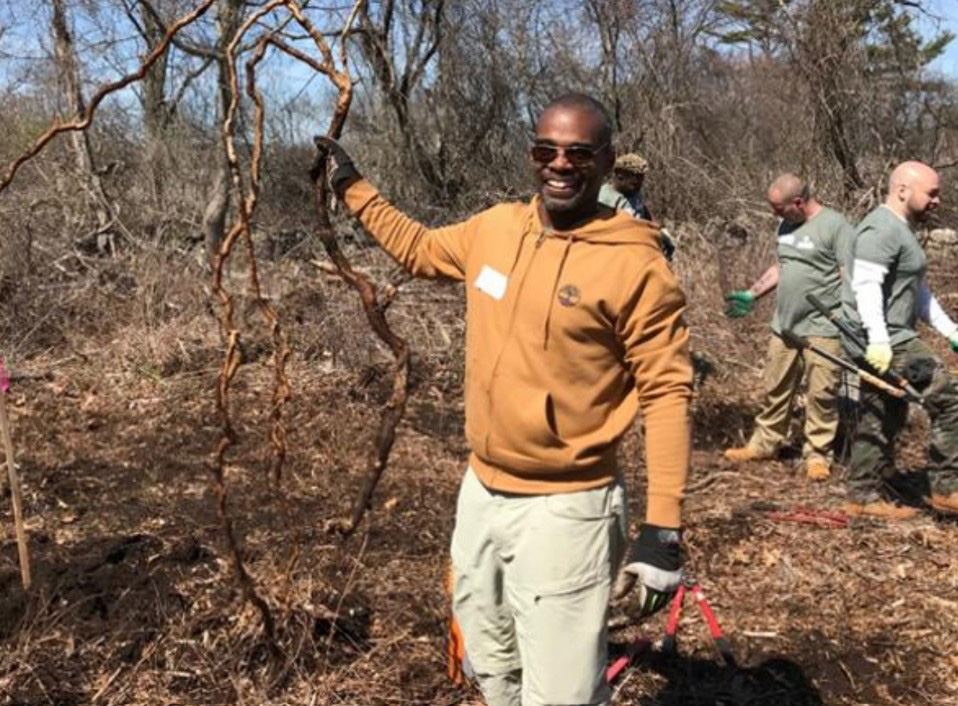
A volunteer holds up the massive roots of an invasive bittersweet. If left unchecked bittersweet will become a monoculture, climbing and ultimately killing trees. Photo provided courtesy of the Rockingham County Conservation District.
For many of the birders who attended the June field walk, the restoration effort represents more than an environmental project. It reflects an ongoing conversation about how public lands should be managed.
Roger Stephenson of Stratham, a wildlife biologist and former Northeast advocacy director for the Union of Concerned Scientists, has been birding at Odiorne Point State Park since 1978. He remembers when parts of the park were nearly impassable and vandalism was present. Last year, he said he recorded 22 species of warblers in a single day, including four long-sought Bay-breasted Warblers that he found in a Norway Maple—another non-native tree that nonetheless provided habitat.
As restoration takes place, Stephenson said it’s important to bear in mind whether the work is being done primarily to help wildlife or to help people. He said some of the trails that had been cleared and widened have been done so to make it safer for parents and for pedestrian traffic.
“As we manage for wildlife and people, who are going to be the advocates for the wildlife moving forward?” he said, noting that an extremely rare Chuck-will’s Widow was spotted at Odiorne Point State Park just yards from the playground in May 2022 as an example of how vulnerable and valuable the state park is.
His comments underscore the broader question facing Odiorne Point State Park as restoration continues: Should the park be managed primarily to maximize wildlife habitat, or to accommodate the growing number of people who come to enjoy it?
For conservationists, the answer may not be either-or. The challenge is finding a balance that protects one of New Hampshire’s most important coastal ecosystems while ensuring future generations can continue to experience it.
As Odiorne Point State Park faces rising seas, persistent invasive plants, and growing crowds, its future may depend not only on restoration crews and park managers, but also on the willingness of birders to become advocates for the habitat they have come to enjoy.
“I understand many people who go out to bird do so to get away from things,” Stephenson said. “But each of us has a responsibility to protect the birds we love and admire.”