
The winter season of 2025-26 was the coldest and snowiest in New Hampshire since 2014-15. After several winters of record warmth and below average snowfall, snow arrived in early December and continued with numerous storms through much of the season. For the first time since 2015, Concord recorded four consecutive months of below average temperatures starting in November. Major snowstorms at the end of January and the end of February, punctuated by a number of smaller storms, kept snow cover in place throughout the state, much to the joy of skiers. New Hampshire birders braved the weather to get out in search of land and seabirds and participated in the Christmas Bird Counts (CBCs), the Super Bowl of Birding, and the Backyard Winter Bird Survey.
The drought that impacted the state during the summer of 2025 meant a poor seed crop and scarcity of food for birds as we headed into winter. With fewer food sources, winter birds such as Dark-eyed Junco moved to the south and were seen in lower numbers. Many of the birds that remained were concentrated at backyard feeders due to the cold and snow cover.
Homeowners reported a number of uncommon birds at their feeders. Overwintering birds present at feeders throughout the season included a Hermit Thrush (Gilford), a Dickcissel (Wolfeboro), and two Fox Sparrows (Londonderry). A Yellow-breasted Chat arrived at a yard in Portsmouth on November 18 and stayed until January 21. This is a species that winters primarily in south and central Mexico and Central America but is sometimes seen in winter in New Hampshire, though not reliably. A White-crowned Sparrow was observed at a feeder in Gorham during January and February, a rare record this far north. A Common Grackle that frequented a feeder in Errol through the winter is also notable, both for being present in this season and in the north country.
Winter finches were predicted to have a record-breaking year similar to the winter of 2020-21, and although this wasn’t the case, it was still an impressive year here in New Hampshire. Irruptive species like Red-breasted Nuthatch and Purple Finch had been moving through the state in numbers as early as September, a promising sign for what was to come.
When the first snowfall hit in early December, Evening Grosbeaks arrived with it, lighting up feeders in the North Country. While some Evening Grosbeaks were scattered throughout the state, especially in the Monadnock region, Coos County was the real highlight, with many reports of over 100 at a time at feeders in Jefferson, Colebrook, and Errol. Numbers for this species reported on CBCs in the north were the highest in 20 years. Pine Siskins were abundant in the north as well, seen alongside Evening Grosbeaks at feeders. Other species like Pine Grosbeaks and Red Crossbills were present in the north but were more scattered and less abundant. White-winged Crossbills were notably scarce, reported only a few times in Jefferson and Errol. Redpolls and Bohemian Waxwings were among the species expected to have a major irruption, but this did not occur; however, Coos, Grafton, and Carroll counties saw decent movement of these species at the end of February and into early March.
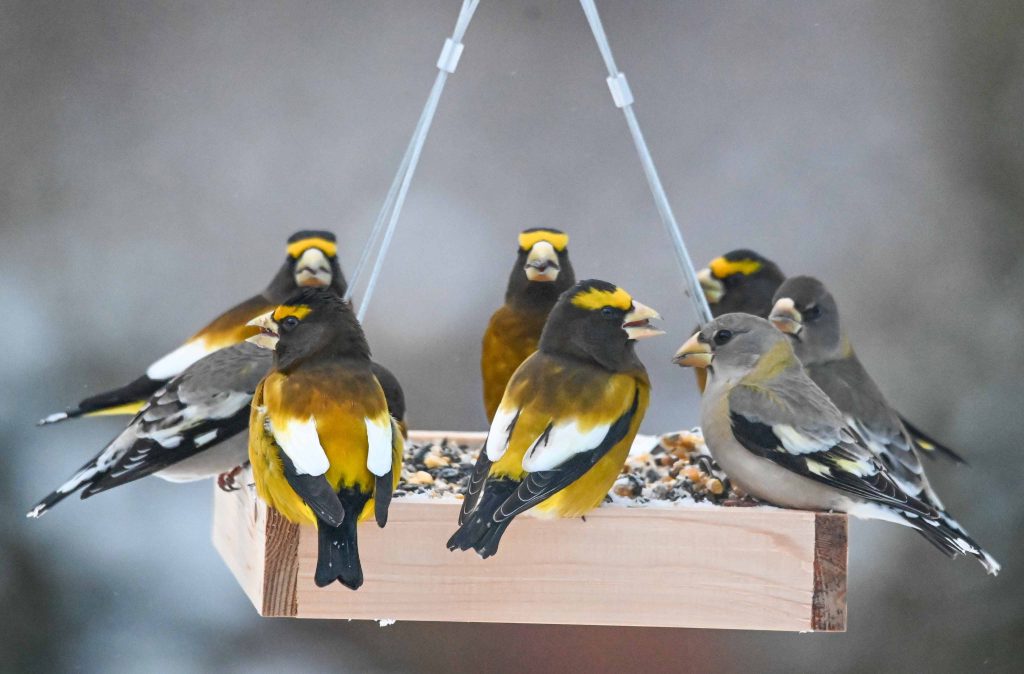
Evening Grosbeaks by John Barth, 1-16-2026, Grafton, NH.
The snow-covered frozen fields likely limited stopovers by migrating geese. A flock of 21 Snow Geese flying over Hilton Park was seen in early December, and a single bird that showed up in the New Castle/Rye area around New Year’s was avidly pursued by many birders. Winter ducks were in their usual spots until almost everything froze over. The Barrow’s Goldeneyes in the Merrimack River in Manchester were joined by a couple of Common Loons that spent much of the winter there.
Gull sightings included a Glaucous Gull that hung around the coast in Rye for a couple of weeks, and one seen at the Rochester Wastewater Treatment Plant (WTP) in early February for a few days. Rochester WTP also hosted up to five or six Iceland Gulls at various times in the winter and an adult plumage Lesser Black-backed Gull. Small flocks of Bonaparte’s Gulls were observed at Hilton Park and Creek Farm in Portsmouth in mid-December.
There was a promising start to the winter pelagic season with 2,139 Dovekie reported on an Eastman’s fishing trip on December 23. The Jeffreys Ledge Christmas Bird Count (CBC) found an estimated 1,126 Dovekie for the day.
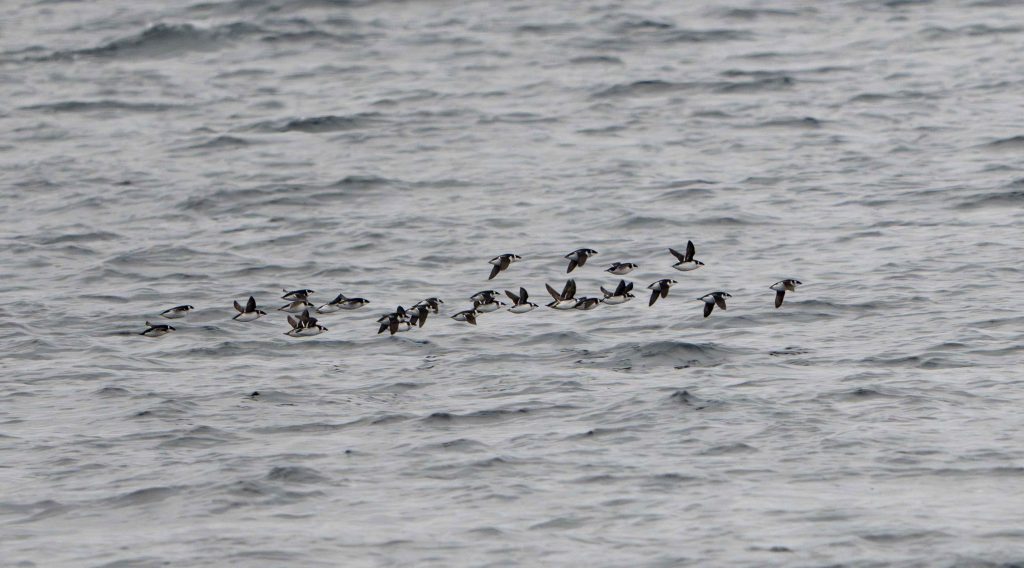
Dovekie by Leo McKillop, 12-23-2025, Jeffreys Ledge, NH.
Eastman’s (a fishing charter company) was reportedly planning to run their fishing trips as deep into the winter as they could, but the severe cold forced them to shut down for the rest of the winter. Observers were limited to what they could find from shore. A number of Thick-billed Murre were seen along the coast and even all the way into Great Bay, a rare inland sighting, with a report there on February 21 by Sam Stoddard.
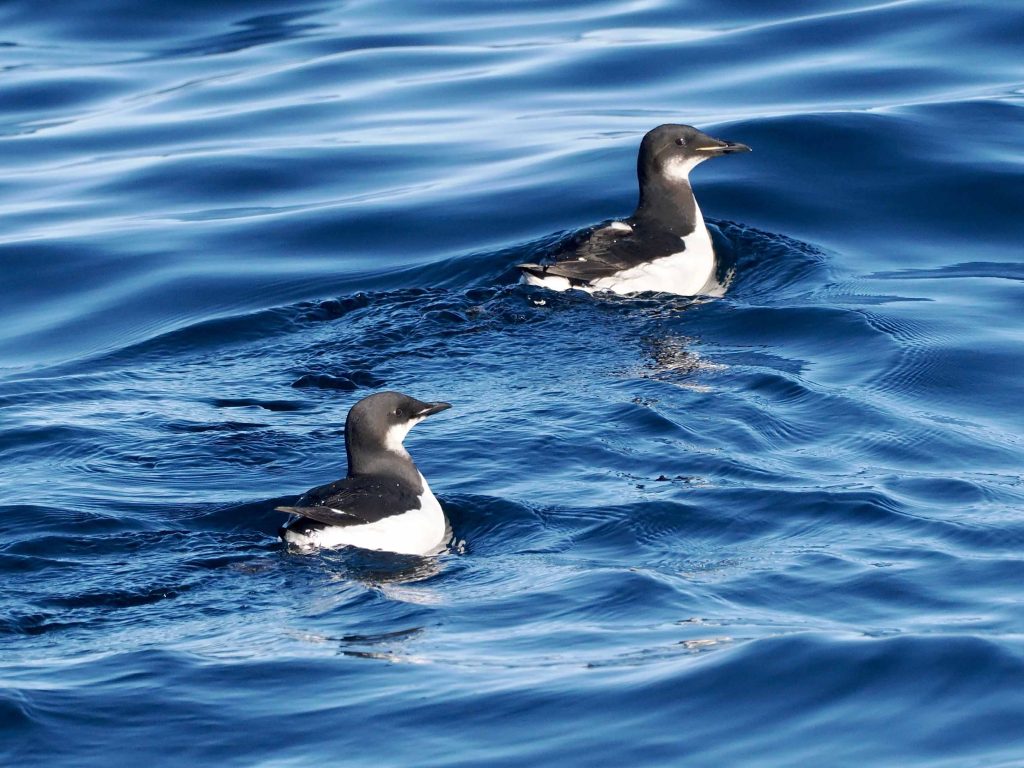
Thick-billed Murre by Jim Sparrell, 12-28-2025, Jeffreys Ledge,
NH, Christmas Bird Count.
A Common Murre was seen and photographed close to shore at Odiorne on February 6 by Diane Sacks. See the note in From the Field about this exciting experience.
This was not an irruption year for Snowy Owls, but a single owl was seen at Hampton Beach State Park in all three months of the season. A Snowy Owl was reported in December and in January from Star Island as well. Inland, one was observed at the Manchester Airport over a few days in January. Several birders chanced on a Snowy Owl at Pulpit Rocks in Rye on February 28, the last day of the season.
Late migrants and over-wintering half-hardy species such as Yellow-bellied Sapsucker were not as abundant as they have been in recent milder winters. The weather also affected returning early migrants often spotted by mid-February, with numbers of blackbirds down. After a series of winters with high counts of warbler species, up to a record of 13 species, only three warbler species were reported in eBird this year: Yellow-rumped, Pine, and Orange-crowned Warbler.
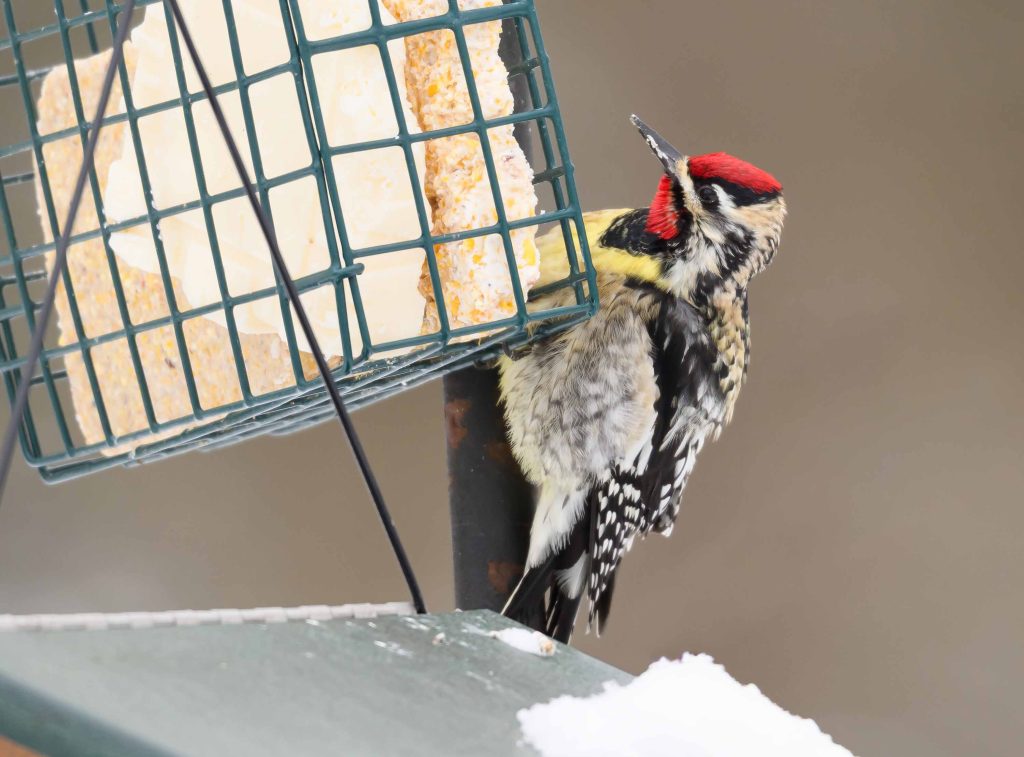
Yellow-bellied Sapsucker by Len Medlock, 1-28-2026, Exeter, NH.
Rare Birds
Rufous Hummingbird
First observed in the fall season, a Rufous Hummingbird continued to frequent a feeder in Stoddard and was last seen on December 14. A rare visitor to the state in any season, this bird was the first winter record for Cheshire County and the second winter record for the state reported to eBird. Watching it feed and perch with snow falling around it and very cold temperatures gave birders an appreciation for this bird’s resilient spirit.
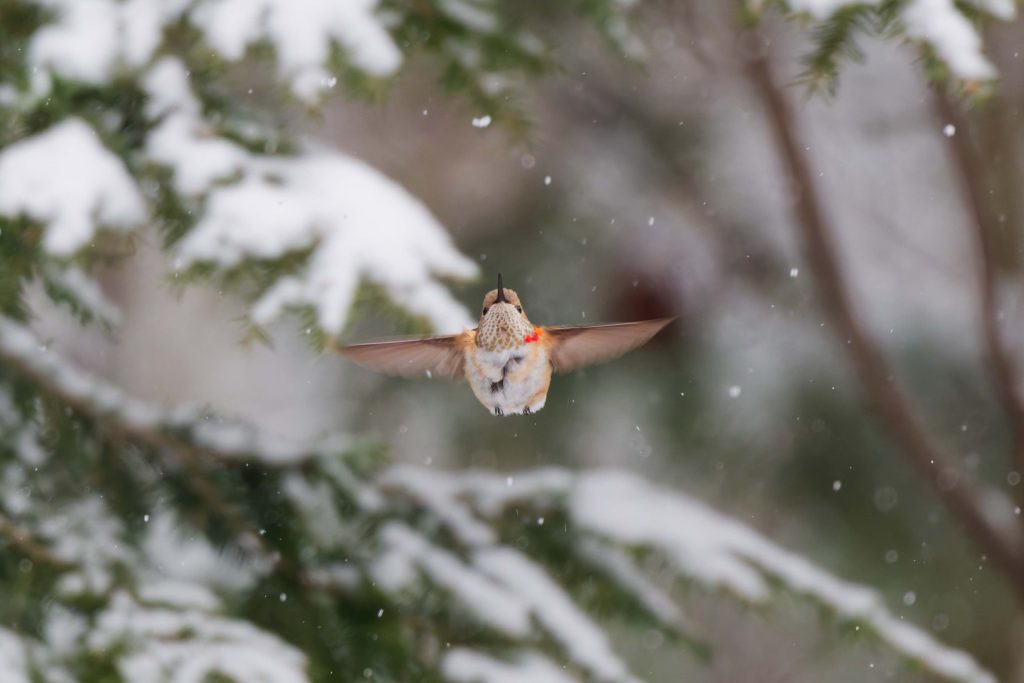
Rufous Hummingbird in flight by Leo McKillop, 12-14-2025, Stoddard, NH.
Eastern/Western Meadowlark
A meadowlark first observed at a feeder in Northfield on December 8 by Roger Simmons was presumed to be an Eastern Meadowlark. Though this species is not commonly seen in winter, records do exist. A number of experts, including David Sibley, reviewed photos of the bird and weighed in on whether it was an Eastern or Western Meadowlark. The most reliable means of distinguishing between the two species is through the song, but observers did not have luck obtaining a recording. The consensus after review of additional photos that revealed the tail clearly, showing less white, was that this bird was a Western Meadowlark, the second state winter record in eBird. The NH Rare Birds Committee will make the final determination.
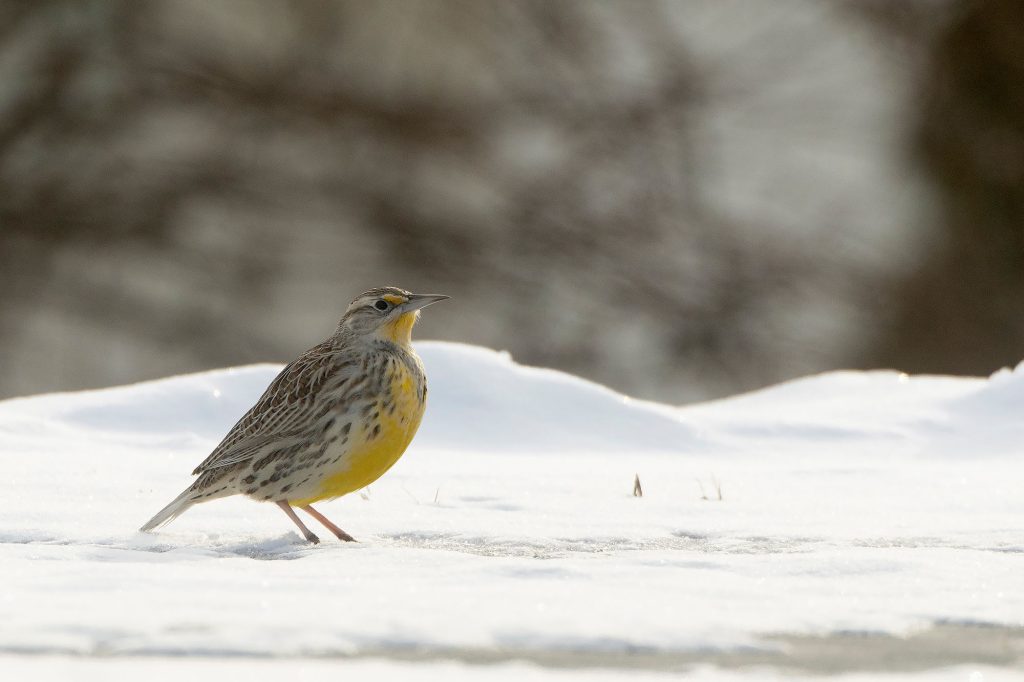
The meadowlark in question by Jason Lambert, 1-4-2026, Northfield, NH.
Painted Bunting
A homeowner in Hampton photographed a Painted Bunting at her backyard feeder on January 29. Either a female or a first-year bird, it continued to visit this private property into February. Commonly found in southern states such as Texas and Florida, this bird was an exciting find, the fourth winter record for the state. The homeowner graciously opened her yard for birders to see the Painted Bunting on the day of the Super Bowl of Birding competition. You can read more about her experience in her article.
Unusual Sightings
Harlequin Duck
A Harlequin Duck seen on the Seacoast in October and November continued into the winter season with reports from Little Boars Head, Bicentennial Park, and Plaice Cove. This brilliant duck can be found reliably during the winter at Nubble Light in Maine, but sightings on the NH coast are more unusual. A group of 20 was observed off Star Island during the Isles of Shoals CBC on December 18, and a single bird was seen by birders on an offshore trip on January 6, the last report for the season.
King Eider
An immature male King Eider was found by Stephen Mirick at Rye Harbor on December 10, the first male seen in NH waters in a number of years. Though a lone female King Eider first reported in May of 2022 in the waters around Odiorne Point State Park remained through 2022, 2023, and into the spring of 2024, the last sighting of a male was in 2017. Birders on the Isles of Shoals CBC were treated to exciting views of a mature male King Eider in full adult plumage offshore on December 18. An adult male was spotted by Jane and Stephen Mirick off Odiorne on February 10 and subsequently seen at Pulpit Rocks with flocks of Common Eider by many birders. It moved up to Peirce Island in Portsmouth on March 14 and is still being seen there. Alex Lamoreaux suggested in a GroupMe post (Maine Rare Bird Alert, 4-11-2026): “The same male King Eider has been a year-round resident of Cumberland, York, and Rockingham Counties for many, many years. It first arrived to the southern Maine coast as a juvenile in October 2010, making it 17 years old now!”
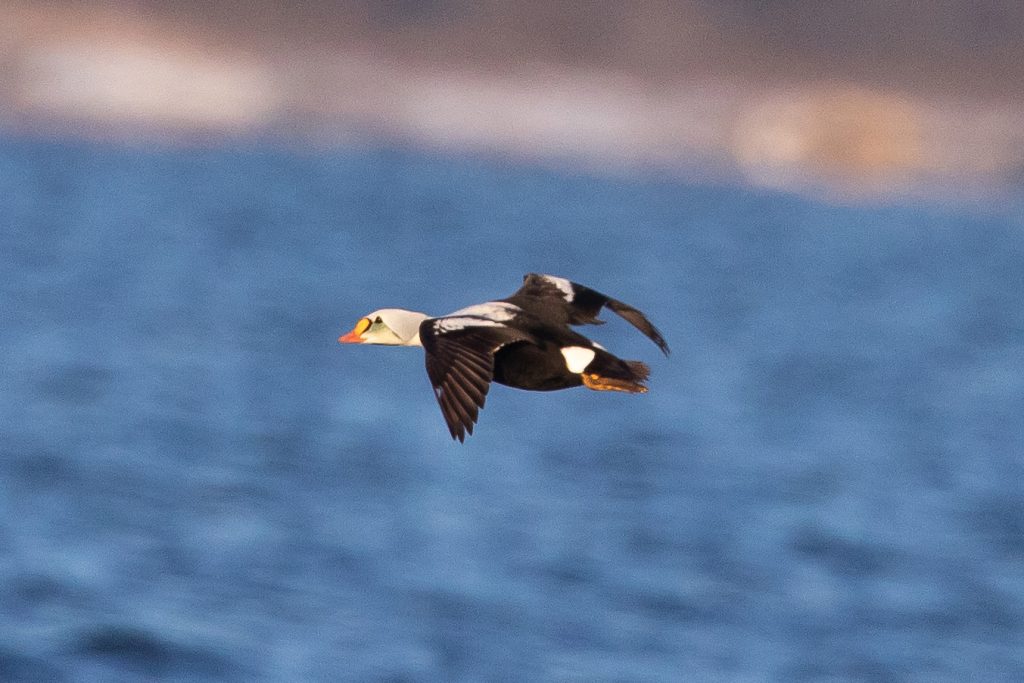
King Eider by Cameron Johnson, 12-18-2025, NH waters between New Castle and Isles of Shoals, NH.
Killdeer and Spotted Sandpiper
A Killdeer found by James Smith at Bicentennial State Park in Hampton is a late winter record. Last seen on January 6, this species was not reported again in the state during the winter season. A month earlier, on December 7, Steve and Jane Mirick found a Spotted Sandpiper at Little Boar’s Head, marking only the second New Hampshire winter record in eBird, with only three previous winter records noted in Keith & Fox (2013).
Osprey
NH birders delight in the return of the Osprey in March. This winter single birds were seen in Auburn on January 11 by Pam Geiger and in Exeter on January 14 by Len Medlock. These are notable sightings as Osprey, long-distance migrants who travel to Central and South America, are rarely observed in NH in winter. The last January report in eBird is from 1989. A single Osprey was observed in Massachusetts in early February, raising the possibility that these sightings were all of the same bird.
Black-crowned Night Heron
Brad Meade found a Black-crowned Night Heron on South Mill Pond in Portsmouth on February 6. The bird was observed sporadically over the next week, roosting at low tide, and was last reported on February 14. Black-crowned Night Herons typically migrate in September and October, going to Florida or farther south to Mexico and Central America. Though this is not the first winter record for NH, it’s a highly unusual sighting that gave rise to speculation about where this bird had been and how it found its way to Portsmouth. One possibility was that it traveled from the Great Lakes when conditions there became too severe.
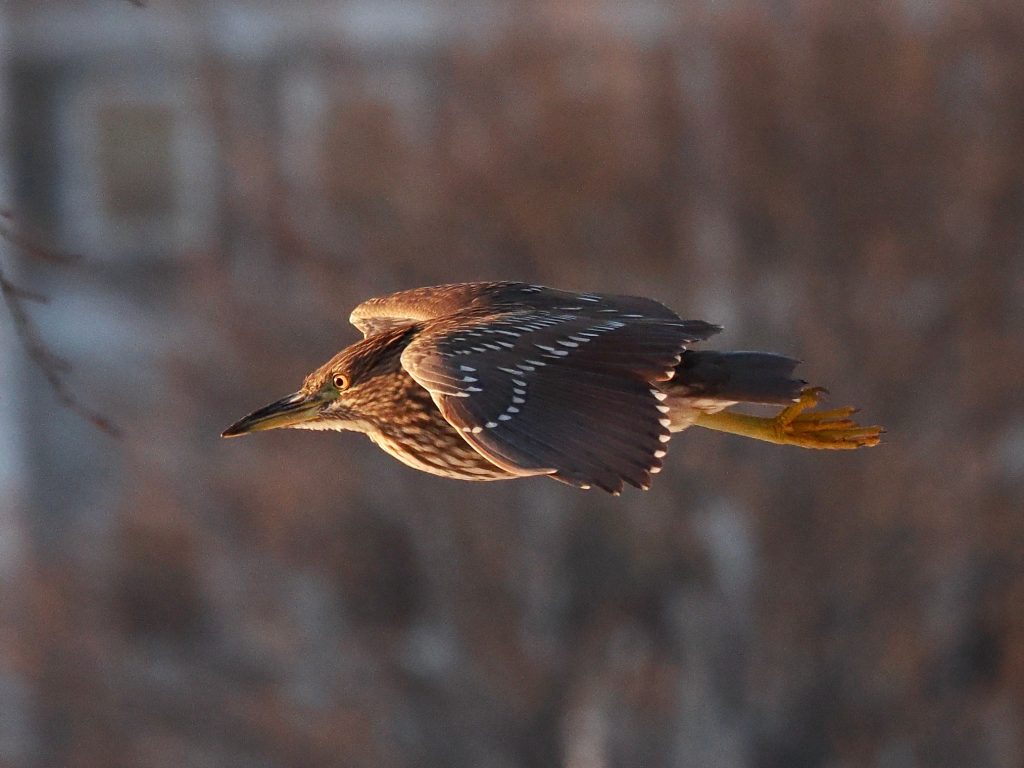
Black-crowned Night Heron by Jim Sparrell, 2-14-2026, South Mill Pond, Portsmouth, NH.
Sandhill Crane
NH has a small population of Sandhill Cranes with reports in spring, summer, and fall from a few locations. This species migrates to the southern U.S. and northern Mexico in the fall. Winter records do exist in NH, mostly of migrating birds, but this year one NH birder was treated to a rare sight. Sam Guiles spotted 30 Sandhill Cranes in flight over the University of New Hampshire campus in Durham on December 3. The following day, Stephen Mirick found three cranes in East Kingston reported earlier by George Gavutis at Bodwell Farm.
Merlin
A Merlin found by Emily Cote on February 20 in Bethlehem is an unusual sighting for this species so far north in winter. Though they are commonly found in southern regions of the state, this was a notable report for the location.
Brown Thrasher
A Brown Thrasher found by Len Medlock on December 20 on Kimball Road in East Kingston was last seen on January 7. The bird frequented a feeder that attracted large numbers of birds this winter. Other winter records exist for this species, but this is not one commonly seen in winter. Brown Thrashers, often skulky birds who stay in thickets, are short distance migrants who spend winters in the US southeast.
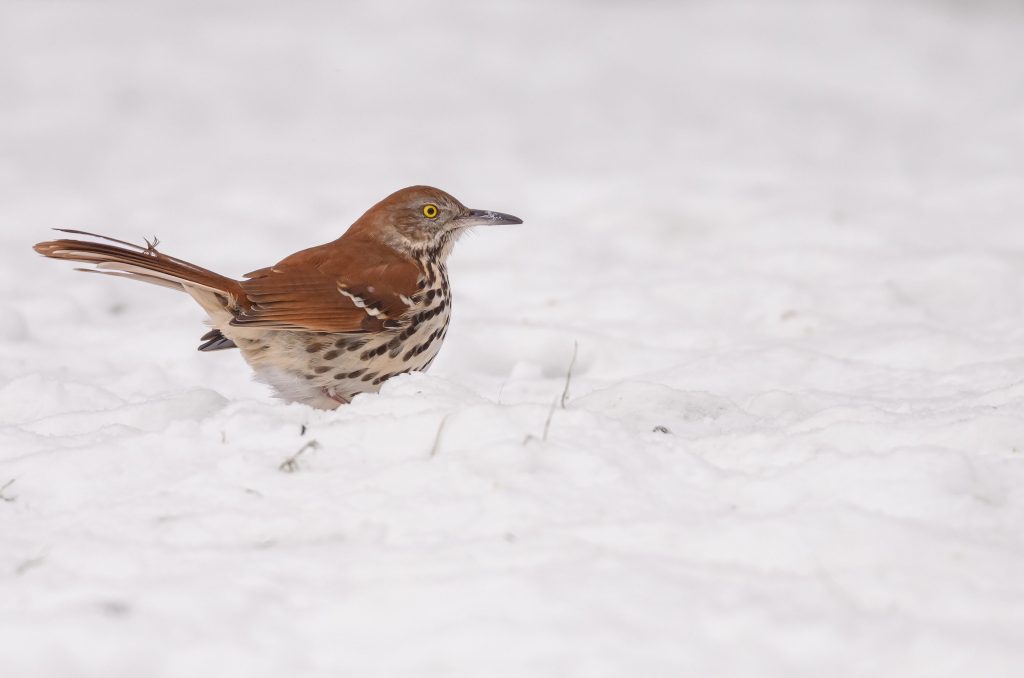
Brown Thrasher by Len Medlock, 1-1-2026, Kensington, NH.