Editor’s Note: This article was originally published in Bird Observer (Vol. 52, No. 4). A special thank you to the Bird Observer for permission to reprint it here, with updates.
New Hampshire’s capital city, Concord, straddles the Merrimack River. Local birders are blessed with multiple access points to the river and its rich floodplain habitats, thanks to the city and local conservation organizations.
This first installment explores five sites clustered around Exits 14 and 15W, from the remnant pine barrens near the airport to the waterbird haven of Horseshoe Pond and the river access at NHTI- Concord’s Community College. Together, they offer exceptional diversity in a compact area and can easily fill a full morning (or more) of birding. To explore more places to bird in Concord, read my second article which highlights birding hotspots from Exit 16 off I-93.
A complete tour of the diverse ecosystems around Concord and in the heart of the Merrimack River watershed starts at the southern floodplains and Concord’s remnant pine barrens. From I-93, take Exit 14 and head east on Loudon Road (NH-9), crossing the Merrimack River. This leads toward the airport and a heavily developed commercial district. In 0.2 miles, turn right onto Gully Hill Road at the shopping plaza. Continue to the edge of a large field (see Map 1, POI 1).
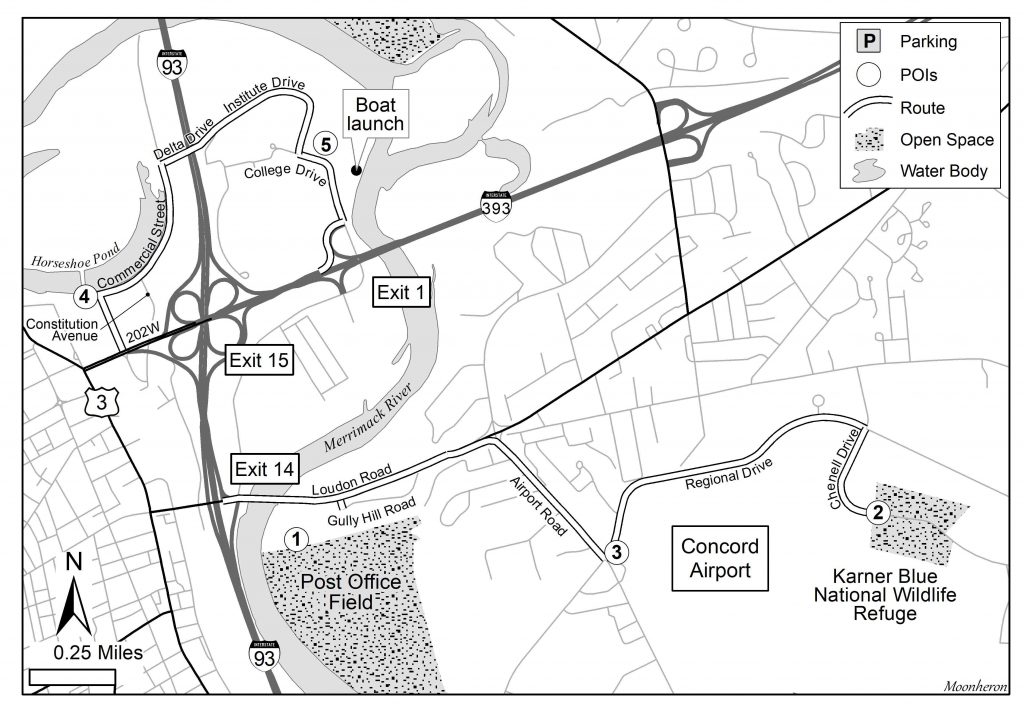
Map 1. Concord, New Hampshire, Points of Interest (POI) 1-5.
Post Office Fields
This field is known to locals as “post office field” because the main Concord post office is in this plaza. At the field, turn right into the parking lot (43.2072, -71.5285). Traditionally this field has been planted in corn, but in 2023 a large portion was converted to sunflowers. Either crop is possible. The best birding tends to be in late fall when sparrows gather in the corn or seeds, along with other open country species such as Horned Larks, Snow Buntings, and the occasional Lapland Longspur. Any of these, particularly the larks, can linger well into winter depending on snow cover.
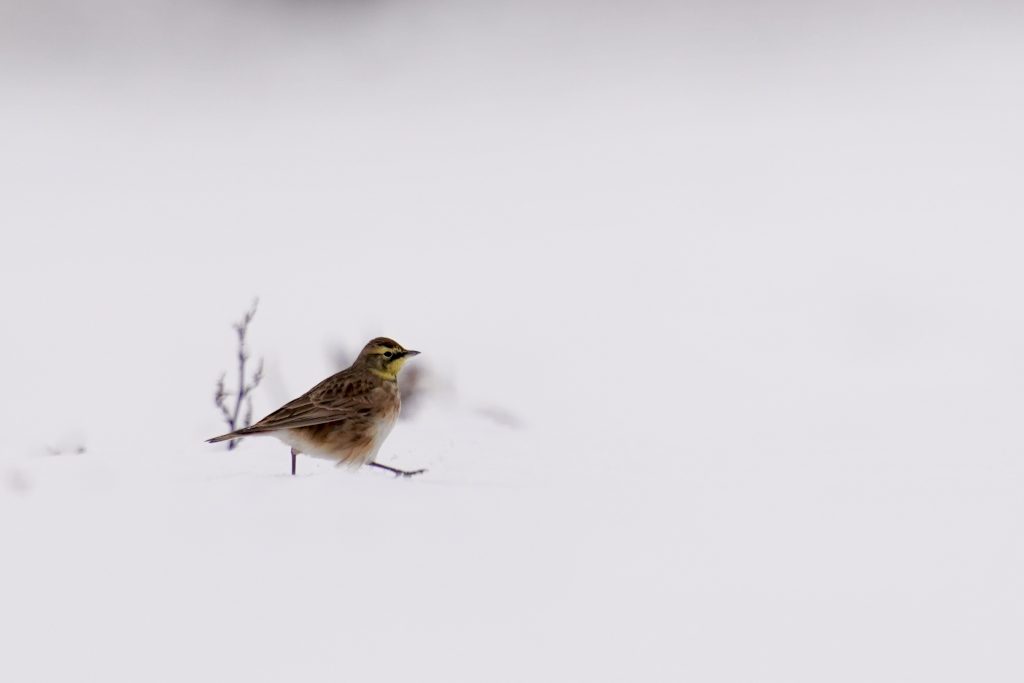
Horned Lark at the Post Office Fields, Concord, NH, by Grace McCulloch.
To the west, you can access the field from the Merrimack River Greenway Trail along the river. This trail connects many of the sites mentioned in this article. To the east, you can follow the north edge of the field. A farm road runs north to south through part of the field as well. Please remember to respect all signage and avoid walking in active cropland. (See the Merrimack River Greenway trail map.)
Along the eastern edge of the field is a small marsh and an area of floodplain forest. These are worth checking, particularly after heavy rains when the wetland complex expands into the fallow cornfields and attracts waterfowl and shorebirds. Unexpected species have included rarer waterbirds such as American Wigeon and Glossy Ibis. One December, there was a Marsh Wren. You can make a loop around the entire site by following the power line between the wetland and river back to the parking lot. Sometimes, in season, the power line has nesting kestrels.
Concord Pine Barrens
To explore Concord’s pine barrens, continue east on Loudon Road for 0.6 miles and turn right onto Airport Road at the traffic light. In 0.5 miles, turn left at the next light onto Regional Drive. Follow this for 1.0 mile, then turn right to follow Chenell Drive for 0.3 miles. The road ends at a gate (43.2083, -71.4952), park along the side of the road.
Beyond this gate is the USFWS Karner Blue Easement (Map 1, POI 2), an area of pine barrens managed for the endangered Karner blue butterfly. Chenell Drive is unpaved within the pine barrens, you cannot drive through. It becomes paved again at the other side. Beware GPS directions for Chenell Drive that might take you to the wrong side. There are also two side trails. The one on the right (south) follows the fence around the Concord airport. It should provide you with a variety of shrubland birds such as Eastern Towhees, Brown Thrashers, and Field Sparrows.
The airport is home to the best populations of Grasshopper and Vesper Sparrows in New Hampshire. Sometimes you can find them perched on the fence or hear them from the grassland within the airport. At dusk, listen for Eastern Whip-poor-wills and Common Nighthawks. Concord is one of only two remaining reliable areas for the state-endangered nighthawk, which nests in nearby developed areas and forages over the barrens and airport. For an alternative view of the airport, retrace your route to Airport Road, then turn left, south, and left again into the parking area. Park at the northern end near an old wooden tower (Map 1, POI 3; 43.2066, -71.5100) and listen. Horned Larks usually breed here starting in March, and this vantage provides another place to listen for them, grassland sparrows, and the increasingly irregular Eastern Meadowlark.
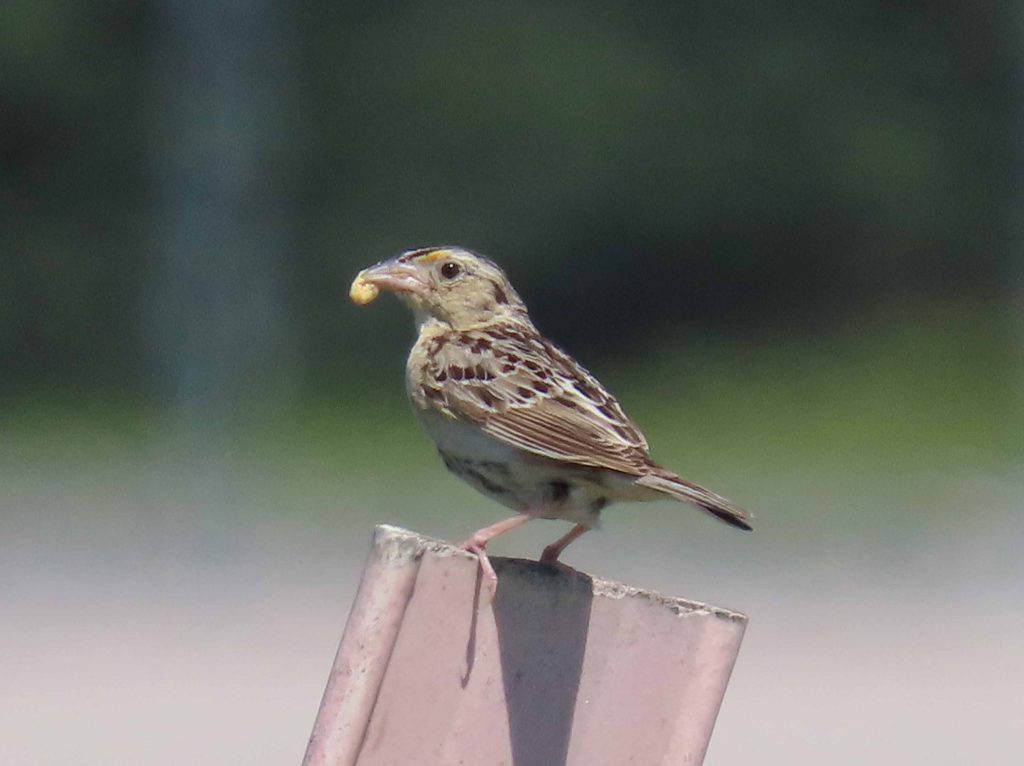
Grasshopper Sparrow by Pam Hunt, 7-19-2024, Concord Airport, NH.
Horseshoe Pond
The central gem of Concord’s Emerald Necklace—shout out to Boston—is Horseshoe Pond, an old oxbow just north of downtown (Map 1, POI 4). The birding can be good at any time of year, 223 species had been recorded on eBird as of February 2026. Horseshoe Pond is most famous for waterbirds. The best times to visit for ducks and geese are March, April, and from August through November, or until the pond freezes. Winter 2023 into 2024, it never completely froze. Twelve species of waterfowl were recorded in January and February.
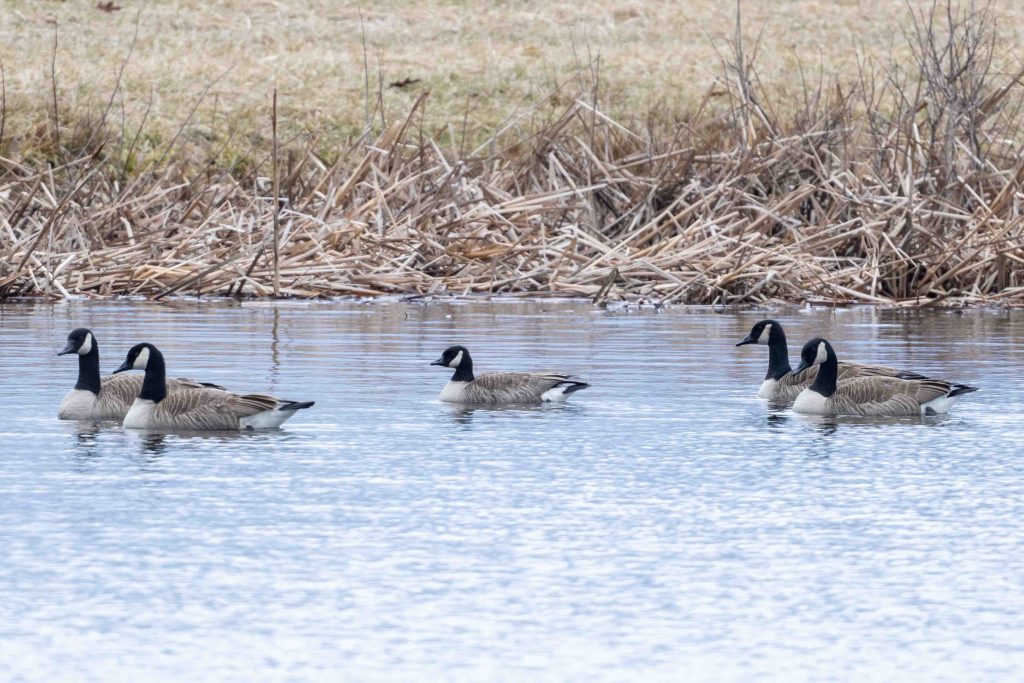
Cackling Goose by Leo McKillop, 4-1-2022, Horseshoe Pond, Concord, NH.
Horseshoe Pond is easy to reach from Exit 15W off I-93. Merge onto US-202 west toward North Main Street (US-3), and in 0.5 miles turn left onto Commercial Street. You can access Horseshoe Pond via several parking lots scattered along its southern shoreline. The westernmost is adjacent to a causeway often used by anglers, a good vantage point to scan the water and adjacent fields (43.2175, -71.5406). As with all the farmland in Concord’s floodplains, these fields are actively used for agriculture. Please respect signage, do not enter fields if they are posted, and avoid walking into crops no matter what. Just to the west of the causeway, you can get a higher view from a railroad grade that also affords a look into another part of the pond. In the past, it was possible to walk the tracks north from here, but that access is currently cut off. Respect the gate across the tracks just north of where they cross a large culvert. The thickets in this area can be good for migrants in season and have hosted rarities such as White-eyed Vireos and a spring Lark Sparrow.
The best way to bird the rest of Horseshoe Pond is to walk or drive east along Commercial Street. If you drive, after you pass Constitution Avenue (43.2196, -71.5359), park in any of the large lots along Commercial Street. These are rarely full, and you can walk across the street to scan the pond and fields at multiple locations.
The key species to search for in this stretch are waterbirds, which can be in the pond or the grassy fields beyond it. During March and April, the flock of Ring-necked Ducks may approach 100 birds. It is always worth sorting through them for a bonus such as a Canvasback or Lesser Scaup.
A Pink-footed Goose was found among Canada Geese in March 2020. In late April and early May, check the swarms of Tree Swallows and for Purple Martins or Cliff Swallows, both rarities for Concord. If there are gulls around, particularly in spring, keep an eye out for species other than Ring-billed Gulls. Herring Gulls are much less common, and any other species would be a bonus. Tropical Storm Irene deposited a Black Tern here in August 2011.
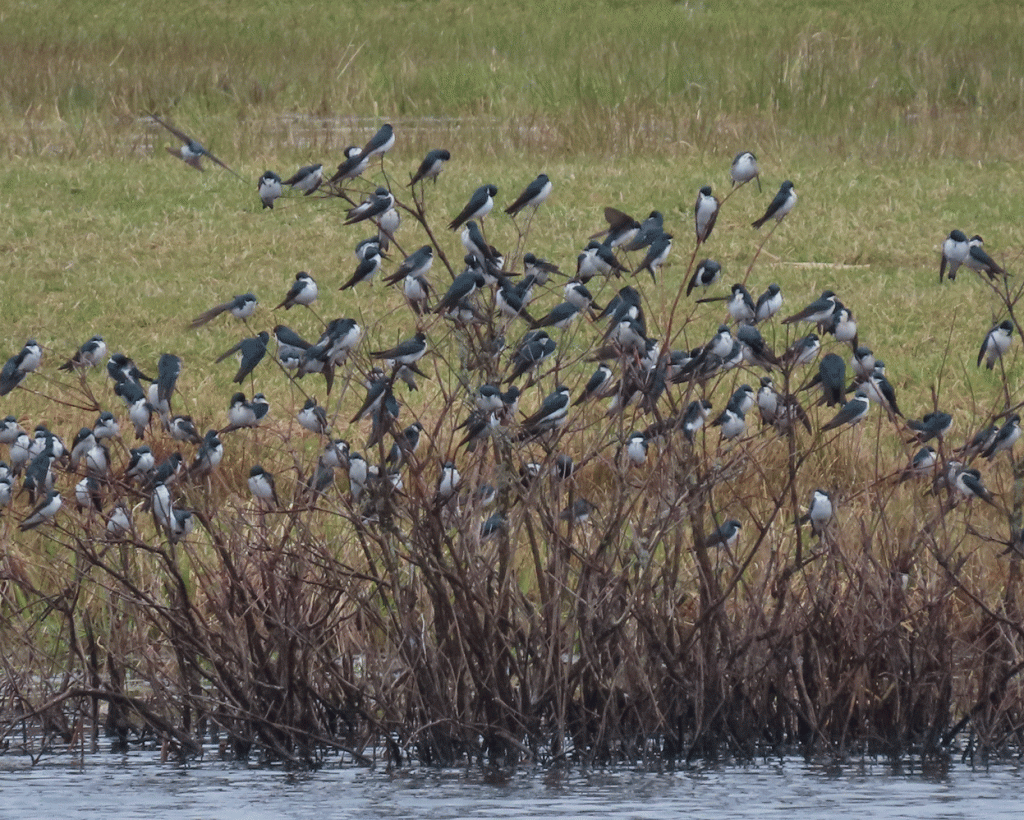
Tree Swallow flock by Pam Hunt, April 11, 2024, Concord, NH.
Across from the pond on Constitution Street, the entrance to the Grappone Conference Center is worth checking in late fall and winter. The mix of fruiting trees and dense conifers planted here sometimes attracts lingering migrants. In November 2022, this area hosted a Baltimore Oriole, Lincoln’s Sparrow, Yellow Warbler, and Northern Parula over a couple of days. If fruit persists and it is an irruption year, watch for Bohemian Waxwings and Pine Grosbeaks.
The easternmost portion of Horseshoe Pond is a shrubby wetland that often hides dabbling ducks and sometimes rarities such as Glossy Ibis. If the water is low in late summer and fall, check this area for shorebirds. They can easily blend in against the lily pads left stranded by the receding water. Access this area from the final parking lot on the right (43.2221, -71.5355), just before the stop sign at Delta Drive. If you continue through this intersection, you will come to a small white building on the left. The trees and shrubs here can be another excellent place for migrants, primarily in May. This area was reliable for Orchard Oriole, near the northern edge of its range in Concord.
NHTI: New Hampshire Technical Institute
Turn right, east, onto Delta Drive. Shortly you will enter the campus of NHTI, Concord’s Community College (Map 1, POI 5). (See campus map.) Delta Drive becomes Institute Drive as it loops around the campus’s parking lots and athletics fields. At the stop sign, turn left onto College Drive. Just past the baseball field is a boat launch (43.2228, -71.5250) on the Merrimack River that is worth checking in spring. Early in the season, when there may still be ice in the backwaters across from the launch, migrant ducks sometimes congregate in the slower water. In late April and May, you may be surprised by unexpected waterfowl such as a Long-tailed Duck. For a different birding experience, put a canoe or kayak in the river and paddle around the wooded island directly in front of you and to the left. Depending on the time of day, you may be the only person on the water. The northern edge of this back channel abuts the floodplain forest conserved by the Society for the Protection of NH Forests (SPNHF).
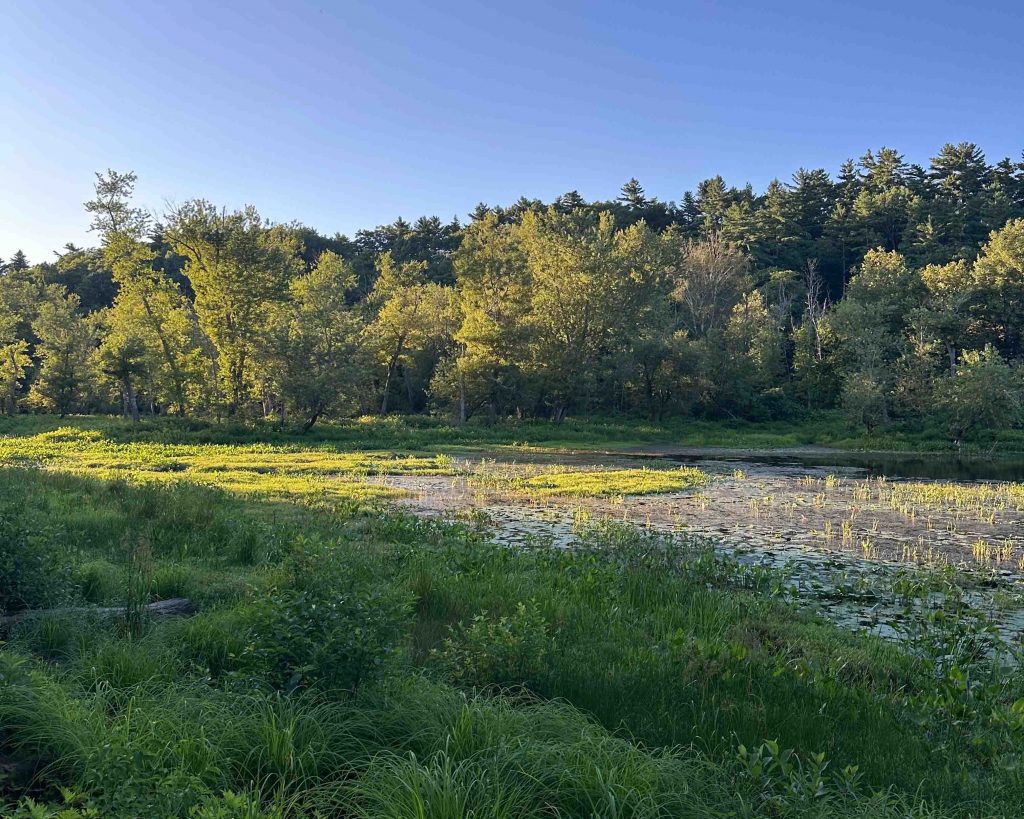
Marsh explored by paddling from the NHTI boat ramp by Grace McCulloch.
Across the street from the parking for the launch, encircled by another oxbow pond, are the Sycamore Community Gardens and a large weedy field. There are paths around the edge of the field. This area is under-birded, but can be good in fall for sparrows. Sometimes the local Peregrine Falcons perch in the massive sycamore—the community garden’s namesake. After you finish birding the garden and boat launch, continue along College Drive to merge onto I-393 West to I-93.
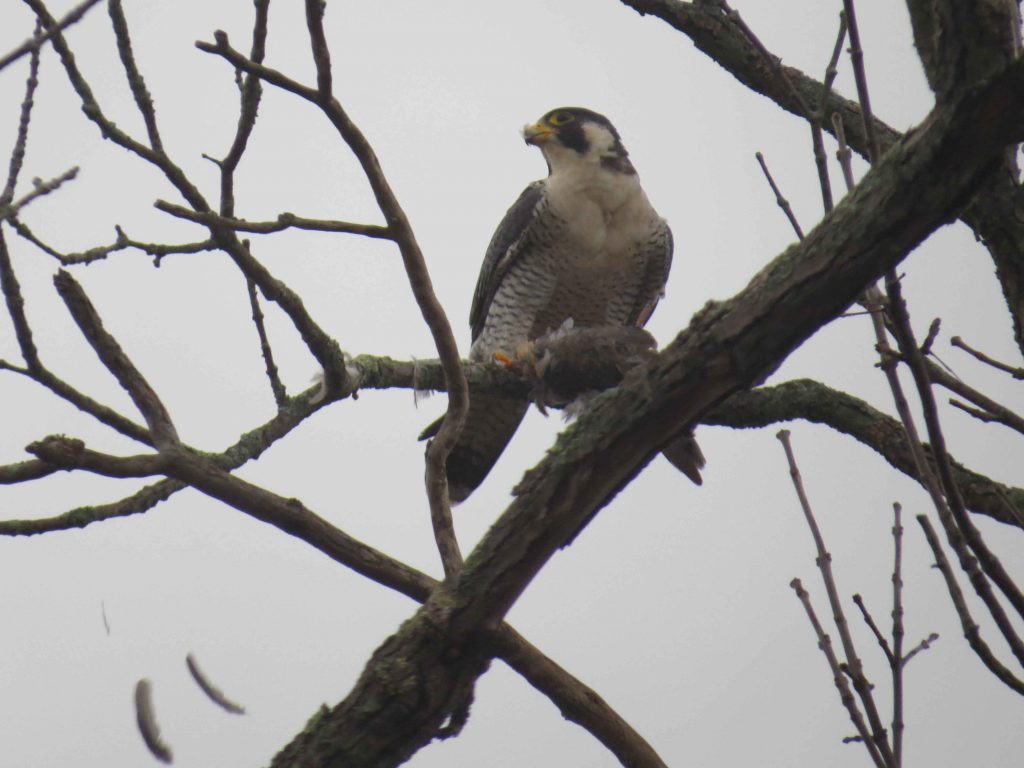
Peregrine Falcon feeding by Pam Hunt, 10-28-2014, Concord, NH.
Continue Exploring
These five sites represent just one section of Concord’s rich floodplain corridor, yet they regularly produce impressive species lists across all seasons. Whether you’re scanning Horseshoe Pond for diving ducks, listening for nighthawks over the pine barrens, or sorting through sparrows in fall fields, this stretch of the Merrimack rewards careful observation.
In Part Two, we’ll head north to explore West Locke Road, the SPNHF floodplain forest, Turtle Pond, Sewall’s Falls, and Morono Park, a collection of habitats that expands the possibilities even further.