
Who: Talia Kuras, Ph.D. Student, University of New Hampshire
What: Saltmarsh Sparrows: Breeding activity, nesting success, and habitat restoration.
Where: Parker River National Wildlife Refuge in Newburyport, Massachusetts, Rachel Carson National Wildlife Refuge in Wells, Maine, and several Seacoast New Hampshire marshes.
Why: Continued research on this species is important to understanding and supporting its survival in a highly unique environment responding to climate change.
When: This research has been going on since ~2010.
The Saltmarsh Sparrow (Ammospiza caudacuta) is endemic to the East Coast. Rising sea levels threaten its tidal marsh habitat, putting this species in a vulnerable position.
Last June’s Bird of the Month article highlighted this species. In the article, NH Audubon’s Senior Biologist for Avian Conservation, Pam Hunt, notes that “in a system finely tuned to allow successful nesting between monthly ‘king tides,’ any rise in the baseline water level could result in widespread reproductive failure.” Given the delicate balance between the sparrow’s habitat and its reproductive success, Hunt adds, “It should come as no surprise that Saltmarsh Sparrow populations are in steep decline and may disappear from a large portion of their range by the end of the century.”
Regular population monitoring, conducted in collaboration with the Saltmarsh Habitat and Avian Research Program (SHARP), is imperative to a continued understanding and study of tidal marsh birds. University of New Hampshire (UNH), Ph.D. Student Talia Kuras plays a key part in this dedicated research. Her work introduces new marsh restoration techniques and tracks sparrow behavior.
The Kovach Lab that Talia is a part of, as well as its research collaborators at SHARP, NH Fish and Game, and the US Fish and Wildlife Service, have been monitoring the New Hampshire Seacoast’s Saltmarsh Sparrow populations in some capacity for the last decade. In some sites, monitoring has been going on for the last 15 years. “Much of the data collected over these years,” Talia explains, “has been used to help develop marsh restoration priorities and plans, to help us best restore marshes with Saltmarsh Sparrows in mind.”
Talia, a second year Ph.D. student, received a Bachelor of Science from the University of Massachusetts-Amherst. Her undergraduate research studying Song Sparrows set the stage for her future sparrow research. Following college, she worked bird-related field jobs in coastal Massachusetts and central Florida, surveying nests of protected species like Florida Scrub-Jays and Piping Plovers. Eventually, she found her way back to sparrows.
Talia began researching Saltmarsh Sparrows at UNH for her Master’s degree and continues that work today. “They’re really incredible birds,” she says. “They nest on the ground in highly dynamic salt marshes that are regularly filled with water during daily and monthly high tides. Females will build a nest, lay their eggs, and attempt to raise their young in the tight 28-day window between monthly high tides that can cause their nest to flood and fail.” Talia mentions females specifically because Saltmarsh Sparrows do not pair bond. Males and females meet to mate, but the females are the sole caretakers for the offspring. Females mate with multiple males, so multiple paternity is quite common. Sparrow eggs in the same nest can have different fathers.
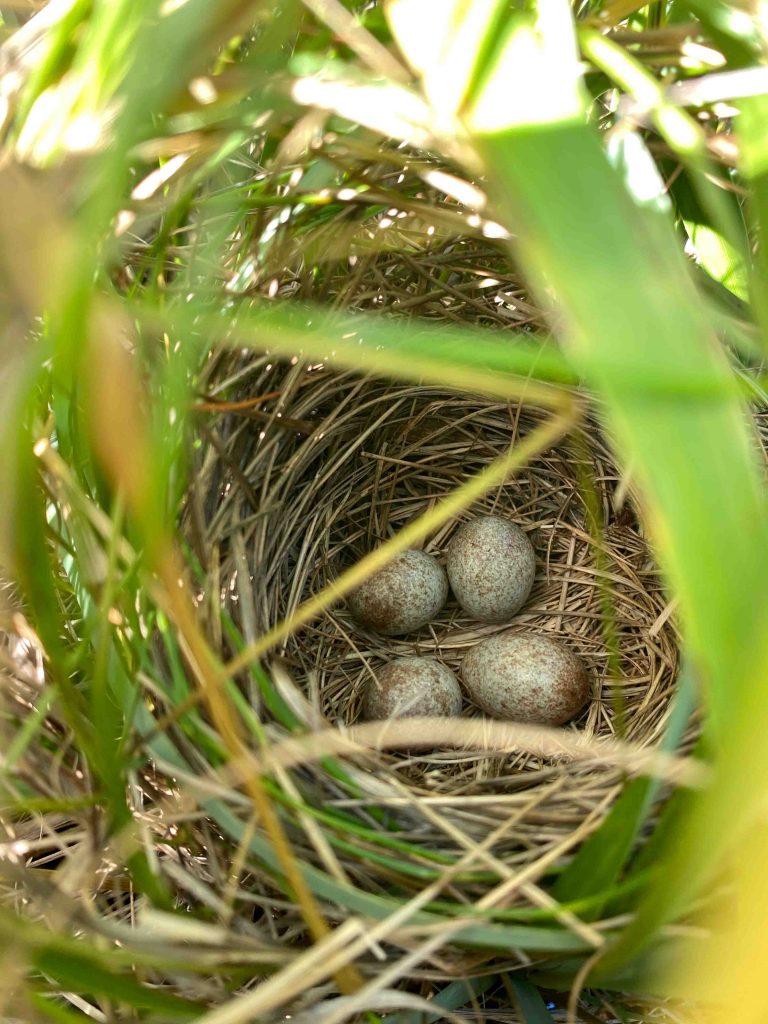
A carefully constructed Saltmarsh Sparrow nest in the grasses of the marsh. Photo by Grace McCulloch.
So we could learn from Talia firsthand, she shared with us a day of fieldwork at Lubberland Creek Preserve in Newmarket, NH. It is a “pre-restoration” site and basic monitoring there establishes baseline information about sparrow breeding populations. Basic monitoring involves various forms of field research. In point counts, an observer stands at a fixed location for a set amount of time and records all birds seen or heard within a defined area. There is also mist netting, where birds are safely captured for banding, data collection, and tracking.
A Day in the Life
Like many ornithologists, Talia begins her workday well before sunup. Most of the day’s fieldwork takes place before lunchtime.
~4:00 am: I wake up, get dressed, make my coffee, and grab the smoothie I made the night before. Then, I hop in my car and put on my fieldwork playlist. It’s mostly 2010s pop with some newer Taylor Swift, Sabrina Carpenter, and Lady Gaga. I drink my smoothie and coffee while I drive to pick up my field crew.
4:30-4:45 am: I make stops to pick up crew members in Hampton and Greenland, NH. There are four of us total on this crew. We discuss the plan for the day as we drive to the site.
5:00 am: We arrive at the Lubberland Creek Preserve parking lot, unload our mist netting gear, and put on our hip waders; they’re like big rubber boots. They help keep us (mostly) clean and dry as we work in the marsh.
5:10 am: We begin the hike from the parking lot to the marsh. We follow a deer trail that skirts the edge of a farm field and we push through a row of invasive common reed (Phragmites australis). Then, we head to the relatively dry section of the marsh, where we’ll set up our banding station. In preparation, we divide our gear. Everything needed for bird handling will stay here; everything needed for mist netting gets packed up so we can bring it to where we’ll set up our mist nets. Mist nets are thin mesh nets that safely capture flying birds.
5:20 am: We set up mist nets by placing the extendable net poles in the ground and stringing our thin 12m long nets between them.
5:30 am: Time to open the nets! We mark this on our data sheet and walk back to our banding equipment.
5:30-5:45 am: We set up the banding station by laying a tarp on the marsh grass. On top of the tarp, we arrange our bird banding equipment. We have United States Geological Society (USGS) metal identification bands, pliers to apply them, and calipers, rulers, and a scale to collect physiological measurements for each bird. We also have tools for collecting blood samples from our banded birds, and the radio tags we deploy at this site. We pull out the datasheets where we’ll record information about each bird, like band number, sex, age, radio tag ID, and more.
5:50 am: Our first net check. Saltmarsh Sparrows don’t always fly into the nets on their own, so we carefully walk up to the nets while clapping, herding sparrows as we go. They fly into the nets and we carefully extract all captured birds. They go into individual cotton drawstring bags tied off at the top and we bring them back to the banding station. On an average day, we capture one to three sparrows per net check.
6:00 am: We begin processing the birds we captured. Females and hatch-year birds get top priority. Females may have nests to tend to and hatch-year birds may still be hanging around with their mothers. First, we’ll check the bird for a USGS metal band. If they weren’t previously banded, we’ll band them. Then, we take a series of morphological measurements and blood samples for each bird. From there, we place the bird in a special tube that helps us measure its weight. If it weighs less than our target weight (~17.5 grams) we release it. If it’s above our target weight, we carefully remove it from the tube and attach a small radio tag. It fastens to the bird via loops that hook around each leg and over its back. Once the tag is attached, we release the bird. We repeat this process with each bird we capture.
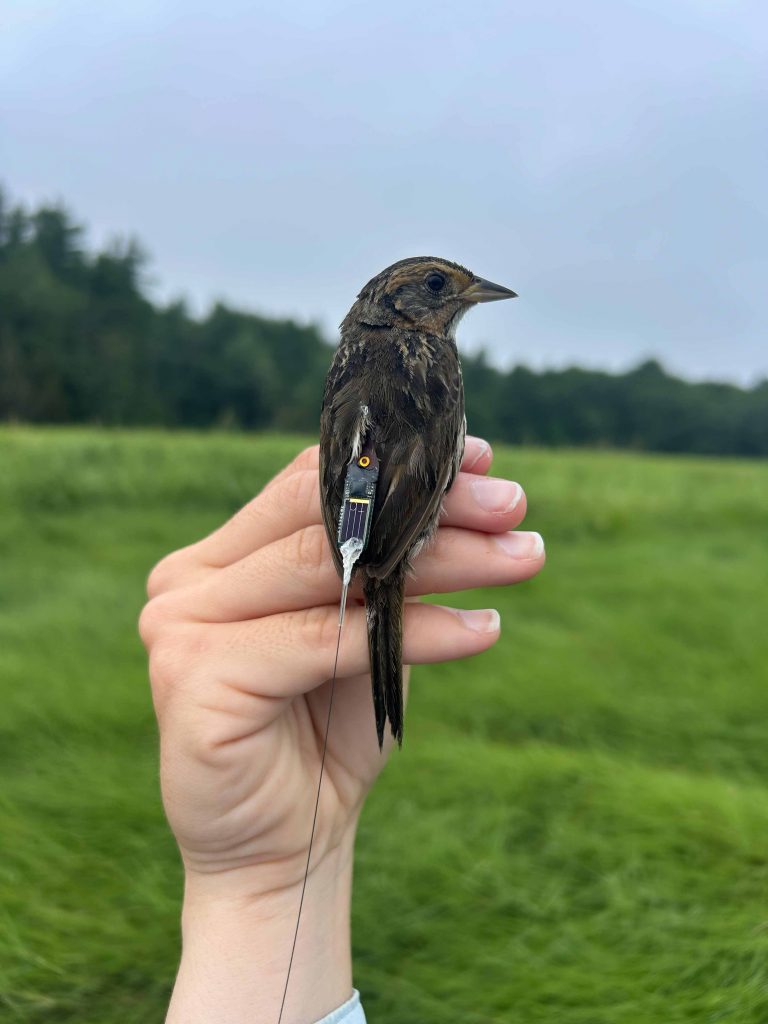
Saltmarsh Sparrow with radio tag by Talia Kuras. These tags help track the bird’s movement during the breeding season and migration, providing essential knowledge to support species conservation.
6:15-9:30 am: We check the nets every 15 minutes, or every time we see a bird go into the net. As each bird comes in, we process it. Typically, around 7 or 8 am, we take a brief snack break.
9:30-10:00 am: Once the birds have slowed down, we close the nets and pack up our banding station. This typically happens around mid-morning.
10:00-11:00 am: We split up and walk around to each nest that we’re monitoring at this site. At each nest, we record its contents, noting the number of nestlings or eggs present and whether the female flushed off the nest as we walked up. We also search for new nests along the way.
11:00-11:30 am: We make our way back to our packed-up banding equipment and hike back to the car.
11:30-11:40 am: We pack up the car, pull off our waders, and head out.
12:00-12:15 pm: I drop the crew back off at their housing.
12:15-1:00 pm: I eat lunch and rinse off.
1:00-2:00 pm: My crew members and I enter the day’s data into various databases that we use to track our progress throughout the summer. Each crew member is assigned to enter certain types of data into certain places. Sometimes, I also take meetings and answer emails during this time.
2:00-8:00 pm: Walk the dog, relax, cook dinner, prep my smoothie for the next day, and take care of any non-work-related tasks for the day. Answer some emails here and there. Then its bedtime so I can do it all again the next day!
A Restoration Future
Talia’s fieldwork tracks the behavior and survival of a sparrow specialized to thrive in tidal marshland as it responds to a changing climate. “Restoration plans and timelines for this site have not yet been finalized,” says Talia, “but I’m very excited to see where they go in the future.”
Saltmarsh Sparrows are an “indicator species” for marsh health because they nest on the ground. Talia explains that healthy marshes have appropriate elevation gradients and “are able to drain well after flooding events.” This leads to healthier sparrow populations.
Human development and climate change have altered marshland ecosystems. They’ve made marshes less healthy. Saltmarsh Sparrow populations have dropped significantly. The overarching goal of marshland restoration projects is to re-establish the ecological integrity of degraded wetlands. This will benefit both birds and humans.
Salt marshes are critical for humanity. They store carbon, filter water, and minimize the impacts of coastal storms. Not only that, but they provide habitat for species like ducks, fish, and crabs, and provide recreational space for activities like kayaking and fishing. “So, making sure that our sparrows and their marshes are healthy is a win-win for everyone,” Talia explains.
Talia is involved in several other projects deploying innovative restoration techniques. One technique utilizes automated radio telemetry to track Saltmarsh Sparrow space use at three sites in the Seacoast region where a new restoration technique is being piloted: marsh microtopography features. Talia describes these features as “mounds of sediment that are made from refuse from other marsh restoration methods.”
“The idea behind these microtopography features is that they’ll serve as nesting habitat “islands” for Saltmarsh Sparrows, Talia explains. They are high enough above the tide line to protect nests from flooding, but low enough in elevation that they are safe from predators or invasive plant species.
Marsh restoration practitioners, such as environmental engineers and staff biologists at Ducks Unlimited or National Wildlife Refuges, design and execute restoration activity. Talia explains one of the popular methods as “runnelling.” Practitioners dig small channels connecting large pools and areas of standing water back to their original source with the goal of restoring natural waterflow to and from the pools. The leftover peat from these processes is packed into mounds around runnels, creating small, island-like areas with potential for nesting. A crucial part of Talia’s research is examining if and how sparrows use these mounds.
While it’s still early in the research process, Talia and her team have tagged 118 birds across three field sites and are looking at how these birds use restoration areas. “We’re seeing some patterns where birds are avoiding certain restored areas, at least in the first breeding season post-restoration,” Talia says. “It’ll be interesting to see if or how that changes over time.” There is much work still to do before any big takeaways can be made about marsh restoration’s impact on sparrows, but Talia has noticed changes firsthand at some partner sites after restoration, because of what she describes as “some pretty simple restoration actions.” This past summer, Talia revisited a site after two years and was pleasantly surprised at the conditions as she prepared herself for waist-deep mud.
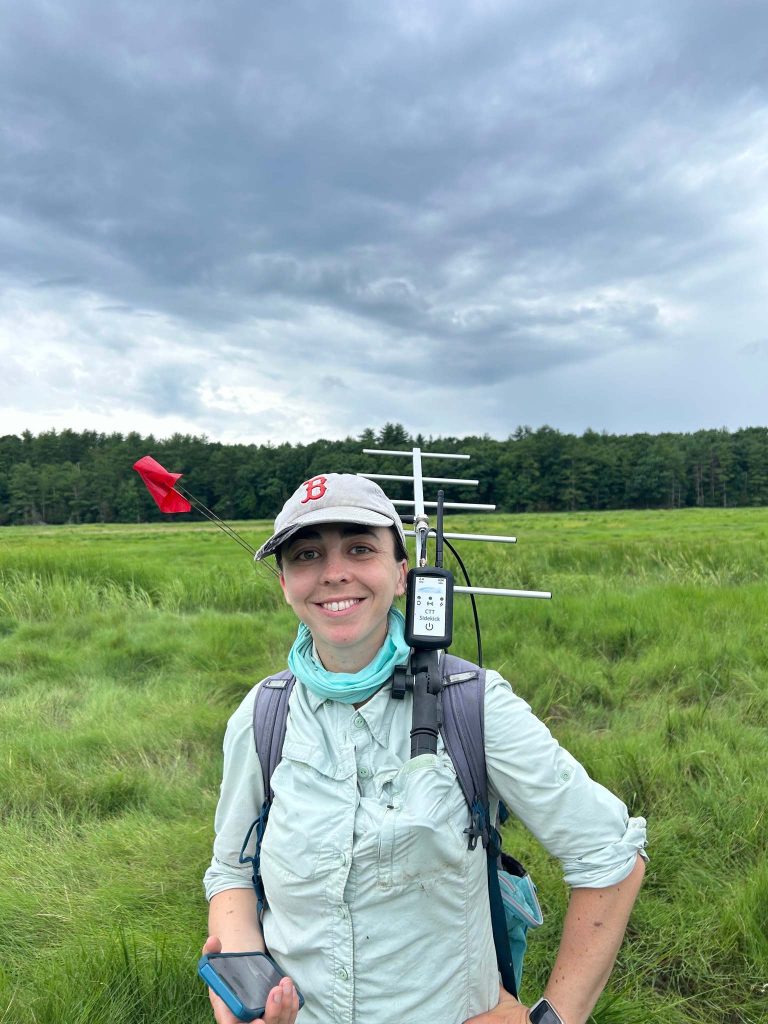
Talia Kuras in with a portable radio tracking antenna for tracking fine scale Saltmarsh Sparrow movements. Photo by Kara Cole.
“That first step into the marsh was solid,” Talia notes. It was dry, by marsh standards, and there was marsh vegetation growing where there’d only been wet muck before. Talia can confidently say, “the restoration work that our partners are doing is definitely making a positive impact on our marshes, and hopefully our sparrows as well.”
Talia, her colleagues, researchers, and volunteers, are drawn to this work because it is directly applicable and makes a noticeable impact. “The data I collect is being used directly to help monitor and preserve this species, which is pretty exciting,” she says. Talia’s dedication to Saltmarsh Sparrow research, as well as her in-depth knowledge, accumulated over years of experience, gives insight into the factors upon which this sparrow’s survival depends.
Resources & Further Reading
NH Audubon article
Hunt, Pam. “Bird of the Month: Saltmarsh Sparrow.” New Hampshire Audubon, June 5, 2025. https://nhaudubon.org/bird-of-the-month-saltmarsh-sparrow/.
Saltmarsh Habitat and Avian Research Program
“Saltmarsh Birds.” TidalMarshBirds.org. Accessed February 16, 2026. https://tidalmarshbirds.org/.
NHPR article
Vaz, Julia. “Birds in Tiny ‘Backpacks’ Might Provide More Insights to New England Marsh Restoration Projects.” NHPR (New Hampshire Public Radio), July 7, 2025. https://www.nhpr.org/nh-news/2025-07-07/marsh-restoration-nh-new-england-sparrows-research-preservation.
Seacoast Online article (restoration)
Huber, Bridget. “Saving Wells salt marshes with sand: Maine tests new restoration techniques” Seacoastonline, October 3, 2025. https://www.seacoastonline.com/story/news/local/2025/09/23/saving-salt-marshes-with-sand-wells-maine-tests-new-restoration-method/86290205007/?gnt-cfr=1&gca-cat=p&gca-uir=true&gca-epti=z113111p001050c001050v113111d–51–b–51–&gca-ft=199&gca-ds=sophi