Editor’s Note: The Superbowl of Birding is an annual event hosted by Mass Audubon. The contest challenges teams to spot as many bird species as possible during a 12-hour period in Rockingham County, NH, and/or Essex County, MA. Some teams (including the WILD CARDinals) compete for the coveted Townie Award, focusing their efforts on a single town to record the highest number of species.
The alarm went off at 3:30 am and the cats, who like their sleep too, looked puzzled. Katie and I stumbled silently around the kitchen making sandwiches and glancing at the clock to make sure we could meet our team at the Rye Recreation Area for our 5 am kickoff. We were competing for the Townie Award, which meant that we had to complete all of our birding in one town. We had chosen Rye, as we have done every year since 2023, with its combination of coastal, marsh, and woodland habitat. Given the snowdrifts and subzero temperatures, there was a large part of my brain saying, “Wait, we’re gonna do what?”
We rushed out to the car in the dark, thankful for heated seats. Arriving at the Rye Recreation Area a minute late, we met up with Ashton Almeida, who’s been with the team every year, and Scott Heron, who agreed to join us this year. As we stepped out of the car, we immediately heard a Great-horned Owl with its deep, resonant call you can feel in your chest. Then another owl answered it from another direction. The temperature was -4 degrees Fahrenheit (-20 Celsius). We walked into the woods a bit, and Ashton, our Saw-whet Owl whistling specialist, started making the distinctive toot. No response. We waited. No response but the persistent call of the Great-horned. This part of the day always seems to go in slow motion. I did my impression of a Barred Owl call and again got no response. We waited in the cold a few minutes and then piled in one car and drove to Massacre Marsh.
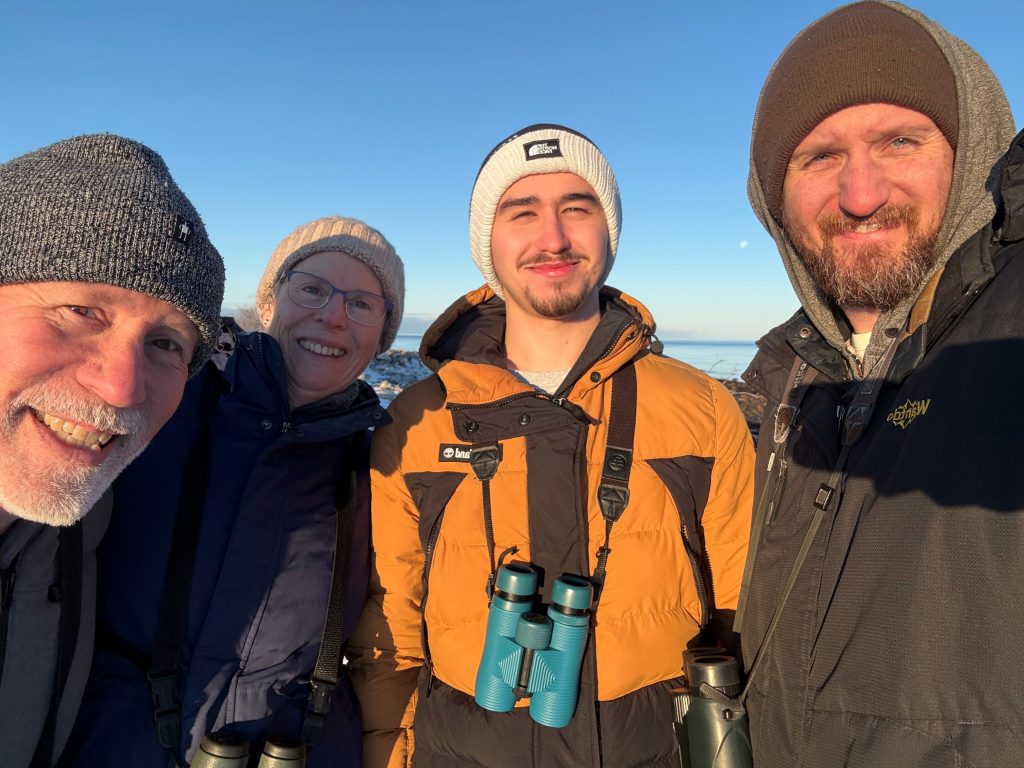
The WILD CARDinals team! Left to right: Jim Sparrell, Katie Towler, Ashton Almeida, and Scott Heron.
There were two other teams already at the marsh, and a Great-horned calling. No response to Ashton’s Saw-whet calls. Then the Fourth and Longspurs showed up, and we exchanged hugs in the darkness. Thanks to Steve Mirick, who did his screech owl call, we eventually heard one answer from across the marsh. Our team decided to try Love Lane for Saw-whet Owls. Scott and Ashton heard one give a toot right when they got out of the car, but I was busy getting a sip of tea, and Katie hadn’t heard it either. Ashton did some more tooting, and finally we all were able to hear an identifiable response. Three owls for the day! That tied our best year. We tried another spot for Barred Owl but got no response. As we drove toward the coast, we speculated about what our first non-owl bird of the day would be. Some dark outlines of ducks went unidentified. At our last owl spot, our first birds were Northern Cardinals calling from multiple directions.
As daylight came, the pace of the day sped up dramatically, although the temperatures remained bitterly cold. At least there was not much wind. We went to Sawyer’s Beach, which was our best chance for American Pipits that had been around when we scouted. A scan of the beach and the wrack, with a tidal line covered in ice, didn’t show anything. I decided to walk the lengthy beach to see if any birds would pop up. Sure enough, one pipit took off pipping loudly and flew low past the whole team. This was a good bird for these weather conditions. At Ragged Neck, we had a nice flock of Horned Larks that were in the wrack and a few Snow Buntings flying around. No sign of Purple Sandpipers or Sanderlings after what felt like a death march through the snowdrifts and bone-chilling cold out to the point.
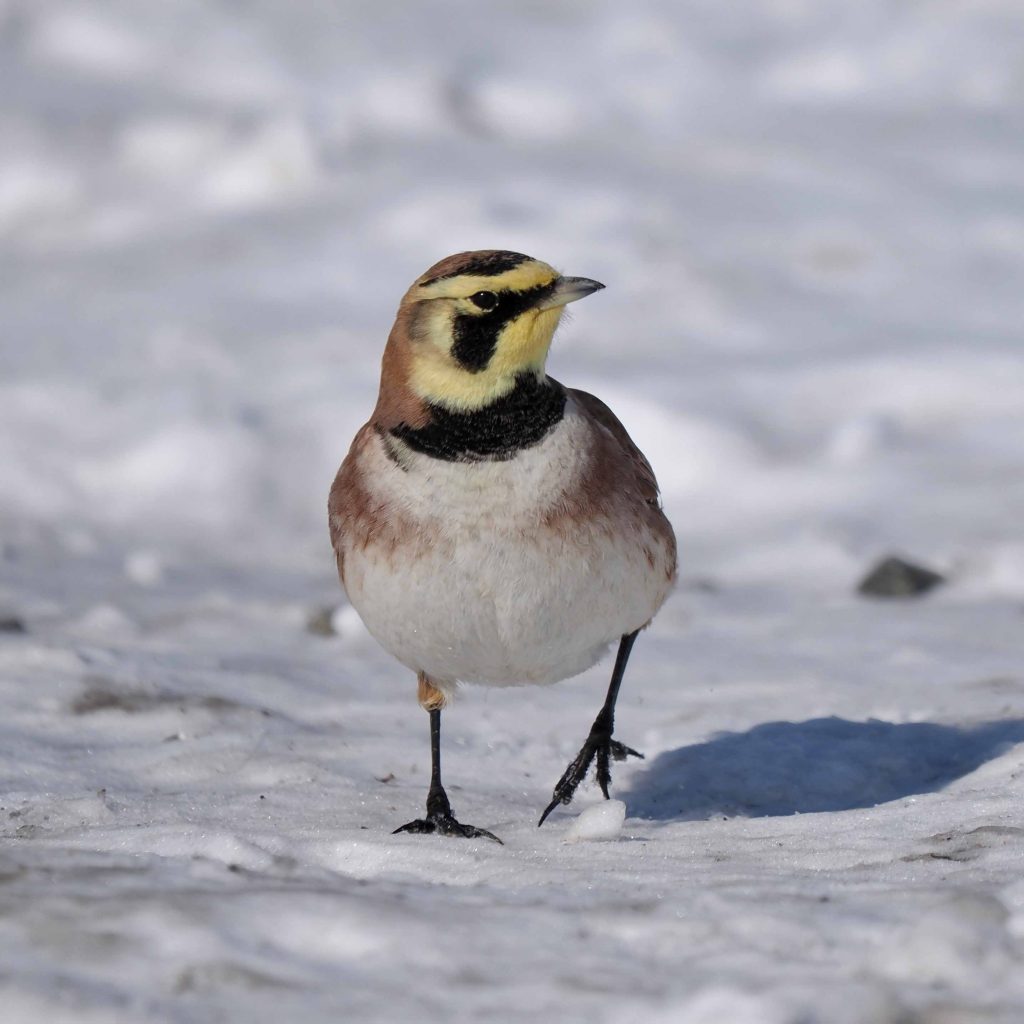
Horned Lark by Jim Sparrell.
It was time for a break, as it was just after 7 am, so we popped into Common Roots for tea and a few snacks. It was nice and warm, and there was a very sweet dog named Sadie who came over to say hello. We managed to launch ourselves back into the cold which did not seem to be budging despite the appearance of the sun.
It was 8 am and time to do some feeder watching, more tolerable from the warmth of the car. We happened on some active feeders with a flock of Eastern Bluebirds and a Cooper’s Hawk nearby. Gradually, we were seeing most of the feeder birds we could expect to find. Some robins and starlings were coming to fruit trees near Webster at Rye. We ended up on West Road at Bud’s, who is possibly one of the nicest people on the planet. He has many feeders at the front and back of his house. We had a flock of bluebirds sitting in the sun that looked like they were frozen in the treetops. After waiting a while, we saw a flash of yellow and then another, and the two Pine Warblers that Bud had been reporting came in. We walked the road, and Scott picked up the call of a Brown Creeper that we were all eventually able to see. From there, we headed to a thickety spot that has sheltered catbirds, Hermit Thrush, and other half-hardy species in the past. No luck with those birds, but there were Golden-crowned Kinglets, hyperactive as ever. We walked up a hill that is home to many bluebird boxes and beehives and had our first White-throated Sparrows of the day. Always nice to see them in the winter. As we got in the car, Ashton, who was keeping our lists, commented, “I think we’re doing pretty well,” but it was hard to judge whether we would pass last year’s count of 56 birds, or not, particularly given the tough conditions.
Back in the car, we checked a spot where some Red-winged Blackbirds had been seen on scouting trips that week. No luck. Then, as we turned around and drove out, Ashton spotted two black blobs high in a tree that could have been Starlings. After a bit of scrutiny, we could see distinct red and yellow wing-bars – success! We realized that we had done almost nothing yet to find sea ducks and gulls, so we cruised along the coast. There was one open water channel that had been iced over in the morning. Now it had opened up a bit, and Scott spotted a nice pair of Common Mergansers and on the other side, a little group of Hooded Mergansers. At a couple of stops, we gradually saw most of the expected sea birds, but we never did find a Red-throated Loon. At Seal Rocks, Scott picked out one Purple Sandpiper in close on the rocks that we were all able to enjoy.
We stopped at Odiorne at noon where the temperature was now up to a balmy 18 degrees Fahrenheit, which actually did feel almost warm. We were hoping to see Razorbills as we scanned, but had no luck, although there were four Black Guillemots scattered around the harbor. I was eating my sandwich as the team decided to head to Chat Cove through the snowdrifts to look for a Northern Mockingbird. I trailed along behind this mutiny but then lost footing and flopped over in the snow. I managed to get up, although I think I looked like some kind of frantic squirrel flailing about. I retreated to the safety of the parking lot. The team returned without a mockingbird, and we pressed on.
As we passed Wallis Sands Beach, Scott called out a bird on the wire that might have been a Northern Mockingbird. We circled back, and there it was, a cheerful mockingbird perched up in the sun. We checked for Sanderlings or any interesting gulls at Sawyer’s and Jenness Beaches without success. Given that the day seemed to be going okay, we agreed to temporarily abandon our quest for birds in Rye and take a detour to Hampton to see the female Painted Bunting that had just been reported the day before. The homeowner graciously allowed birders to visit on Saturday only. We were amazed by the homeowner’s devotion to landscaping and bird feeding evident in this beautiful yard chirping with bird activity. There was a nice Rusty Blackbird at one feeder, and after a bit of a wait, the bunting came in to a feeder, giving us all a nice look.
We climbed back into the car and debated strategy for the remaining birds we might still find in the waning afternoon. We headed back to Bud’s feeders and met up with the 4th and Longspurs, who were hoping for the Pine Warblers to return. We were able to find both nuthatches and an American Tree Sparrow under the feeder. From there it was back to the coast (again!). Driving along Eel Pond, I noticed something large and dark in the center of the ice and thought it might be a Bald Eagle, but no, it was a beautiful coyote trotting along the length of the pond. Cruising around the Rye Harbor parking lot I spotted a hawk perched up and said, “Oh, there’s the Red-tailed we had this morning.” Ashton and Scott immediately said, “No, wait, that looks like an adult Red-shouldered.” Indeed it was! We finally found a few Sanderlings at Rye Harbor and south of Sawyer’s Beach, after searching for this species repeatedly throughout the day. It was a little after 4 pm, and we headed back to Rye Recreation Area to finish where we had started. We walked into the woods on one of the packed trails. I hooted for a Barred Owl but still no response. By now, it was almost 5 pm, and we headed back to the car. We all stopped when Ashton thought he heard something that turned out not to be a bird, but fortunately he looked up to find a Barred Owl perched above our heads silently watching us, just a few feet away. A fitting end to a wonderful day of birding. I commented to Ashton at the pizza party, “I can’t think of a day of the year that I dread more and end up enjoying so much.”
Totals
- 64 species
- 106 points
The previous Superbowl Record for Rye appears to be 63 species.
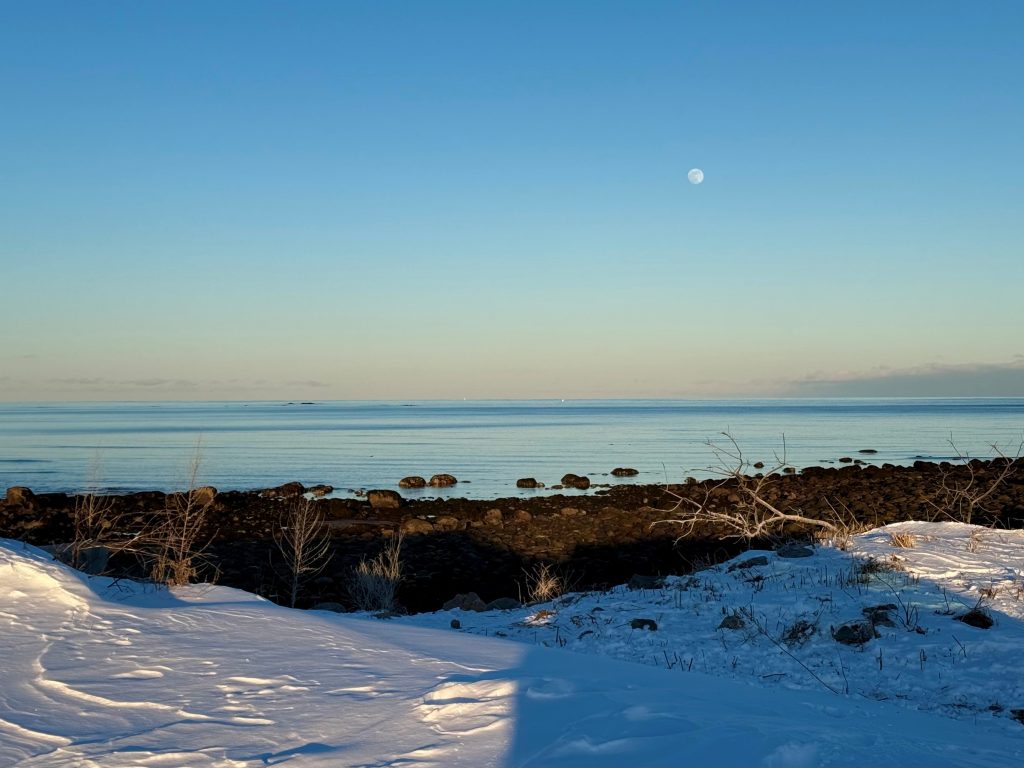
The WILD CARDinals were treated to a beautiful (almost) full moon. Photo by Jim Sparrell.
Editor’s Note: The WILD CARDinals took home the Townie Award! You can read another account of the Superbowl of Birding here by the Twitchers.