
(on which we found a ton of birds, possibly literally)
Word problem: If one phalarope weighs about 1.5 ounces (on the average), how many phalaropes does it take to equal one ton?
Memorial Day 2025, New Hampshire Audubon and Granite State Whale Watch hosted the annual spring pelagic-birding trip. We went out there for the day to look for birds and anything else that might happen to cross our path. We’re equal-opportunity nature nuts, willing to watch almost anything that’s alive and not human, but mostly birds.
For all the time that I’ve been organizing these trips, my benchmark for success has been our trip in Fall 2009 (a frightening number of years ago, but never mind that now). We spent all day within sight of the Isles of Shoals and logged all four expected species of shearwaters, all three possible species of jaeger, and more individual birds than I thought possible. It was the best show of pelagic birds I had ever seen, and had remained so ever since.
After this trip, I have to update my benchmark, because this trip at least matched that one and possibly exceeded it. How, you might ask, could it possibly do that?
Well, I had high hopes for this trip. I had gone out with Granite State’s first run of the year that Saturday and saw an incredible number of Red Phalaropes, a few Red-necked Phalaropes, a scattering of other pelagic birds, and an impressive number of whales. My guess at the time was more than 500 phalaropes, and I wished very hard for them to hang around for 48 hours, so we could find them again during the pelagic trip.
As it turned out, they did. When we left Rye Harbor we headed southeast toward where we’d found the phalaropes and whales on Saturday. Just over the border in Massachusetts waters, we found a lot of phalaropes and (again) an impressive number of whales. Not Red Phalaropes, no, these were Red-necked Phalaropes, hundreds of them, all in breeding plumage so it was easy to tell the difference. We sailed through the phalaropes for a while, busily counting, and eventually settled on a total of about 700 Red-necked Phalaropes, plus a few other pelagic birds, plenty of gulls, and twenty or so very active whales, mostly Humpbacks.
Eventually we turned away from the phalaropes and headed east-northeast into NH waters and to the far side of Jeffreys Ledge, waters that Granite State normally doesn’t visit very often. For much of the way we found nothing, and I was seriously wondering where all the Red Phalaropes from two days before had disappeared to. Or, had I somehow been wrong? Were they actually Red-necked Phalaropes, and I just misidentified them? I don’t think of myself as a great birder or even an exceptionally good one, but surely I couldn’t have been that wrong. Could I?
Then we started seeing more whale blows in the distance, and headed that way. Where there are whales there are often also birds. This day was no exception. When we reached the whales, we found they were accompanied by an ENORMOUS mass of birds, all Red Phalaropes. It was the most stunning sight I’ve ever seen on a pelagic trip. Even Steve Mirick, who’s seen pretty much everything the birding world has to offer, had to admit he’d never seen anything like this. For two hours, we sailed past raft after raft of Red Phalaropes. Getting an accurate count was impossible, the best we could do was guess. Our best guess was something in the vicinity of fifteen thousand individual birds. There were a few Red-necked Phalaropes mixed in, but otherwise these were all Red Phalaropes, more Red Phalaropes than anyone on board had ever seen at once, and probably more than most of us had ever seen in total, through all our years of birding.
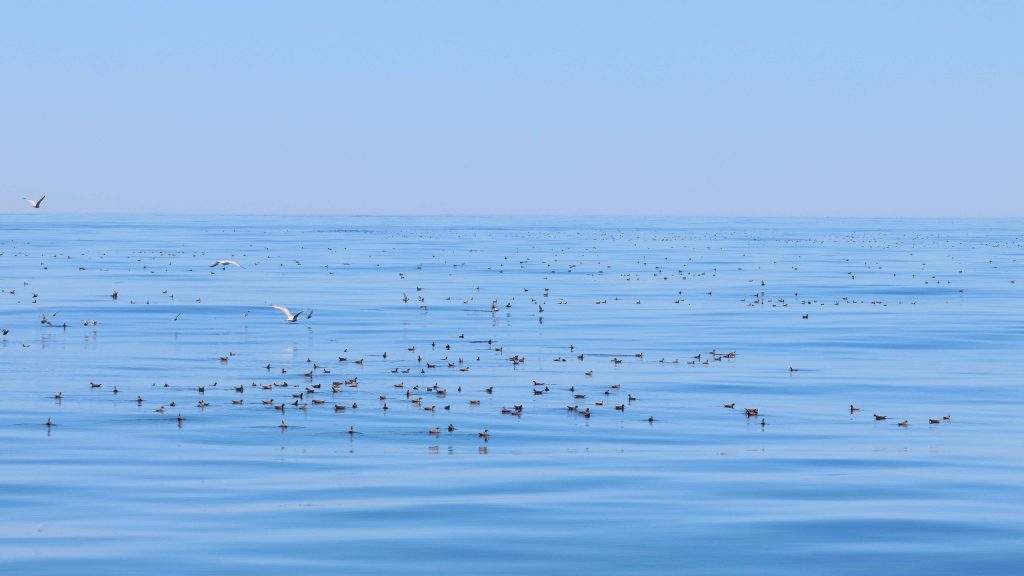
Red Phalaropes galore! Photo by Steve Mirick, 5-26-2025, Jeffrey’s Ledge, NH
Meanwhile, at least another twenty Humpback Whales were putting on a dazzling display of bubble-net feeding, joined by a dozen or more Fin Whales and even a couple of Minke Whales. It was like something out of a National Geographic or Blue Planet TV show, with five, six, seven whales cooperating to form enormous bubble nets, then surfacing together through the center of the net to gulp down as many fish as they could. No one on board had ever seen anything like it in these waters.
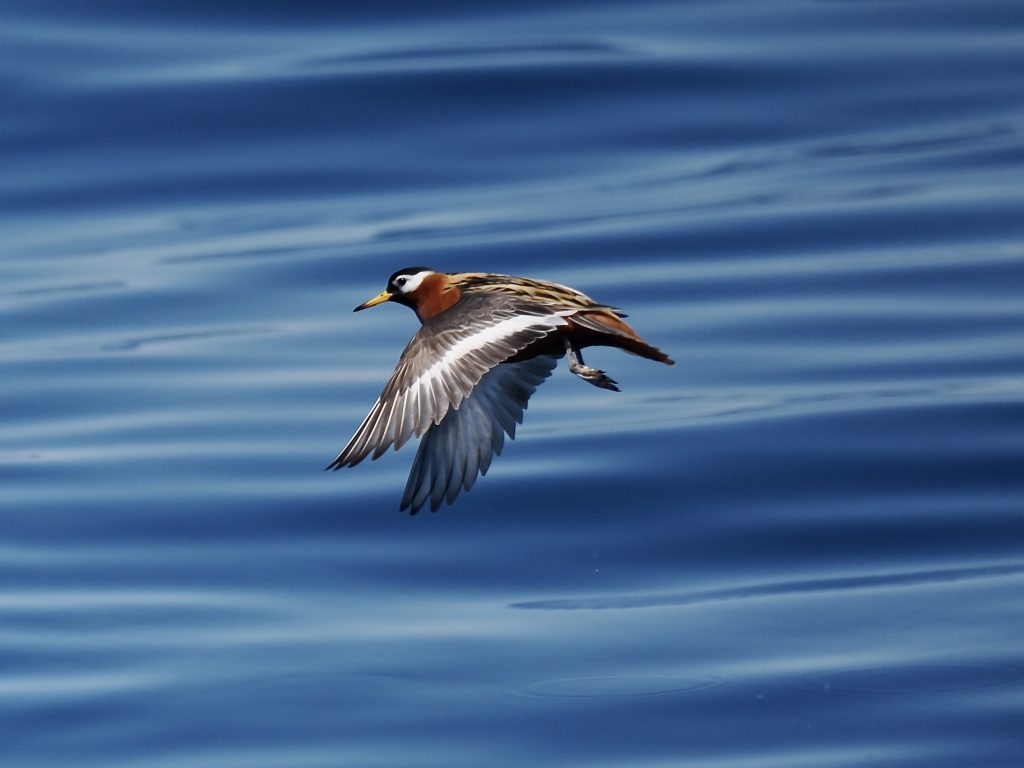
A close up of a Red Phalarope. Photo by Jim Sparrell, 5-26-2025, Jeffrey’s Ledge, NH.
Sadly, eventually we ran out of time and had to start homeward. Along the way, we passed through the Isles of Shoals and made our usual check for migrants, shorebirds, and close-to-land seabirds. As usual, the Isles didn’t disappoint, providing good views of Black Guillemots and American Oystercatchers, plus some very late Purple Sandpipers. By the time we reentered Rye Harbor, there was general agreement on board that it was the best pelagic trip New Hampshire Audubon has ever done.
Check out the full eBird checklist: eBird Checklist – 26 May 2025 – Jeffrey’s Ledge (NH) – 16 species (+1 other taxa)