
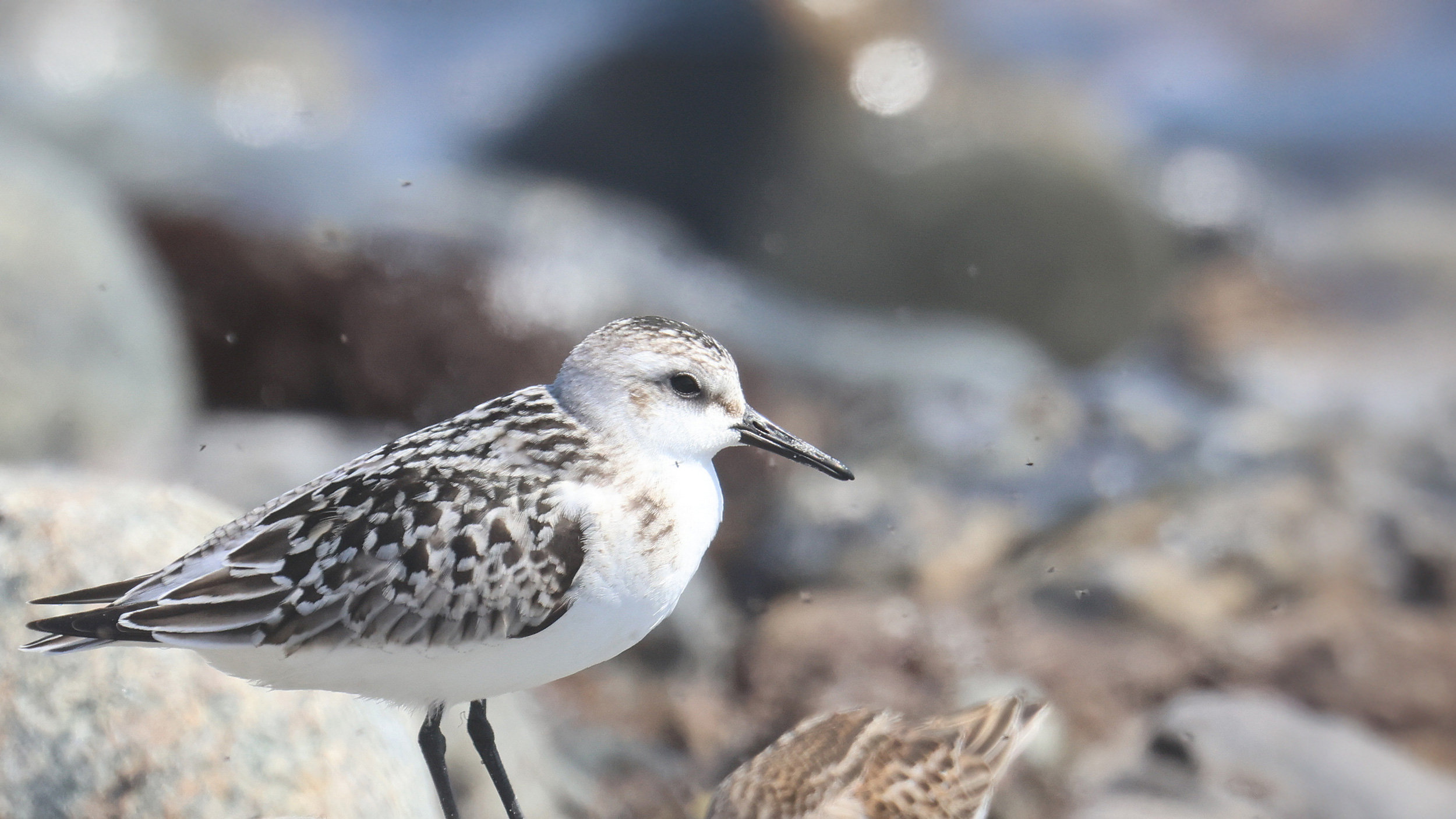
Photo by Stephen R. Mirick
Can you identify this bird?
Reveal Answer
Sandpipers can often be daunting to birders who rarely visit the seacoast where sandpipers are routinely encountered. This is particularly true when one shows up out of range inland or if it’s seen all by itself with no basis of comparison. This week’s photo quiz is obviously a sandpiper, but what kind? Sometimes process of elimination can help narrow down the list of potential ID’s. Key starting points for identification on sandpipers are estimating the age and determining the size and shape. The uniform feather wear and “neat” appearance of this bird’s feathers mean that this bird is in its juvenile plumage. Unfortunately, we can’t judge the size of the bird from this photo, but it’s clear from the shape that this sandpiper is dumpy, with short wings (matching the tail length), short legs, and a short bill. This quickly narrows down our search to the “Peeps” including Semipalmated, Least, White-rumped, Western, White-rumped, and Baird’s Sandpipers as well as Pectoral Sandpiper, Red Phalarope, Red Knot, and Sanderling. Baird’s and White-rumped Sandpipers can be eliminated by the relatively short wings. Red Knot and Least and Pectoral Sandpiper can be eliminated by the black legs on the subject bird.
This week’s photo quiz is a juvenile Sanderling. The key features for this identification include the straight stout bill and the unique pattern of black and white on the back found only in juveniles of this species in the fall. The jet black blotches contrast strongly with the clean white blotchy fringes throughout the back and shoulders of the bird creating a checkerboard pattern. Other species of sandpipers show a similar pattern in their juvenile plumage, but always with uniform, thin, buffy fringes creating a scaly pattern. As the Sanderling molts in the winter months, the checkerboard plumage turns to a uniform pale gray.
Sanderlings are common on beaches along the New Hampshire Seacoast from late summer into early winter but are rare inland.