
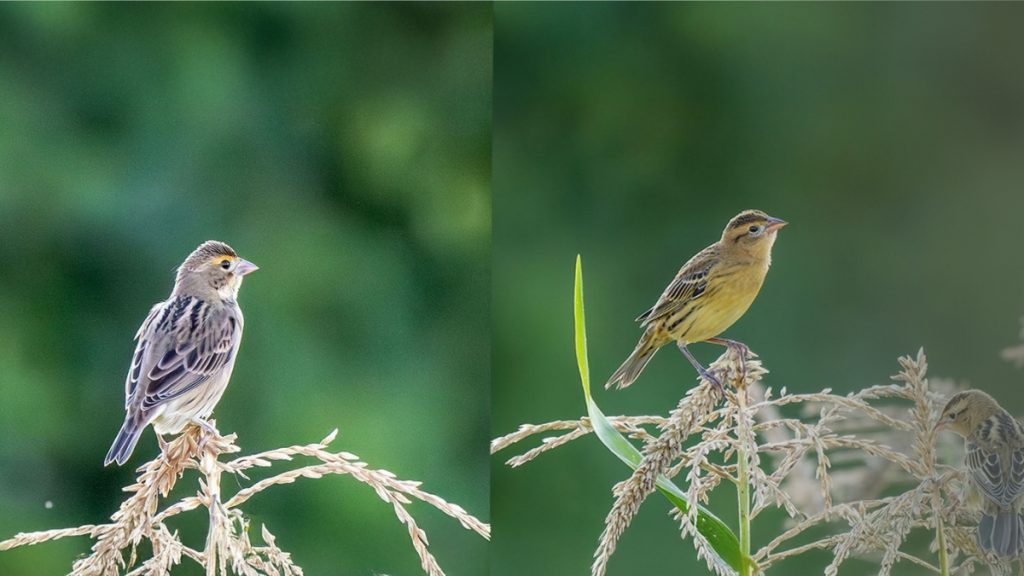
Photo by Pam Geiger.
Can you identify these birds? Which one is the rare bird?
Reveal Answer
Seeing a rare bird is always a thrill, especially if it’s one you’ve never encountered before. When I recently went to the Birch Street Community Gardens in Concord in search of a Dickcissel, I was full of anticipation. One had been reported earlier that day at the same location. I had consulted my field guide and had in mind that Dickcissels look like “large sparrows.”
It was getting late, around 6:30 pm, when I spotted two striking birds perched atop corn tassels (the two on the right of the photo). Larger than sparrows? Check. My heart skipped a beat as I raised my camera and began snapping away. These were pretty birds, practically posing in the golden light of evening. With their yellow wash on the breast, they certainly weren’t your usual sparrows. Soon, two more birds joined, and for a moment there were four together.
In my mind, I had seen four Dickcissels! Wow! Later that evening, reviewing the photos, a little bell went off in my head. One of the birds looked suspiciously like a Bobolink; the head shape seemed puffier at the back. However, since my mental image of a Bobolink was of a male in breeding plumage (black body, white back, and straw-colored nape), I dismissed the thought and uploaded the photos to eBird.
Then came the dreaded red warning box from eBird’s photo upload AI: “Merlin suggests one of your photos shows a different species than what you reported.” Sure enough, the flagged bird was a Bobolink.
All was not lost, though. One of the four birds (the left bird in the photo) was indeed a Dickcissel—a lifer for me! The other three were Bobolinks, the males of which look different in the fall. I learned my lesson. Slow down and listen when that inner bell rings, and when you’re still unsure, eBird AI is there to help. There is never a bad day of birding and always something to learn!
How to Tell Them Apart
Dickcissels and female/immature Bobolinks can be confusing. Here are some key differences:
- Bill: Dickcissels have a thick, conical bill (similar to a grosbeak’s), while Bobolinks have a slimmer, more pointed bill.
- Breast & Throat: Male Dickcissels often show a bold black throat patch (“bib”), though females only have faint streaking like the one pictured above.
- Face Pattern: Dickcissels typically show strong facial markings, yellow around the eye and a pale supercilium (eyebrow). Female/young Bobolinks are plainer, with a buffy face and less contrast.
- Back & Wings: Dickcissels are warm brown above with crisp streaking. Bobolinks are also streaked but often show more buff tones and a longer, slimmer body.
- Behavior & Season: Dickcissels are rare visitors to New Hampshire (most breed in the Midwest), while Bobolinks breed locally in hayfields and migrate in flocks by late summer.
Answer: One Dickcissel (left) and two Bobolinks (right).