
Pawtuckaway State Park is located in Deerfield and Nottingham, NH. It is 5,500 acres in size and contains a variety of landscapes centered around the Pawtuckaway Mountains and Pawtuckaway Lake.
The park has recorded several bird species normally found farther south in New England, including Cerulean Warbler, Worm-eating Warbler, Hooded Warbler, Kentucky Warbler, and Acadian Flycatcher. These occur in the park irregularly and mainly in association with the Dry Appalachian Oak Forests, primarily restricted to the park’s south-facing slopes. Red and White Oak as well as Shagbark Hickory dominate the tree canopy on these slopes.
The park’s most productive birding areas are accessible by gravel roads and hiking trails. The last three weeks in May are a particularly good time to visit. Tower Road and Round Pond Road are usually gated until Memorial Day, consequently there are no motorized vehicles on the roads. This is also a peak time for returning avian migrants. Some breed in the area, others just stop over as they travel farther north.
The Reservation Road, Tower Road, and Round Pond Road Loop
To get to the west entrance of the park, travel on Route 107 to Reservation Road and drive east. There is a small brown sign indicating the way to the Fire Tower. In 1.1 miles, there is a power line crossing. This is not the park but is a good place to pull over, as long as the “No Trespassing” signs are heeded. Early successional trees and shrubs under the wires are maintained by regular cutting. From the roadside, a number of species can be encountered; Prairie Warbler, Chestnut-sided Warbler, Eastern Towhee, Field Sparrow, and Indigo Bunting nest here. Most of these species can also be found in the park.
In 0.1 miles, bear right to continue on Reservation Road, which is dirt. After about 0.25 miles, you will enter the park, and in another short distance there is a sign for North Mountain trail, formerly the designated parking lot. To get to the current parking area, continue 0.3 miles until a large, signed parking area on the left. Park here to hike the North Mountain Trail (since you already passed it, you will have to walk back on the road to the trailhead). Yellow-bellied Sapsucker have nested in this area; they can be heard “tapping” Morse code-like on trees.
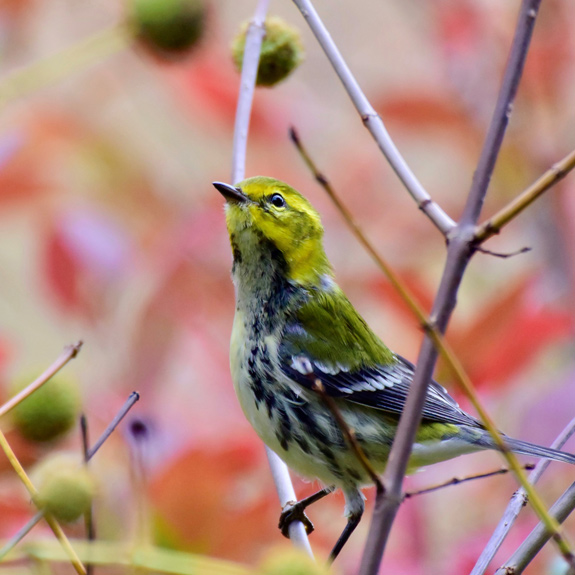
After another 0.5 miles, Reservation Road crosses a wetland. This wetland can attract a variety of species. Look for Wood Duck, Gray Catbird, Common Yellowthroat, and Baltimore Oriole. In a short distance, Round Pond Road branches off to the left; it is usually gated until the end of May. Continue straight on Reservation Road for a short distance until you see a pull-out on the right. Four or five cars can fit. There is a small stand of pole-sized trees here that can attract Yellow-billed Cuckoo when there are webworms or hairy caterpillars present. Black-throated Green Warbler is also sometimes found on the other side of the road. Park here to continue on foot.
Just a little farther on Reservation Road brings you to a left turn onto Tower Road. After about 0.3 miles, Tower Road travels along the edge of an extensive wetland. This habitat can yield many species including Hooded Merganser, Yellow-bellied Sapsucker, Red-bellied Woodpecker, Eastern Wood-Pewee, Least Flycatcher, Veery, Hermit Thrush, Red-breasted Nuthatch, Blue-gray Gnatcatcher, Black-and-white Warbler, American Redstart, Purple Finch, and Swamp Sparrow. In May, migrants can include Yellow-bellied Flycatcher, Swainson’s Thrush, Ruby-crowned Kinglet, Northern Parula, and Palm Warbler. Evening Grosbeak was formerly regular but is now rare.
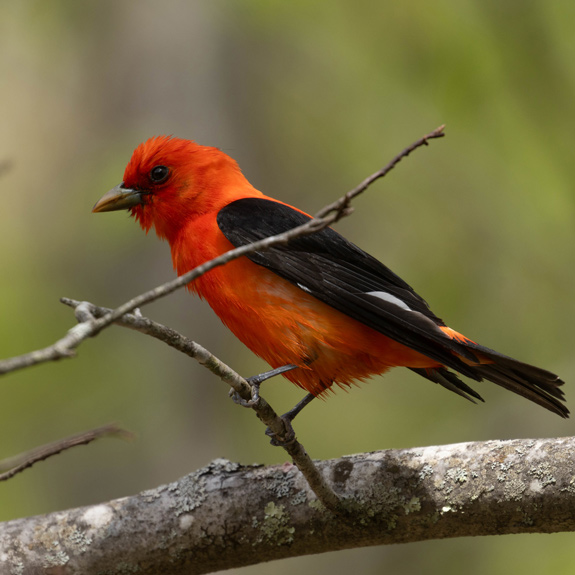
Traveling another 0.4 miles will bring you to the Middle Mountain trailhead, and then to the Tower trailhead. A small stream-crossing here often hosts Louisiana Waterthrush, and this area was where Cerulean Warblers nested for several years. Great Crested Flycatcher, Cedar Waxwing, Red-eyed Vireo, Ovenbird, Scarlet Tanager, and Rose-breasted Grosbeak can all be found here. If needed, there is a pit-toilet here.
The Middle Mountain Trail is roughly one mile and ends at a rocky outcrop with a view. Early spring arrivals found in this area include Pine Warbler, with its variable trilling song. White Pine trees are found throughout the park, but most Red Pine has been removed due to an infestation of Red Pine Scale. Louisiana Waterthrush can be heard singing and seen foraging along streams. Blue-headed Vireo usually arrive in April. Listen for Yellow-throated Vireo here. Their song is similar to Blue-headed Vireo but listen for a phrase that sounds like “three-eight” or “ee-yay.” Also listen for Blue-gray Gnatcatchers’s song, with its whispery high thin notes. Dark-eyed Junco nest at the top of Middle Mountain. A section of the trail is steep and rocky, but the open woodland allows for good views of the birds.
A half mile hike on the Tower Trail brings you to the peak of South Mountain (908 ft.) and the fire tower. This can be a good place to look for migrating raptors in September and October. A short distance on Tower Road past the tower trailhead, there is a large parking area on the left next to the small Mountain Pond. Continuing on the road you will see a small clearing on the right, which is gradually filling in with trees. Least Flycatcher nests in this area. Aspen stands attract resident Ruffed Grouse, which can be heard “drumming” with their wings on downed logs. Just beyond the clearing, a swamp is on the right and Tower Road can be rough on the way to the intersection with Round Pond Road. The steep slope on your left has hosted Worm-eating and Kentucky Warblers, but that was at least 25 years ago!
Turn right onto Round Pond Road. It is roughly a mile on the rough road to Round Pond. It leads past some Eastern Hemlock trees with nesting Blackburnian Warbler. Acadian Flycatcher has occurred at the Boulder Field trailhead on the left and a Black-backed Woodpecker was photographed here once–very rare! Winter Wren and Louisiana Waterthrush can sometimes be found along the streams and in the ravines past the Boulder Field trailhead. You will eventually see a swamp on the left that attracts Hooded Merganser, Wood Duck, Red-winged Blackbirds, and Tree Swallows. In a short distance, you will reach Round Pond on the right. In the Round Pond area, some possible birds are Eastern Phoebe, Yellow-throated Vireo, Blue-gray Gnatcatcher, Cedar Waxwing, Yellow-bellied Sapsucker, and Turkey Vulture. The road does not end at Round Pond but is usually underwater for a short distance before it continues to Route 156. Plan on turning around and backtracking.
Head back on Round Pond Road. A short distance past the intersection with Tower Road you will see a marsh on the left. There is a right turn leading into a parking lot. Park here to explore the marsh. This is a good place to look for Great Blue Heron, Eastern Kingbird, Veery, Yellow Warbler, Baltimore Oriole, and Gray Catbird. Mid-March through early April is a good time to look and listen for early-returning Red-shouldered Hawks soaring and vocalizing over the wetland areas. Resident Barred Owls can be heard hooting in the same habitat.
Continuing on Round Pond Road, there are numerous recent clearings and some wetlands. Broad-winged Hawk, Great Horned Owl, Canada Warbler, Nashville Warbler, Chestnut-sided Warbler, and Virginia Rail are all possible on the way back to Reservation Road.
Geology
The Pawtuckaway Mountains in New Hampshire are a small, rocky, circular range. They form the outline of an ancient volcanic ring dike, dating from 110-130 million years ago, the Cretaceous Period. The inner ring is about one mile in diameter, the outer is nearly two. There is a geologically unusual field where large boulders known as glacial erratics were deposited when glacial ice melted near the end of the Ice Age. This is known as Boulder Field and is frequented by those seeking to climb them.
History
One source claims the name “Pawtuckaway” came from the Algonquian language, meaning “the Place of the Big Buck.” Another source notes that Native Americans called the area of Pawtuckaway the “Land of Sticks and Stones,” since the lake area was not suitable for agriculture.
Restrooms
There is a pit toilet at the Tower Trail, but this should only be used in an emergency. The main park entrance and Fundy Road boat launch both have toilets.

References
Delorey, A. 1996. A Birder’s Guide to New Hampshire. American Birding Association, Colorado Springs, CO.
Foss, C. 1994. Atlas of Breeding Birds in New Hampshire. Audubon Society of New Hampshire, Concord, NH.Sperduto, D., and B. Kimball. 2011. The Nature of New Hampshire. University Press of New England, Hanover, NH.