This article was originally published in the Summer 2023 issue of New Hampshire Bird Records.
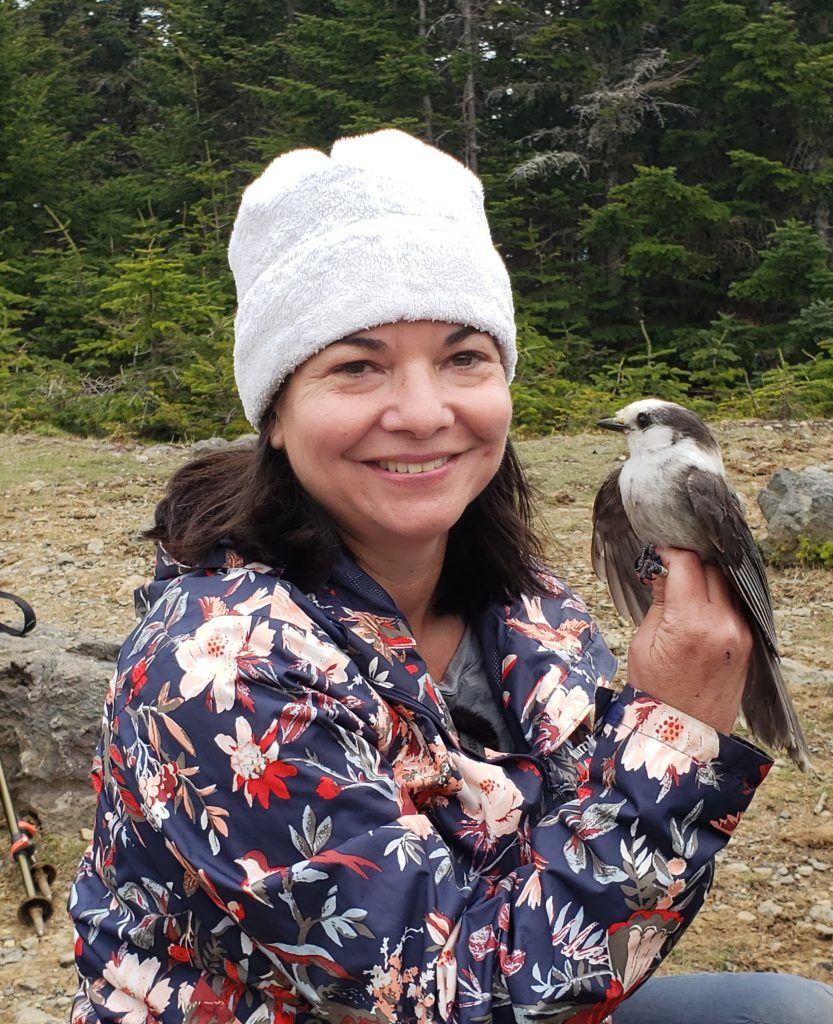
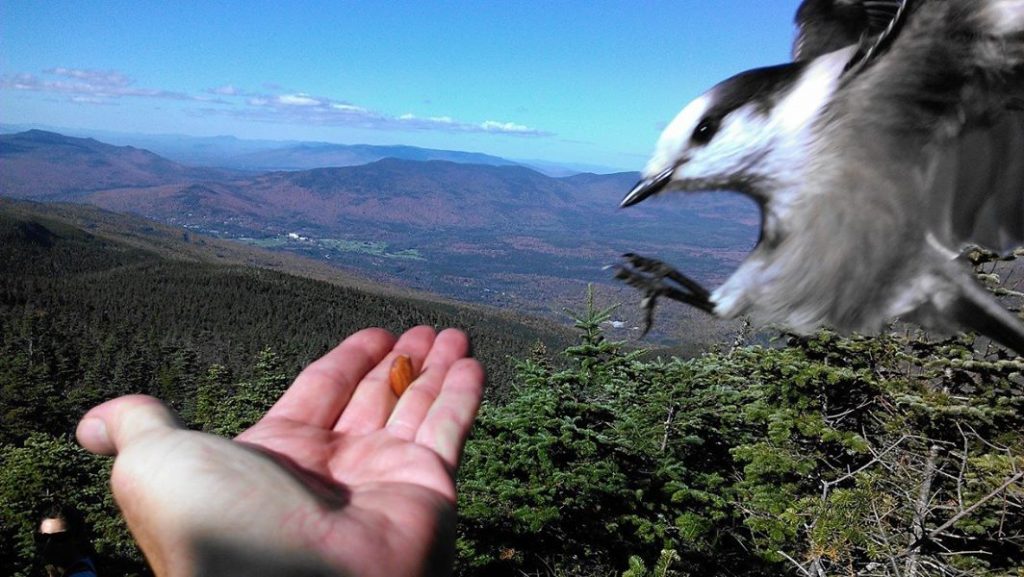
The incredibly cute and inquisitive Canada Jay (Perisoreus canadensis) is well known to anyone hiking the alpine summits of the White Mountains. Canada Jays (also known as Gray Jays, Whiskey Jacks, Gorbies, or Camp Robbers) often have close interactions with people and are frequently photographed landing on a person’s hand to take food, perching on someone’s head, or photobombing a perfectly staged summit shot.
Canada Jays have a very good reason to take the calculated risk of approaching a person for food, because they must store a great deal of food to survive the harsh northern winters. Canada Jays live year-round in boreal forest regions across Canada and in the northeast United States. The southern part of their range just touches parts of northern Maine, New Hampshire, Vermont, and the Adirondacks of New York. To prepare for the coming winter, Canada Jays use specialized salivary glands to store hundreds of food morsels under tree bark dispersed all throughout their territory. It is thought that the Canada Jay’s sticky saliva and their preference to cache in evergreen trees, such as spruce, aids in preserving the caches through the winter.
Nesting in these jays occurs extremely early, under the cold, snowy conditions of early March, so they must also rely on their cached food to feed their nestlings. Luckily, Canada Jays are not picky eaters and will eat just about anything, including insects, berries, fungi, carrion, and human food, as well as the eggs and nestlings of other birds. Therefore, these birds are more than happy to pose for a photo in exchange for a tasty treat of any kind. This feeding of jays, however, has sparked much debate in the outdoor community when it comes to Leave-No-Trace principles. Should we really be feeding these birds or not?
Some research suggests that supplemental feeding by outdoor recreationists may in fact help the jays. Previous studies at Algonquin Park in Ontario, Canada, have found that food supplementation allows jays to begin breeding earlier and lay more eggs. Food supplementation also allows the nestlings to leave the nest sooner, which gives the fledglings a leg-up in finding a territory of their own. On the other hand, concern has been expressed that Canada Jays attracted to wilderness recreationists might increase local predation pressure on nesting songbirds.
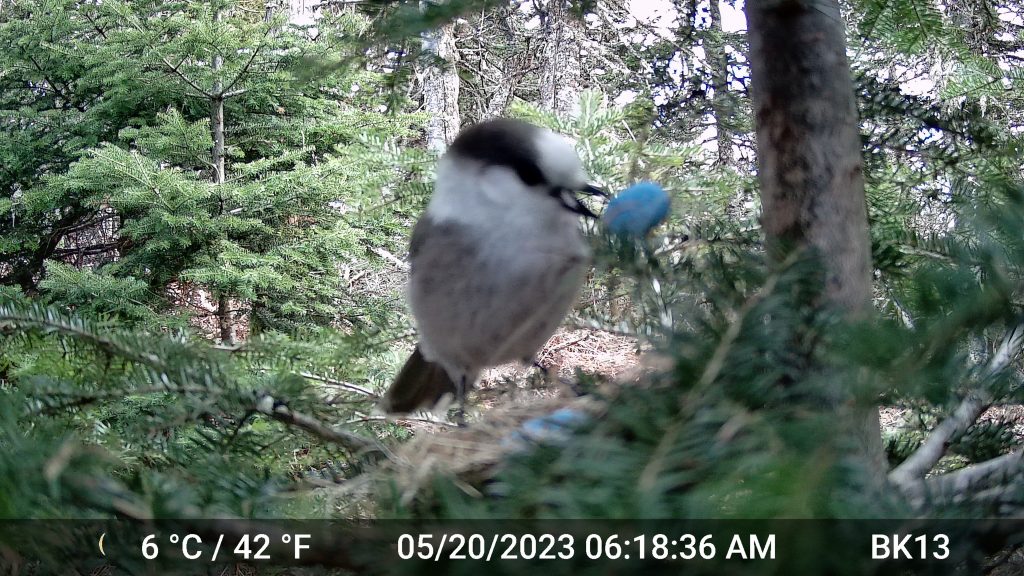
To try to address this concern, Dr. Marielle Postava-Davignon from Virginia Wesleyan University and I are performing field experiments looking at the effect of human feeding on Canada Jay behavior, local density, and nest predation. The hypothesis of the study is that jays regularly fed by recreationists may become attracted to human activity, increase in density around popular recreation areas, and increase predation pressure on nesting songbirds. To test this hypothesis, we are comparing jay behavior and levels of nest predation between control sites, where no human feeding has been observed, and experimental study sites located at popular lunch spots for hikers, where feeding has been well-documented.
Our current research takes place during May and June, the peak nesting season for most forest songbirds, and includes study plots in the White Mountains of New Hampshire and in several areas in western and northern Maine. We capture and color-band Canada Jays on the study plots to track individuals, use artificial nests with game cameras to study nest predation, and use acoustic recorders to document songbird activity in the area. We rely heavily on citizen scientist observations on eBird, iNaturalist, and through our google survey to find our study sites.
When you see Canada Jays out on the trails or in other parts of New Hampshire or Maine, please visit our website and fill out our survey. It helps us to gather information on where the jays are seen, how often, at what times of year, and what types of interactions they are having with humans. You can also find more information on our study and see updates as our research progresses.