

Reveal Answer
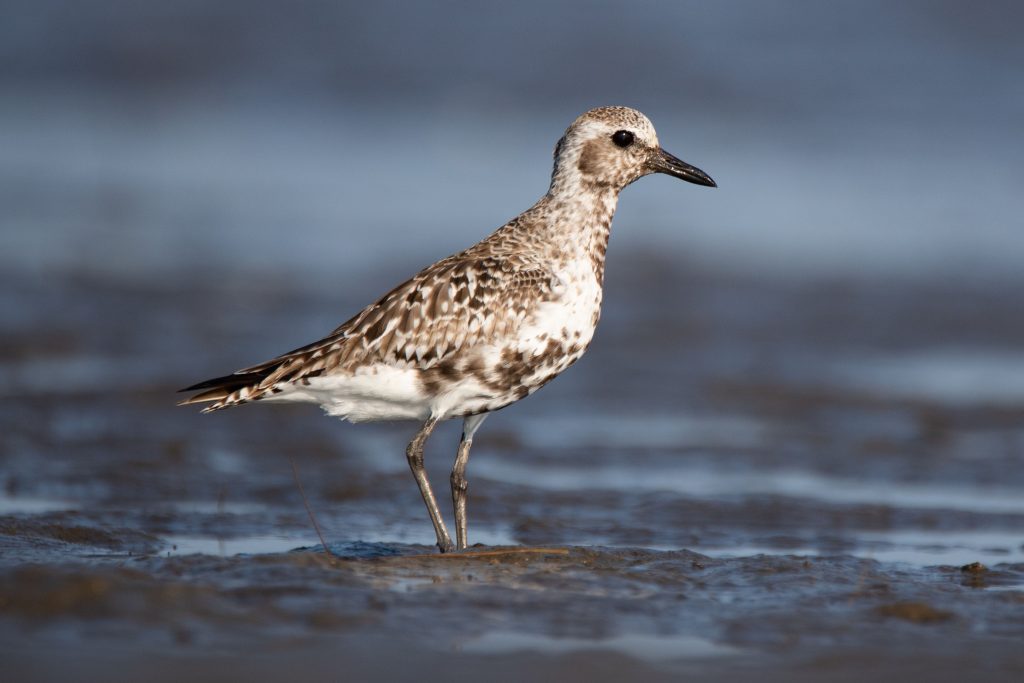
During migration, New Hampshire can expect two similar looking shorebirds in the genus Pluvialis, the uncommon American Golden Plover and the much more common Black-bellied Plover. These birds can be found singly, in homogenous flocks or sometimes mixed together with both species (as well as other shorebirds), so knowing the important field marks can be crucial in making an ID. Can you determine which is the Black-bellied and which is the American-Golden Plover?
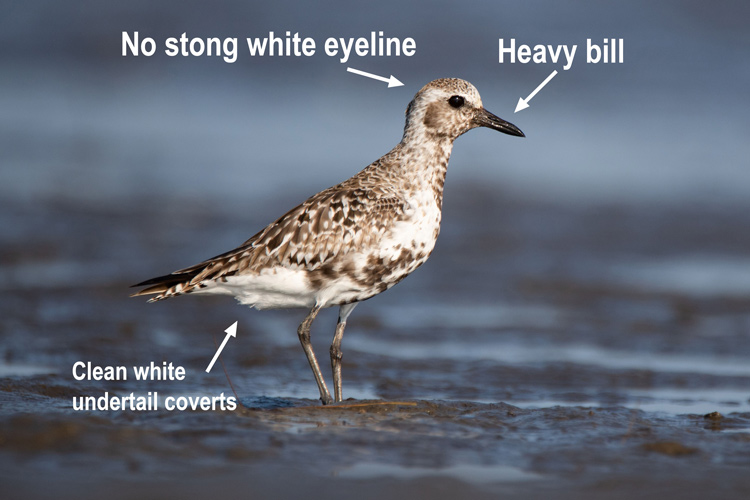
The first thing to look for is at the undertail coverts (the feathers underneath the tail) and one of the quickest ways to rule out American Golden-Plover is if the bird has “clean” white coverts. American Golden-Plover can have “speckled” undertail coverts or entirely black coverts in the rare case you see a breeding-plumaged bird. The second important thing to note is the bill: Black-bellied’s will have a thicker, heavier-looking bill, while American Golden-Plover have a daintier, thinner bill. Finally, American Golden-Plovers have a strong white eyeline that contrasts heavily with their dark caps, where Black-bellied Plovers eyeline is almost more faded and stands out less compared to their lighter caps. A bonus point of ID that can be helpful if they are seen in flight: Black-bellied Plovers will have a dark patch of feathers in their “wing-pits” which the American Golden-Plover will lack!

Answer: Black-bellied Plover by Cameron Johnson. Notice the clean undertail coverts, thicker bill, and less prominent eyeline compared to American Golden-Plover.
Answer: American Golden-Plover by Cameron Johnson. Look for speckled or black undertail coverts, thinner bill, and strong white eyeline.