
Studying Fall and Spring Migration of Northern Saw-whet Owls
NOTE: All banding, marking, and sampling is conducted under a federally authorized Bird Banding Permit issued by the U.S. Geological Survey’s Bird Banding Laboratory.
Among the many birds that call New Hampshire’s forests home, few capture the imagination like the Northern Saw-whet Owl. Barely robin-sized, these tiny predators help regulate small rodent populations and serve as indicators of ecosystem health.
Studying them, however, presents a challenge. Saw-whets are secretive and nocturnal, making them difficult to detect with traditional bird survey methods designed for daytime species. As a result, migration banding programs have become one of the most effective ways to understand population trends and movement patterns.
Project Owlnet is a continent-wide network of banding stations studying saw-whet owl migration. Data collected since 1994 have revealed important patterns in fall migration timing, demographics, and regional movements. For more information about how Project Owlnet stations operate, please see Hillary Siener’s recent article.
However, most Project Owlnet stations operate only during fall migration. As a result, scientists still know far more about fall migration than about the owls’ spring return to breeding territories. To truly understand how populations function and respond to environmental change, researchers must study the entire annual cycle—breeding, migration, and wintering periods together. That means studying both directions of migration.
Ongoing work at the Black Mountain Banding Station (BMBS) hopes to fill important knowledge gaps about spring migration. Located in Black Mountain Forest on land managed by the Society for the Protection of New Hampshire Forests, BMBS contributes to Project Owlnet and other continent-wide, long-term studies of breeding songbird populations. The station also engages volunteers and the public in hands-on conservation science.
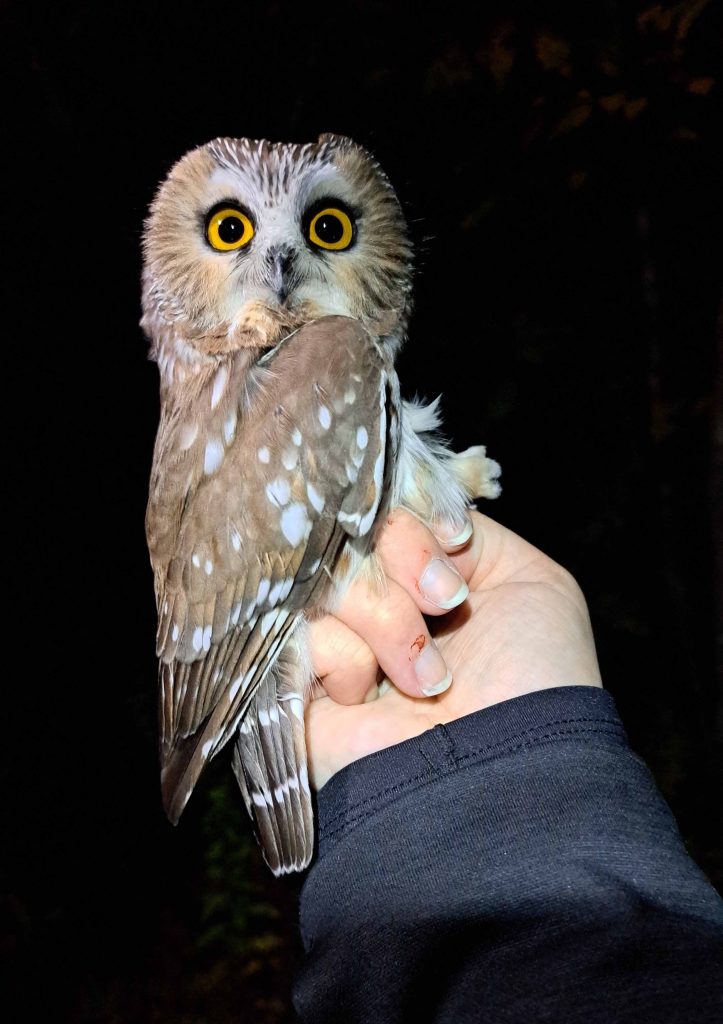
Northern Saw-whet Owl banded at Black Mountain Banding Station in fall 2025. Photo by Lindsay Herlihy.
South vs. North: Two Very Different Journeys
From late September through mid-November, owls move south toward areas with greater food availability and easier winter hunting conditions. However, this is not just random seasonal wandering in search of more abundant resources. Combined banding data across hundreds of Project Owlnet stations show distinct fronts of owls progressing steadily southward in organized waves. The migration lasts roughly six to eight weeks, a relatively relaxed pace. Studies suggest owls travel an average of about 10.5 kilometers per night. Additionally, inexperienced young birds hatched earlier that year—called hatch-year owls—join adults on their first long journey. In many places, including New Hampshire, young birds often outnumber adults in fall migration.
Beginning around late February or early March and continuing into April, saw-whets head north again to establish territories and begin breeding. Hormonal changes associated with reproduction likely create greater urgency, making spring migration shorter and more condensed than fall. Spring timing is also more unpredictable, especially in New England. Weather—particularly snow cover—is thought to play a major role because these owls hunt small mammals by sound on the forest floor. Heavy snow can delay migration if refueling becomes difficult.
The Importance of Spring Data
These seasonal differences mean that fall banding data alone cannot fully explain how saw-whet populations function during spring migration. Researchers still have limited data on questions such as:
- Do saw-whets follow the same routes north in spring as they do south in fall?
- How does winter survival affect the age structure of spring migrants?
- How does weather influence migration timing and stopover behavior?
- How variable are spring arrival times on breeding territories in different years?
- What impacts could climate change impose on spring migration behavior?
This is where stations like BMBS hope to make a meaningful contribution. By collecting consistent data in both seasons, researchers can begin connecting the pieces of saw-whet life history that occur across different times of year and geographic regions.
Lessons so Far
Spring banding ran for five weeks in 2025, with 16 nights of operation totaling just over 60 hours from March 1 through April 4. Despite the shorter season and more frequent weather interruptions, the effort brought together an impressive 22 volunteers who helped keep the station running.
During the season, BMBS banded 20 Northern Saw-whet Owls, 11 of which were hatched the previous fall. The station also recorded three foreign recaptures—birds originally banded elsewhere and encountered again during migration—all of which were adults three years old or older.
The large proportion of young owls during this spring migration season unexpectedly aligned with typical fall age demographics, raising several questions:
- Did the relatively mild winter enable greater survival of inexperienced hunters?
- Did BMBS begin banding too late, missing an earlier push of adult owls?
- Is it typical for young birds to outnumber older adults?
Hopefully many more years of spring banding data will help us understand the demographics of spring saw-whet migration.
Fall 2026 Migration Painted a Different Picture
With the help of 27 volunteers, BMBS banded 59 Northern Saw-whet Owls over the course of six weeks. More than 82% of owls captured were female, a common pattern in many saw-whet banding datasets.
BMBS also recorded three local and two foreign recaptures. One owl had originally been banded in Northampton County, Pennsylvania, while another came from Worcester County, Massachusetts. These long-distance connections illustrate how migration banding helps map movement patterns across a species’ range.
Another owl previously banded at BMBS was later recovered at the Berkshire Bird Observatory, further highlighting the network of research stations tracking these birds across regions.
Demographically, the fall captures reflected the expected influx of young owls. Nearly 44% of the birds handled had hatched earlier that same year and were making their first migration journey.
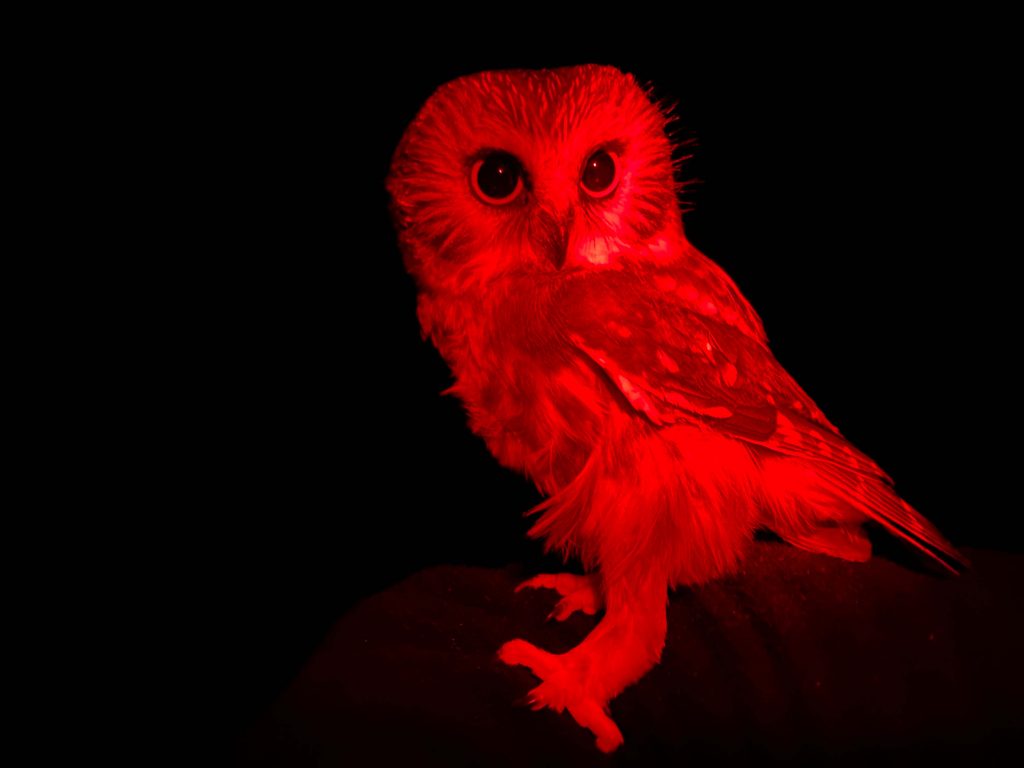
A Northern Saw-whet Owl banded at the Black Mountain Banding Station takes a moment to get her bearings before continuing her southbound journey. Photo by Carrie Deegan.
2026 Spring Season So Far
The 2026 spring season, which began on February 15, is already providing a fascinating contrast to 2025.
From February 15 through March 8, BMBS captured only two saw-whet owls. One possible explanation is weather: more than 18 inches of snow covered much of New England during this period, potentially delaying migration. Like many migratory species, saw-whet’s physical readiness to start migration is thought to be driven by hormonal changes triggered by day length (photoperiod). However, as short-distance migrants, saw-whets can also make real-time decisions about when to move north based on prey availability and weather.
Snow cover likely plays a role in this decision-making, where deeper snow cover makes it more challenging for saw-whets to capture their favorite prey, mice in the genus Peromyscus, which are able to burrow beneath the surface of the snow.
Since early March, activity has increased. So far, the station has banded eight saw-whet owls plus one foreign recapture, with the following age demographic breakdown:
- 3 second-year owls (these are the young from 2025)
- 4 third-year owls
- 2 after-third-year owls
Although the season is still underway, the slower start raises intriguing questions:
- Did unusually harsh winter conditions—including deeper and more persistent snowpack—reduce survival among inexperienced young owls?
- Alternatively, did weather simply delay migration timing, pushing activity later into the season?
These are exactly the types of questions that long-term monitoring helps answer.
Why It Matters
Together, the spring and fall seasons at BMBS show why studying both halves of migration is so valuable. Fall migration reveals how many young owls enter the population and how birds disperse across the landscape. Spring migration, meanwhile, provides clues about winter survival, breeding readiness, and the timing of return to northern forests.
When combined with data from other stations in Project Owlnet, these observations help researchers track population trends, understand migration strategies, and identify potential conservation concerns. For volunteers and visitors, the work offers something equally valuable: a rare chance to witness one of North America’s most secretive birds up close, and to contribute to the science that helps ensure these tiny nocturnal hunters continue to thrive in the forests of New England.