
The nocturnal and elusive behaviors of Northern Saw-whet Owls (Aegolius acadicus) make them a difficult species to study. Once thought rare across their range, banding studies have revealed that saw-whet owls are actually quite common. To monitor their population and fall migration through the Monadnock Region of southwestern New Hampshire and to contribute to the larger understanding of this species, the Harris Center for Conservation Education (harriscenter.org) captures and bands saw-whet owls with a team of volunteers each fall. This is the fourth consecutive year of this project at the Harris Center, and is part of a larger network called Project Owlnet that was founded in the mid-1990s to investigate owl movements across North America. The Harris Center also offers public demonstrations and scientific talks related to this project, reaching over 450 people since 2022.
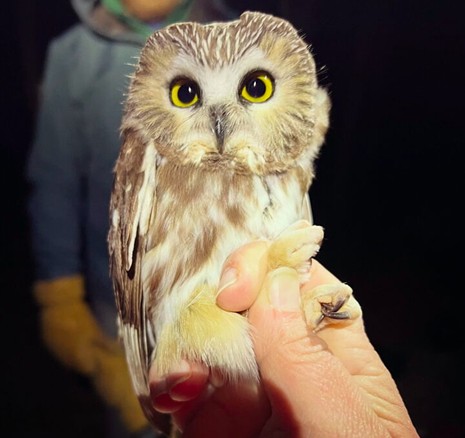
A Northern Saw-whet Owl banded on Harris Center lands in 2025 (photo © Brett Amy Thelen).
Capture and banding protocols involve using an array of four 12-m long mist nets and broadcasting the male saw-whet owl territorial call on a continuous loop to lure owls towards the nets. Our Harris Center team opens nets at one of two sites each night (starting about one hour after sunset), turns on the lure, and checks the nets for owls every 15-30 minutes for a total of four hours (weather permitting). Captured owls are removed from the nets by trained individuals; the birds are then measured, sexed, examined to determine age, outfitted with a federal band on their legs, and released back into the wild. At the end of each night, the nets are closed and the lure is switched off.
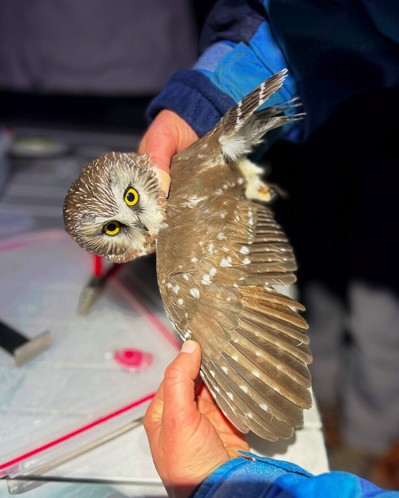
Flight feathers are examined to determine age. (photo © Brett Amy Thelen).
Over 26 nights between October 4 and November 15, our team captured 140 individual saw-whet owls. On average, 5.4 owls were captured per night. October 17 had the highest number of captures with 15 owls, (Figure 1). Migration timing peaked in mid-late October (October 19 – 25). This is consistent with our capture timing from 2022 and 2024, and about one week earlier than 2023.
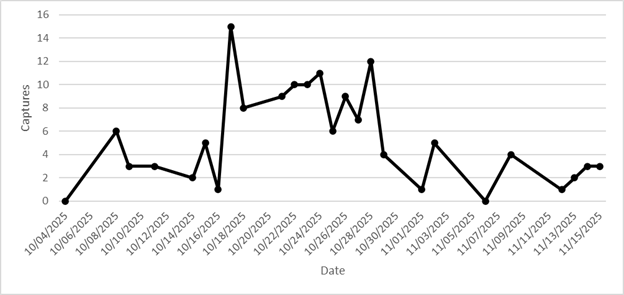
Fibure 1. Number of Northern Saw-whet Owls captured per night at the Harris Center for Conservation Education’s banding sites in the fall of 2025.
Of the 140 captures, there were 125 females, 3 males, and 12 were unable to be sexed. The higher proportion of females is typical at saw-whet owl banding stations. Though playing the male advertising call may attract more females (despite not being breeding season) and/or deter males, there is also evidence to suggest that saw-whets have a sex-differentiated migration, with males not migrating, or not migrating as far as females. Northern latitude banding stations catch proportionally more males than southern latitude stations.
The majority of the owls we captured were in at least their second year of life (hatched in 2024 or before). 31.4% were aged as hatch years (hatched in 2025).
Since 2022, the Harris Center has documented 30 between-site encounters of saw-whet owls (Figure 2). In 2025, nine of the owls (or 6.4%) we captured had already been banded by researchers at other North American stations. This is the highest recapture rate our station has had in four seasons. Interestingly, each one of these owls was banded in a different US state or Canadian province. One owl banded in Tadoussac, Quebec in October was recaptured at our station 38 nights later on November 8, traveling an average straight-line distance of 9.8 miles per night. This owl was captured again four nights later at the same station, suggesting that she was lingering in the region before continuing on, or perhaps was here to stay for the winter. All other recaptures were of owls banded in 2024 or earlier from Massachusetts, Vermont, New York, Maryland, Pennsylvania, West Virginia, Michigan, and Wisconsin. The owl from Michigan was banded on November 2, 2024, and recaptured at our site almost exactly one year later on November 1, 2025. This demonstrates a departure from the traditional regional flyways that we have typically observed, perhaps reflecting some of their nomadic tendencies or low site fidelity to breeding and wintering grounds.
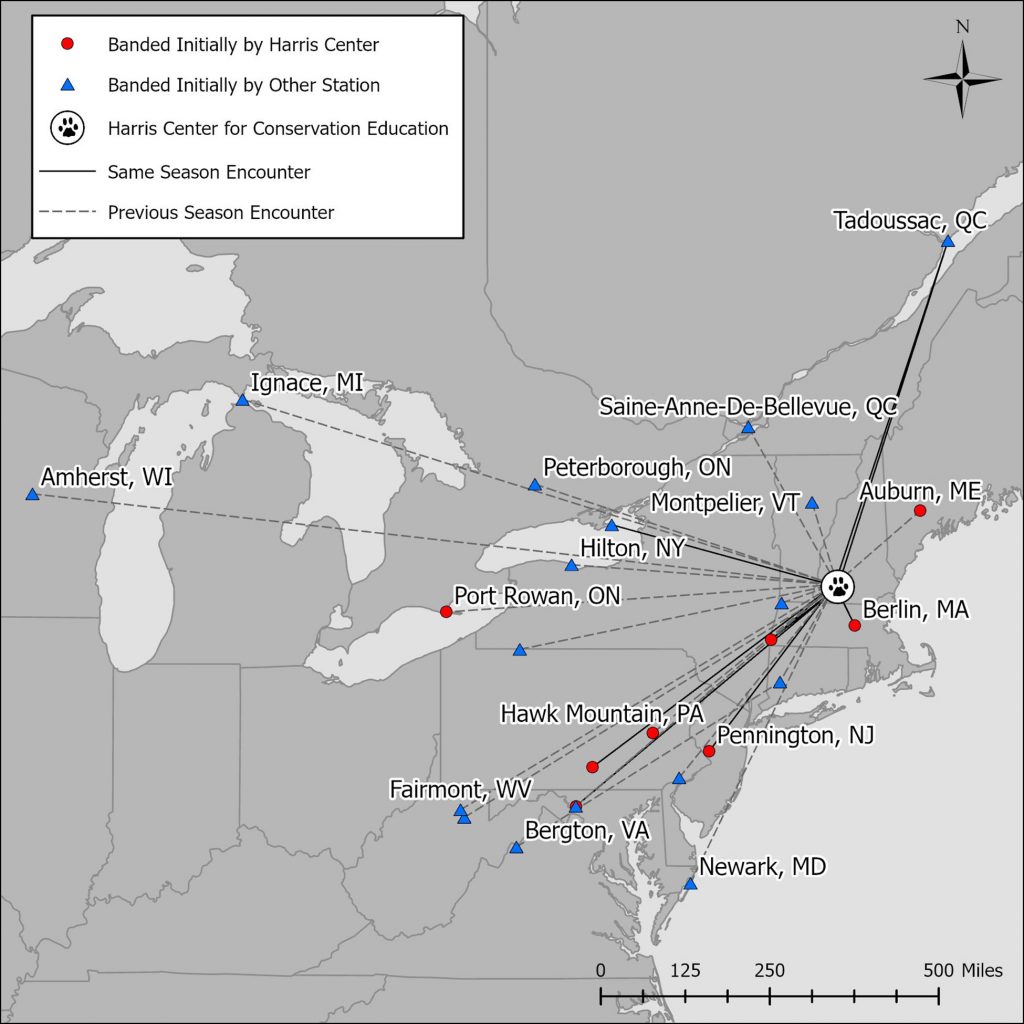
Figure 2. Encounter locations of saw-whet owls captured at Harris Center banding stations from 2022 to 2025. Solid lines connect direct-encounter locations, and represent general direction of travel. Dashed lines connect prior-season encounter locations. Encounters include owls banded at Harris Center sites and subsequently encountered elsewhere, and owls banded at other locations that were recaptured at Harris Center banding sites. (map by Mike Valentino and Nate Marchessault)
Additionally, four owls that were banded by us from 2022 to 2025 were encountered elsewhere in 2025, including three sites in Massachusetts and one in Maine. Unfortunately, the owl that was encountered in Maine fell victim to a vehicle collision in March of 2025. She was five years old.
The Harris Center will continue to monitor the saw-whet owl population, contribute to the continent-wide understanding of their movements, and offer educational programs in 2026. Special thanks to the Davis Conservation Foundation, the Harris Center’s Adopt-an-Owl donations, Project Owlnet, and New Hampshire Fish & Game. This project was also made possible by a team of 22 Harris Center staff and volunteers, who contributed hundreds of hours this season alone. Heartfelt thanks to all for their excellent company in the chilly, starlit woods and for all the gear hauling, net opening, net closing, data recording, weather watching, midnight driving, and cold toes in the name of science!