These days, when one mentions birding Horseshoe Pond, it is necessary to distinguish between the site in Concord (traditionally the more frequented) and the one in Merrimack. The latter has, in my humble and admittedly biased opinion, more than earned its place among the worthwhile birding hotspots in the south-central portion of the state. eBird records show that the 44-acre Horseshoe Pond only started receiving regular birder visits around 2013, and since then has accumulated a respectable 152 species. I have been birding there for all but two of those years (since the very beginning of my birding passion) and the pond has become not just my favorite birding haunt, but almost a second home in its familiarity. It is a gem of diverse wetland habitat, sandwiched between residential housing and industrial development, offering fulfilling birding year-round and outsized value for the birds that call it home.
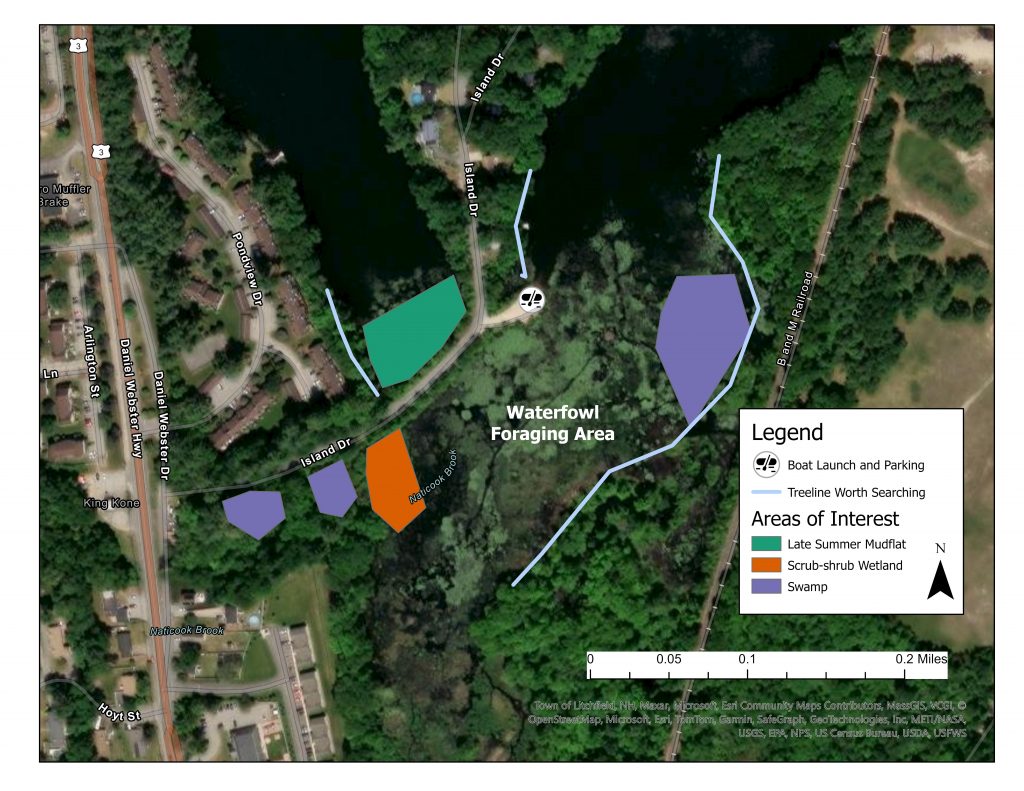
Parking for Horseshoe Pond is located at the public boat launch on Island Drive, owned and managed by NH Fish and Game. This pull-off can accommodate about half a dozen cars. In summer, the pond is used extensively for recreation such as fishing and canoeing, and in winter for ice fishing. If parking is full, it is likely a sign the site may be too crowded to be worth birding at that moment.
The walkable area of Horseshoe Pond is quite small—about a thousand feet—but that poses no limitation on the number and diversity of birds you are likely to see. Birding is typically done from the boat launch and along the stretch of Island Drive heading toward the main road (Daniel Webster Highway). All but the furthest bend of the pond’s horseshoe shape is visible from these vantage points, and no scope is needed. Island Drive is a low-traffic road leading only to a small residential neighborhood, so walking along the road poses few issues if you stay near the guardrails. School buses occasionally come through, so keeping one eye out is always wise. There are no trails or boardwalks around or through the marshes.
Most of Horseshoe Pond is deep, open water, and birding in these portions is somewhat limited, with Double-crested Cormorants perching on half-submerged snags, hunting Ospreys, and gulls on the winter ice. Birds are more often found perched in the narrow band of forest cover lining the banks on the boat launch side. Raptors such as Bald Eagles (which visit from the nearby Merrimack River) and Red-tailed Hawks are frequent, as well as the usual woodpeckers, Belted Kingfishers, Baltimore Orioles, and Great Blue Herons tucked into lower branches. Scanning the horizon toward the Merrimack River can yield distant soaring raptors, and songbirds often cross the pond, giving decent views from the boat launch
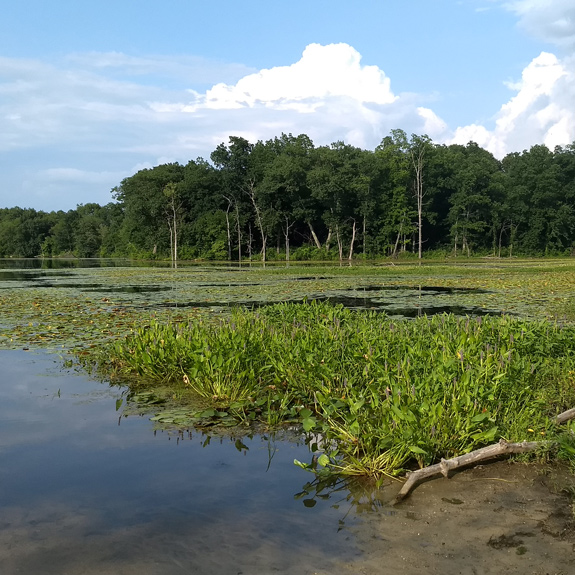
The most productive parts of the pond, however, are the emergent marsh, scrub-shrub wetland, and swampy areas closer to the boat launch and road. This is where the majority of the bird activity occurs year-round. The diverse plant communities and habitat structure support many species in a relatively small area.
In spring, waterfowl congregate in the shallower open waters and more concealed marsh areas, separating out by preferred depths for dabblers and divers. Ring-necked Ducks, Green-winged Teals, Mallards, Canada Geese, and Hooded Mergansers are frequent, with occasional Common Mergansers, American Black Ducks, Northern Shovelers, Buffleheads, American Wigeon, and Northern Pintails. In total, 18 species of waterfowl have been seen here, plus rarely Pied-billed Grebe, American Coot, and Common Loon. Wood Ducks are common and conspicuous most of the year, raising numerous young on the pond. Ducks often forage in the furthest reaches of the pond facing Daniel Webster Highway, visible diagonally from the road or boat launch, as well as along the south bank in an area of logs and snags that easily obscure them. Depending on the time of day, they often return closer to the road, either in the central open area encircled by the road and boat launch, or sticking close to emergent vegetation, requiring keen eyes to detect movement. Sometimes they forage right next to the road, offering excellent views. This marshy area can also be productive for out-of-season waterfowl in winter, as it is the last to freeze and often stays open when other nearby water bodies are frozen. In recent years, Gadwall and American Wigeon have become almost regular for weeks at a time in midwinter, along with American Black Ducks and large numbers of Mallards.
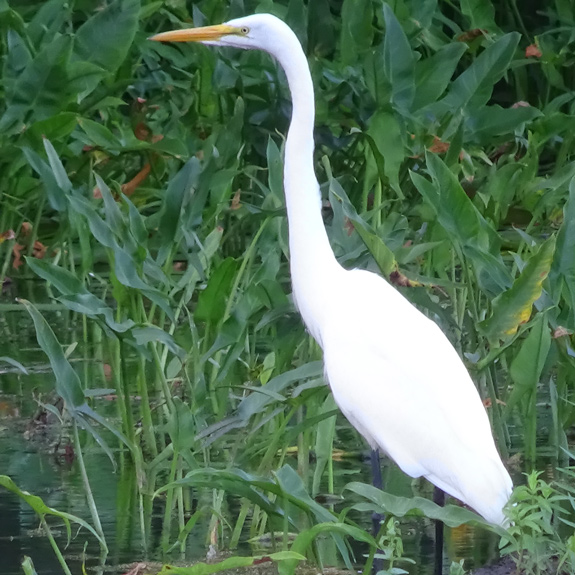
Wading birds like Great Blue Herons and Green Herons are common, with occasional, Black-crowned Night Herons. Great Egrets usually show up in midsummer (mainly August), sometimes multiple at a time. Horseshoe Pond is also a standout location for viewing Common Nighthawk migration in August and September. Nighthawks pass over the pond in a steady stream or large flocks of several dozen or more, starting around 6 pm. The wide-open view from the boat launch is ideal for spotting them as they approach from any angle.
Songbird diversity is decent, with Baltimore Orioles, Warbling Vireos, Rose-breasted Grosbeaks, and Gray Catbirds among others breeding here. Orchard Orioles rarely show up during spring migration. Warblers are not a main draw, though numerous species have been recorded, including Tennessee, Palm, Yellow-rumped, Blackpoll, and Common Yellowthroat, but usually in low numbers. In fall migration, however, sparrows can be productive around the boat launch and swampy areas, where dropping water levels create grassy thickets that attract Swamp, Lincoln’s, White-crowned, and Savannah Sparrows, as well as Indigo Buntings in non-breeding plumage. American Tree Sparrows often linger in winter by the boat launch. The scrub-shrub area, especially where it opens to sandy banks near the road, is a good place to look and listen for Winter Wrens, which are found fairly consistently in midwinter. Typical wetland birds abound, including Red-winged Blackbirds, Common Grackles, Eastern Kingbirds, Yellow Warblers, and Song Sparrows, though secretive marsh birds like rails and bitterns are essentially absent. Large flocks of Tree Swallows appear in April to forage over the water, often intermixed with Northern Rough-winged, Barn, and Bank Swallows. Rusty Blackbirds usually pass through in autumn and often winter as well. Forest birds such as Wood Thrush, Great Crested Flycatcher, Wild Turkey, and Eastern Wood-Pewee are occasionally heard or seen distantly. In late summer and autumn, mudflats appear next to the road on the north side, attracting small numbers of peeps, plovers, and Solitary Sandpipers for those patient enough to search the dried mud and waterlilies. Personally, I find fall migration the most exciting time at Horseshoe Pond, as the most interesting species seem to show up then, though every season has countless wonders to offer.
Horseshoe Pond is a dynamic location. Intermittent occupation by beavers and muskrats has led to water-level changes over the years that continually alter the composition of the wetland areas, and encroaching housing developments along Daniel Webster Highway have greatly reduced the wooded buffers around this important bird habitat. The plant communities are diverse and beautiful, with many flowers and insects to enjoy, but are plagued by aquatic invasives like Eurasian Water-milfoil and Asian Carp. Still, the richness of bird life here demonstrates the site’s value and the need for continued protection and management to preserve habitat quality. It is easily accessible to birders, with most walking areas being level, paved road. A quick walk will yield plenty of conspicuous species, but those who spend more time searching the roadside brush, scanning the skies, and listening for the chip and “tsit” calls of hidden sparrows will be rewarded with even greater treasures year-round.
If you’re in the area, Merrimack has many other excellent birding locations too. Less than a ten-minute drive from Horseshoe Pond is Wildcat Falls Conservation Area, which is productive for Prairie Warblers, Eastern Towhees, and Red Crossbills. Further down near Baboosic Lake is Grater Woods Conservation Area, an extensive tract of forest and beaver ponds with numerous trails and good bird activity, including warblers in spring.